
Here’s a peek inside the ADUs that could transform downsizing
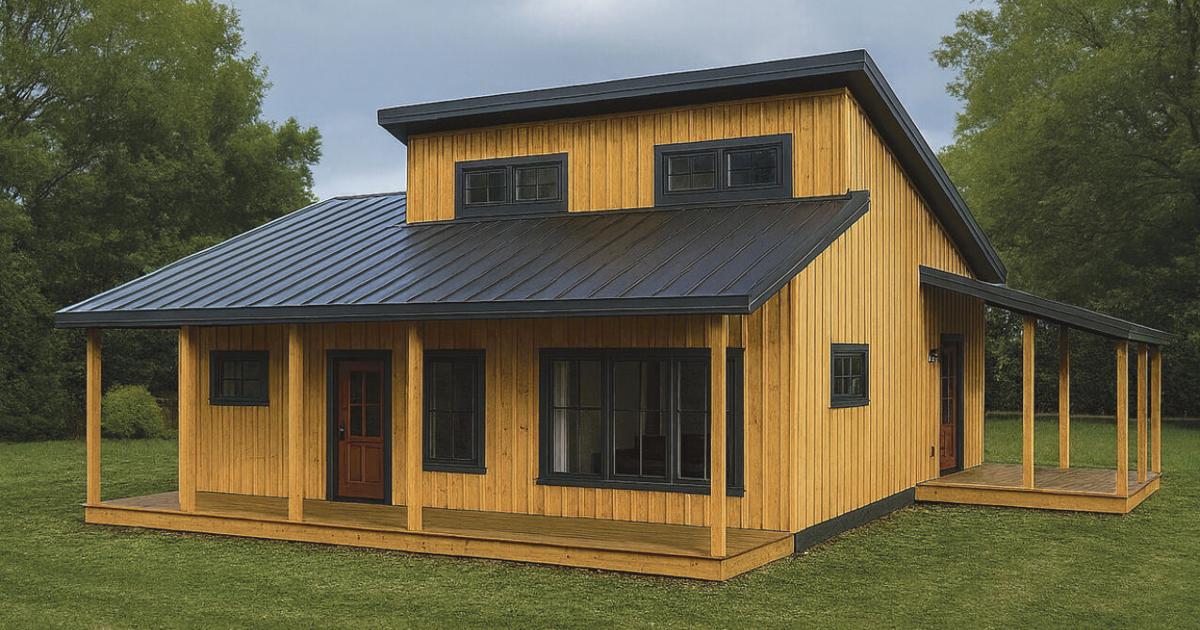
NORTH ADAMS — Tiny homes don't have to look like cargo containers with just the bare essentials inside. Some, like the designs that won North Adams Partnership's accessory dwelling unit design competition, can stand alone as architecturally interesting, functional and accessible.
The North Adams Partnership partnered with AARP to offer an ADU design challenge with the goal to help address the housing crisis and make the housing stock more accessible for North Adams' aging population.
The competition yielded six winning designs. Three ADU designs won the overall category and prize, and the other designs won in the student category.
Winning designs are being made available to the public with hopes that someone can turn those concepts into actualized ADUs.
Anthony Adelmann, Rare Forms Design and Kuth Ranieri Architects submitted the winning designs for the overall category. They each received $2,500 for winning.
The winners of the student category were Ruth Estien Garcia at the University of Massachusetts Amherst, Ryleigh Holland and Grace Perrault, both from McCann Technical School. They each received $500.
The designs will be presented during a public ceremony at 6 p.m. Thursday at Hotel Downstreet.
The ADU design submitted by Greg Boise and Rare Forms. It is their Chestnut ADU model.
The idea for the competition came from community concerns.
"I sat in on some meetings with just a local group of seniors who are all homeowners, and they're all concerned about wanting to downsize and not having nice places downsize to," said Jenny Wright, the executive director of the North Adams Partnership.
This idea led Wright to the AARP Community Challenge grant, which funded the design challenge.
Submitted designs had to follow the normal set of criteria for building an ADU — like having a separate entrance and being no larger than 900 square feet.
Each concept was judged on four criteria: universal design principles (meaning designs should prioritize accessibility and adaptability), sustainability and resilience, cost effectiveness and innovation and aesthetics.
"We want to make sure that the judges are looking at these designs through the lens of accessibility for people to age in place," Wright said. "The goal is to have some concept plans that we can actually take through to construction."
The ADU design submitted by Anthony Adelmann.
For Kuth Ranieri Architects' Liz Ranieri and Rob Marcalow, their design was informed by the design's challenges.
Ranieri wanted the ADU to take on the mountainous feeling that surrounds North Adams while still adhering to the accessibility challenge.
"Everyone deserves good design, and every type of project deserves good design," Ranieri said. "I mean, thoughtful, well considered, really understanding the parameters, the budgetary needs, the goals of a client."
Both the form and the design competition meant entrants had to get creative with how they used space.
"Being efficient with space is important," said Adelmann, who owns his own architecture firm. "Also, since the focus was on allowing older people to age in place, a key focus was on incorporating universal design requirements without making it look like an afterthought."
The ADU design submitted by Ryleigh Holland.
For the students — who joined the competition not knowing there would be a student category — their designs impressed the committee enough that the North Adams Partnership joined forces with Moresi Associates to create and offer prizes for the student category.
"For the constraints and stuff, focusing on like the sustainability part of it and really researching into that was a big part of how I developed my design," said Holland, a McCann Tech senior.
"I really focused on making it affordable while also making it look comfortable," said Perrault, also a senior at McCann Tech.
The winning designs will be made available to the public, and Wright hopes someone will use one to build their own ADU.
"Ultimately, we want to be able to build one of these and to work with the partners that we've developed through this design challenge to help guide us through what it would actually take to do that affordably," Wright said.
For the designers, they want their concepts actualized too.
"If my design can be used in a good way to help around the community, that would be really nice," Holland said.
Read the Original Article
This article was originally published by Berkshire Eagle. Click below to read the full article on their website.
Visit Berkshire Eagle