
A new study demystifies Lee's Little Italy, showcasing an industrial history supported by immigrants
LEE — Just west of the Big Y, along a stretch of the Housatonic River, sits a neighborhood that was settled by immigrants.
In the early part of the 20th century, Italian immigrants came to the area looking to work in the local marble quarry and at the lime kilns, according to Jennifer Doherty, a preservation planner.
Their familiarity with marble quarrying in their home country, she said, drew them to the area, where they helped mine the durable stone that would be used in the Washington Monument and in headstones in Arlington National Cemetery, as well as the Lee Library.
"It's really kind of an interesting story of an immigrant neighborhood that has impacts nationwide," said Doherty, a researcher for the Barrett Planning Group.
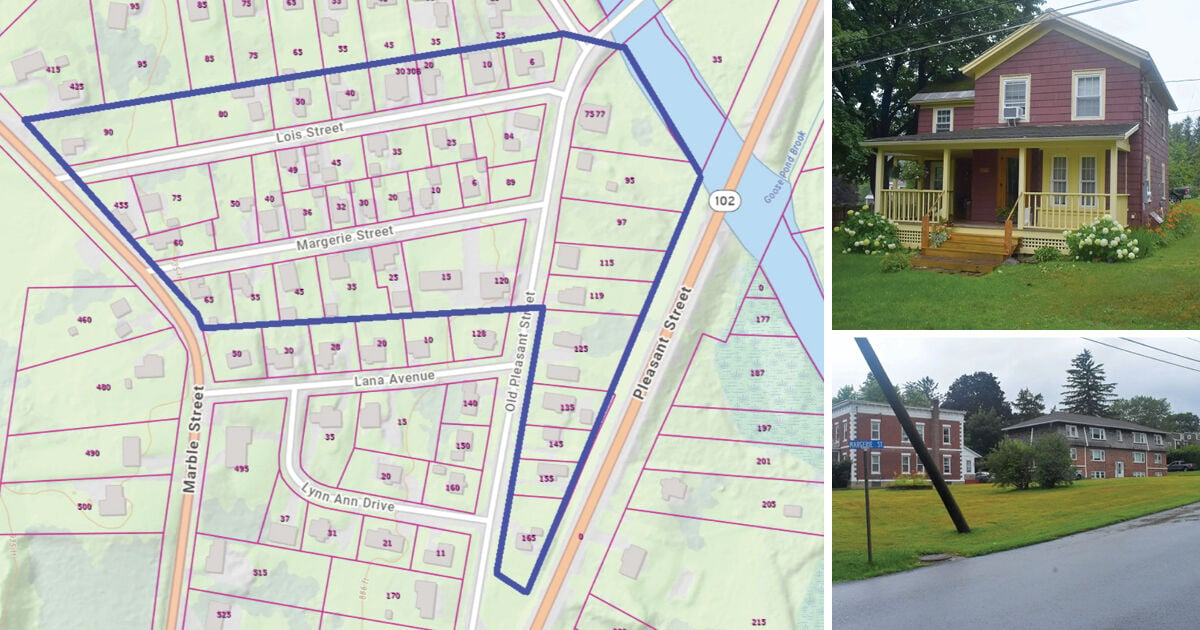
All the plots within the blue line are considered to be part of Lee's Little Italy, according to Jennifer Doherty, the preservation planner who produced the study. Of the 40 homes in the area, 30 were built between 1904 and 1920.
The Lee Historical Commission recently contracted with that group to create a study on the area, known as Little Italy, illuminating an important aspect of the town's diverse industrial history.
Roughly 40 homes can trace their origin back to the settlement, which which encompasses all of Margerie and Lois streets and a portion of Old Pleasant Street.
"It's obviously not as recognizably historic as some of the sort of Gilded Age mansions in the Berkshires," Doherty said.
The Lee Historical Commission recently contracted with that group to create a study on the area, known as Little Italy, illuminating an important aspect of the town's diverse industrial history.
Still, she said, the commission wanted to learn more about the neighborhood, understand its history and document its history.
The neighborhood had little construction before 1904, Doherty said. In the early 20th century, that would change as a subdivision plan split the area into 84 lots, which were sold off to be developed individually.
That type of development is not uncommon in Massachusetts, she said, but it helped shape the structure and culture of the neighborhood in ways company developments — where local companies, buy the land, build the home and then rent those domiciles out — could not.
The home at 65 Margerie St. was built in 1910. Of the 40 homes in Lee's Little Italy, 30 were built between 1904 and 1920.
For those company developments, "you might have more more turnover in that situation because it is rental housing," Doherty said. "In this neighborhood, there were multiple generations of families living in the same building, year after year."
Her study highlights one home in particular, at 40 Lois St., which has been owned continuously by the Buffoni family since the home's construction in the 1920s.
It's one of the newer ones in the neighborhood — 30 of the 40 homes in the area were built before 1920, the study found.
Doherty completed the study by using public records like the Registry of Deeds, archival news clips and historic materials like old maps and street directories. The study cost $16,000, funded by Community Preservation Act funding, a program that sets aside real estate excise tax for specific purposes like historical conservation.
One resource, old census records, showed how the neighborhood itself changed, as those records showed the nationalization process of the immigrants and their families, Doherty said.
"Folks may hear the term 'Little Italy' and associate it with that neighborhood, but may not realize the fuller history," she said. "[Italian immigrants] were here, they were working in the marble quarry; they were doing this sort of important industrial labor for for the community."
Read the Original Article
This article was originally published by Berkshire Eagle. Click below to read the full article on their website.
Visit Berkshire Eagle