
A wave of construction is modernizing or replacing Berkshire County’s midcentury schools
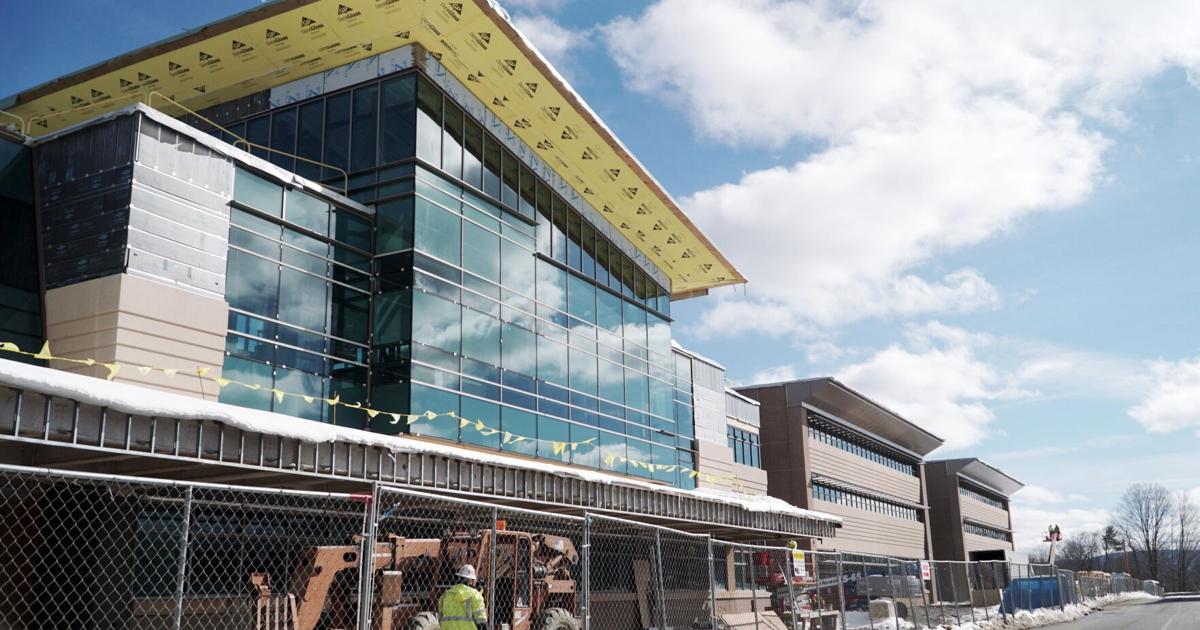
GREAT BARRINGTON — A wave of school construction has swept across Berkshire County since 2010, replacing or renovating aging buildings from Cheshire to Pittsfield to Dalton, ushering in a new, expensive era of education.
While aging infrastructure and state funding have driven much of the rebuilding, whether schools ultimately move forward has depended just as much on whether communities are willing to accept higher local taxes.
Projects over the past 15 years include the reconstruction of Hoosac Valley High School in 2011, followed by Taconic High School in Pittsfield and Mount Greylock Regional School, both of which opened new facilities in 2018. Wahconah Regional High School followed in 2022. Now, Monument Mountain Regional High School in Great Barrington and other districts are advancing through the state approval process.
Mount Greylock Regional School in Williamstown underwent renovation and expansion in 2018. The $64.8 million project replaced much of the aging midcentury facility with a modern building designed for fewer students. SCOTT STAFFORD — THE BERKSHIRE EAGLE
The ability to complete these projects comes down to support from the Massachusetts School Building Authority, which reimburses districts between 30 and 80 percent of construction costs. But even when state approval comes, that doesn’t guarantee a new school. The MSBA sets a multiyear process that determines eligibility, feasibility and design, while local voters must ultimately approve paying the district's share, which can be tens of millions of dollars.
Many Berkshire schools, built in the 1960s, are more than 50 years old, with aging roofs, HVAC systems, electrical infrastructure and layouts that no longer match modern educational programming. Districts must demonstrate those needs through a formal “statement of interest” to enter the MSBA pipeline.
Over the past 15 years, Berkshire school construction projects have totaled hundreds of millions of dollars. Taconic High School’s reconstruction cost roughly $120 million, with the state covering a major share. Wahconah’s project exceeded $70 million. Monument Mountain’s approved project carries a $152 million price tag, with an estimated 48 percent state reimbursement.
Even with state support, local shares often reach tens of millions of dollars — borrowing that must be approved through town votes or debt exclusions.
For Wahconah’s project, taxpayers in Dalton, the largest town in the seven-town district, were estimated to see taxes rise by more than $560 for the average single-family home.
Taconic’s project was the single largest taxpayer-funded project in Pittsfield’s history, The Eagle reported in 2015. The 46-year-old building at the time had a leaky roof, falling ceiling tiles and an inefficient heating system. The average single-family house assessed at $175,000 would pay $142 more annually in property taxes under a 20-year bond.
District leaders say new buildings offer more than modern classrooms. Updated HVAC systems reduce maintenance costs, layouts allow for flexible programming and accessibility standards are met more fully than in mid-century structures.
Plans for Monument Mountain’s classrooms include new desks, chairs and teaching technology, and science labs with upgraded safety systems, fume hoods and flexible layouts. Every classroom would have natural light, flexible layouts and built-in technology for collaborative and hybrid learning — a contrast to the current building, where many rooms have no windows and limited electrical capacity.
By Adam Shanks
[email protected] @EagleAdamShanks on Twitter
At the same time, administrators acknowledge that new schools do not reverse enrollment decline or eliminate broader budget pressures. They are long-term infrastructure investments, not short-term solutions.
The MSBA process can take several years before construction begins. After submitting a statement of interest, districts must be invited into the eligibility phase, complete a feasibility study and secure board approval before voters are asked to authorize borrowing. Projects can remain in the pipeline for years before reaching a ballot question, and some districts are not invited into the program at all during a given cycle.
Even when the need is widely accepted, construction can stall if voters are unwilling to accept higher taxes.
Mount Greylock Regional School in Williamstown completed a major $64.8 million, 22-month renovation and expansion project in 2018. The original structure was built in 1960, with an addition in 1972, when it served 1,200 students in 177,000 square feet.
The new building was designed for 535 students in grades 7-12, based on MSBA projections developed during the design process. Though the county is seeing a general decline in enrollment, the physical expansion focused on modernizing and reorganizing academic, arts and athletic spaces to meet current educational standards.
For the Berkshire Hills Regional School District, officials first said Monument Mountain Regional High School was in need of a makeover more than a decade ago. The building was built in 1968 and has a host of issues that helped it secure MSBA support in 2014, but voters rejected the proposal twice before approving it last November.
A scale model of the Monument Mountain Regional High School is displayed during a public presentation in Great Barrington. Voters approved the $152 million project after planning and debate. STEPHANIE ZOLLSHAN — THE BERKSHIRE EAGLE
Great Barrington taxpayers faced an additional $92 per $100,000 of assessed property value in the 2014 vote. In the 2025 vote, taxpayers approved $145 per $100,000 of assessed property value.
“This is a very nuanced and long-fought battle,” Superintendent Peter Dillon said.
In a rare additional chance, the successful vote followed years of community outreach and a clearer comparison between the price of renovating the existing building and constructing a new one, a failed district consolidation proposal and plans to expand vocational programming, Dillon said.
“Then the decision was pretty clear: It's better to invest in the new than to invest in the old and not get much for that investment,” Dillon said.
A major point of contention throughout the process was the high taxes the $152 million school would bring, even with the state paying for nearly half. Those concerned struggled to see the need for higher taxes when money is already tight as enrollment declines.
“We recognize that when people voted to approve this, they were doing it at a personal sacrifice,” Dillon said. “But they also see it as an investment in the long-term viability of the community.”
Enrollment across Berkshire County has declined over the past decade, mirroring statewide trends in rural districts. Several districts that rebuilt schools have opened new facilities serving fewer students than the buildings they replaced. That dynamic complicates building votes, as taxpayers weigh long-term infrastructure needs against shrinking class sizes and demographic uncertainty.
Monument’s path is not unique. Wahconah Regional High School in Dalton opened a new facility in 2022 after voters approved borrowing several years earlier. In North Adams, Greylock Elementary School has advanced through the MSBA process and recently selected a contractor for the $50 million project.
In Pittsfield, district leaders have identified aging elementary schools in need of major upgrades, but the scale of potential projects along with the size of the local share has complicated the path forward. Officials there say enrollment uncertainty and existing debt obligations factor heavily into discussions about when and how to pursue additional construction.
“I think the MSBA is making a bet on a school district that the school is going to work hard and convince their voters and residents to support it,” Dillon said. “They’re a great partner in this.”
Read the Original Article
This article was originally published by Berkshire Eagle. Click below to read the full article on their website.
Visit Berkshire Eagle