
Advocates rally behind a rent control ballot question in Pittsfield. Opponents say it would harm development and property values
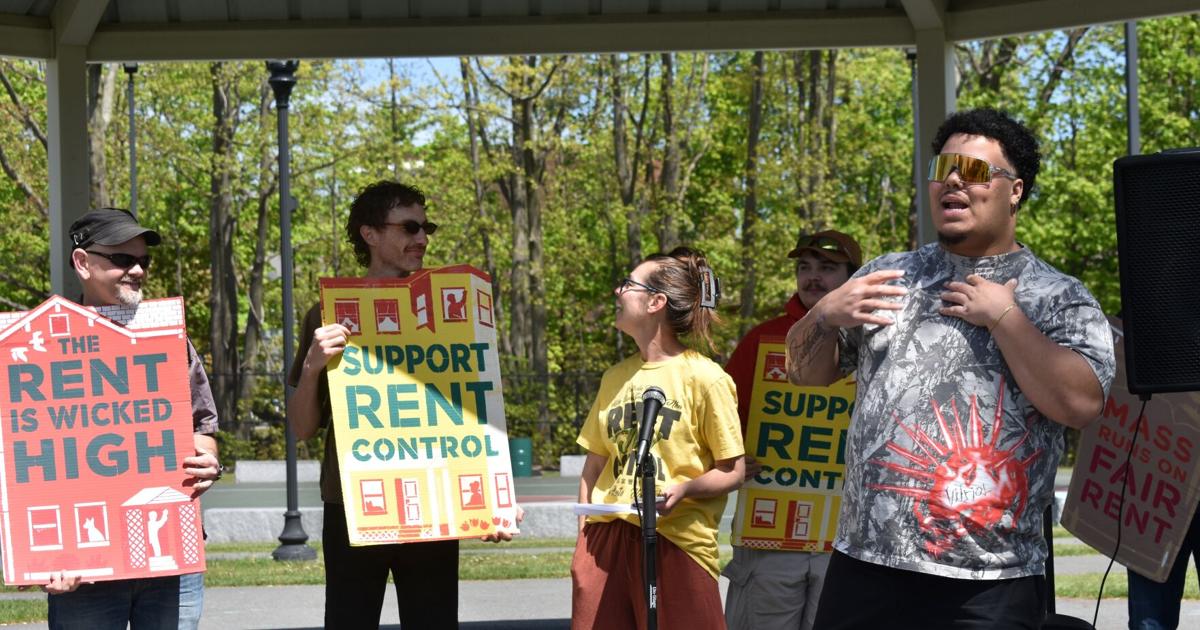
PITTSFIELD — At the Pittsfield Common, dozens of residents commiserated about skyrocketing rents while advocates proposed a solution: capping rent increases.
In Berkshire County, 54 percent of renters spend more than 30 percent of their income on rent, which means they are cost-burdened. A ballot initiative, which needs another 12,429 signatures, seeks to cap rent increases at the rate of inflation or 5 percent (whichever is lower) — with a few exceptions.
Opponents of the idea believe the cap could harm development and property values, causing economic harm to municipalities.
But for Carolyn Chou, of Homes for All Massachusetts, the group supporting the initiative, "We need a housing system that centers people, not profit," she said.
"There's so much need and hunger here in Pittsfield for common-sense rent stabilization, and we wanted to show that," said Carolyn Chou, the executive director of Homes for All Massachusetts. "This is an issue across the state and in every corner."
Last year, inflation was 2.7 percent. Under the proposed ballot measure, that would make the maximum rent increase for an apartment renting for $1,000 a month $27 at that rate.
The proposal would also apply when a new renter moves in. Owner-occupied buildings with four or fewer units or buildings completed within the last 10 years would be exempt.
Local landlord Yakov Kronrod said that housing should be seen not as a commodity but as a right. "If you treat it like an investment market, you're in the wrong market."
How will it impact property values?
Housing for Massachusetts commissioned a study conducted to find out the monetary impacts of the bill. It found that there would be a 14 percent loss of property value over 10 years in Pittsfield, and a 16.4 percent loss in North Adams.
The initiative will destroy "$300 billion in property values across the Commonwealth over the next decade," said Connor Yunits, chair of Housing for Massachusetts.
"It’s bad for renters, it’s bad for homeowners, and it’s bad for communities," he added.
Yakov Kronrod is a local landlord who believes capping raises in rents is both a good solution and doesn't inhibit landlords from using properties to build wealth.
Kronrod disagrees. "This will keep home prices from skyrocketing but it's not gonna make home prices drop," he said.
"[Landlords] can still build generational wealth and provide affordable housing for people," he said.
"It will help renters because of predictability," said Margot Page, president of Berkshire Interfaith Organizing. "They can rent into a place knowing that in a month, five months, six months, their rent won't go up."
"What's happening is rents are going up and our folks are not able to stay in town," Page said. "The folks that want to live here can't."
For renters, not having to spend a majority of their paycheck on rent allows them to reinvest in the community, Kronrod said. "They can invest in developing businesses, educating kids, growing whatever efforts they're trying to do."
Even in Massachusetts there are places that have rent control, specifically mobile home parks, said Margot Page, president of Berkshire Interfaith Organizing. That form of rent control helped protect a local park from having rents hiked by $500.
Homes for All Massachusetts is trying to get those final signatures by June 14, Chou said.
"We believe that rent stabilization is a common-sense solution," she said.
Read the Original Article
This article was originally published by Berkshire Eagle. Click below to read the full article on their website.
Visit Berkshire Eagle