
After 190 years, Bel Air Dam is nearly gone. Now comes the hard part: building a river
PITTSFIELD — It’s time to build a river.
Now that the Bel Air Dam, deemed unsafe after decades of neglect, is almost entirely removed, the construction team working just off Wahconah Street is turning its full attention to the project's next step: rerouting the Housatonic River’s West Branch to flow once again through its original path.
The Bel Air Dam, originally constructed in the 1830s, diverted water to power a woolen mill until the 1920s. Allowed to fall into disrepair over the course of a century, the dam was deemed a high-risk hazard by the state in 2019. If its structural deficiencies went unaddressed, a dam failure could have resulted in severe flooding that would have damaged surrounding roads and buildings.
A little over a year since the Bel Air Dam removal project began, the dam is nearly gone.
Now, a little over a year since the removal project began, the dam is nearly gone. Those who look through the construction fencing at the former dam will see only a small portion of its original masonry.
It marks the end of nearly two centuries of service for the dam, a bygone reminder of the region's industrial heyday.
The Bel Air Dam is almost completely removed and the next phase of the project is beginning. It marks the end of nearly two centuries of service for the dam.
"It really is a relic of our industrial past," said Jim McGrath, the city’s parks, open space and natural resource program manager.
"In one respect, it's sad to see it go," he said of the dam. "On the other hand, removing it eliminates a modern hazard."
The restored river segment will be short, slightly under a quarter of a mile long. But there’s more to making a river than just digging soil. All that sediment being dug out, some of it contaminated with heavy metals and fossil fuel byproducts, needs to be shipped off to a landfill in New York.
According to a 2021 analysis by AECOM, the project’s engineering company, about 35,500 cubic yards of sediment would need to be removed if the dam were to go. That sediment removal is going to be the most costly part of the state-funded project, which comes to about $20 million.
A June 2 project update stated that sediment excavation is expected to be completed by the end of this summer. The update also stated that sediment testing has not uncovered any PCB contamination at the site. Over half of the necessary sediment removal is now completed.
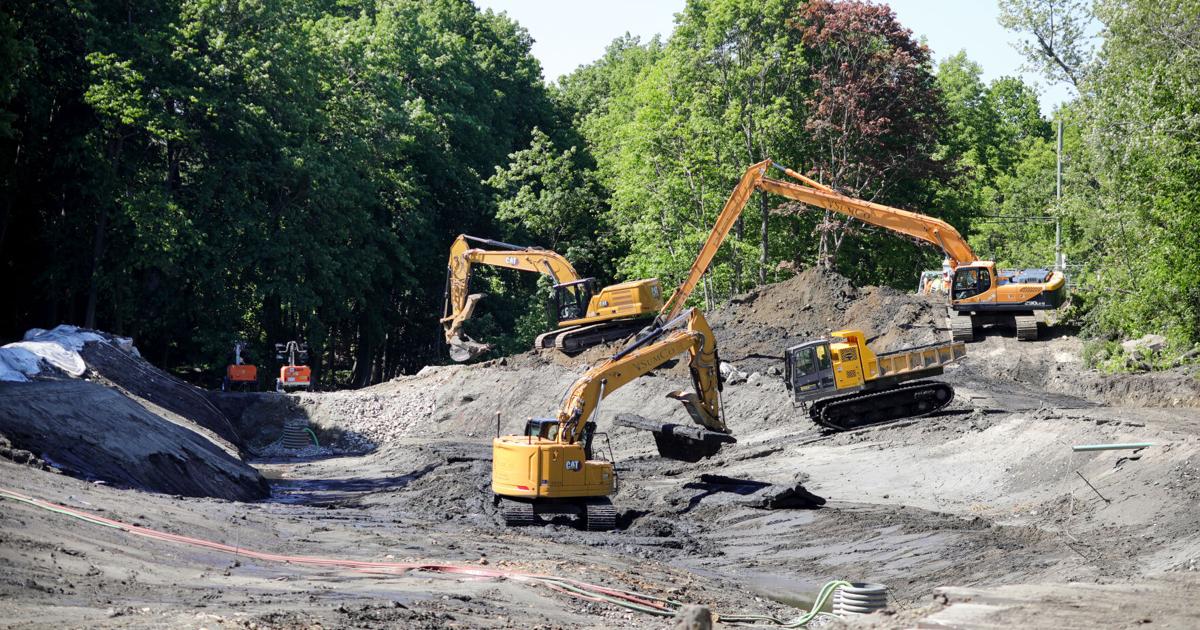
During the day, workers from SumCo Eco-Contracting can be seen using cranes to scoop out sediment from a formerly marshy expanse to deepen it enough for the river. Once that’s wrapped up, SumCo will then work to create a new stream channel, shape the riverbanks and install native plant species, blending the site back into the natural landscape. That work is expected to wrap up near the end of the year.
Contaminated sediment is removed from the river bed at the Bel Air Dam project and hauled away for disposal. The state-funded project will come to about $20 million.
A section of the new riverbed is already being lined with fresh rocks to prepare for the water’s return, and as the cranes continue moving earth, the river's contour is becoming clearer by the day. Once completed, the new river channel is expected to be 40 feet wide and 2.5 feet deep.
There have been a few setbacks this spring, but nothing major. The site flooded in March after water released from Pontoosuc Lake resulted in higher flows downstream. It eventually receded after a few weeks with no noticeable impact on the water quality.
A spokesperson for the state Department of Conservation and Recreation also said a bypass channel discovered about a month ago needed to be repaired before excavation work could be continued, but that work has since resumed.
About five construction workers are typically on site during excavation of the Bel Air Dam in Pittsfield.
About five construction workers are typically on site during excavation, with more occasionally joining depending on the day’s project. There’s also a full-time archaeologist on site in case excavators find something interesting in the sediment — but so far, it’s been mostly old bottles.
Traffic interruptions throughout the summer will be minimal. Both lanes on Wahconah Street remain open, with traffic only pausing occasionally when a truck needs to exit the construction site. A handful of traffic cones keep cars from getting too close.
Read the Original Article
This article was originally published by Berkshire Eagle. Click below to read the full article on their website.
Visit Berkshire Eagle