
After sudden sinkhole closure, Great Barrington tests quick fix for temporary bridge
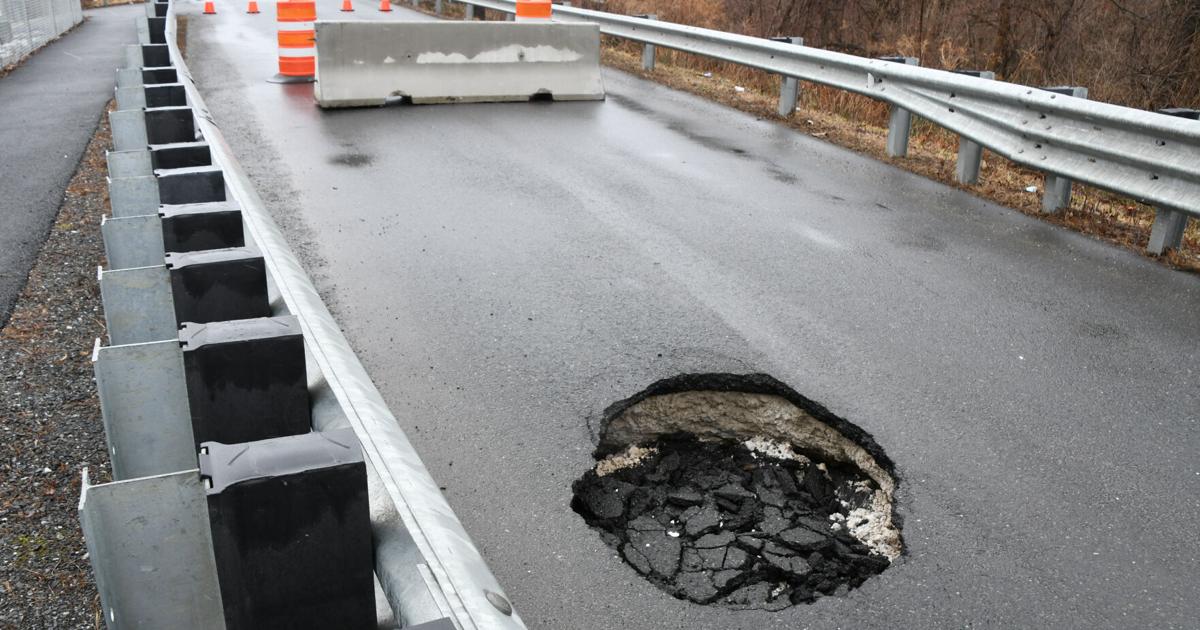
GREAT BARRINGTON — The town Department of Public Works will excavate a sinkhole on the temporary Division Street bridge as a first step toward potentially reopening the span.
The Select Board voted Tuesday, with Garfield Reed voting no, to have the DPW excavate the sinkhole. After, the town’s on-call engineering consultant, Tighe and Bond, will evaluate the site to determine whether recompacting the hole is a safe and effective fix.
If deemed viable, the low-cost repair could allow the bridge to reopen in about a month, with daily monitoring for recurrence.
If Tighe and Bond determine recompacting is not a viable option, the Board will reconvene to determine if they should move to a more expensive and months-long fix of full excavation to abutment and drainage reconstruction.
The bridge has been closed to all traffic since March 23 after a sinkhole discovered on March 20 expanded, signaling an “unstable subsurface,” Town Manager Liz Hartsgrove said.
The temporary bridge went up in 2022, three years after the state closed the original structure due to safety concerns.
With construction of a permanent two-lane bridge expected to begin this fall and bids planned to go out in June, the Select Board will have to determine if they want to move forward with the fix if recompacting by the DPW isn't safe.
All members stressed that the number one priority is safety.
Tighe and Bond's initial evaluation, including a dye test, did not show a definitive reason for why the sinkhole formed so suddenly, though they suspect the weep holes are a contributing factor.
The DPW and Tighe and Bond used 3,000 gallons of traceable green water for the dye test, which showed that water was not pouring into the river but was instead trickling very slowly through the abutment joints and weep holes, suggesting that sediment might have been going out over a long period.
Read the Original Article
This article was originally published by Berkshire Eagle. Click below to read the full article on their website.
Visit Berkshire Eagle