
At Berkshire first responders banquet, keynote speaker urges talk about trauma. 'Your vow of silence needs to be the one vow you break.'
PITTSFIELD — They don’t talk about it.
If you wandered among the round tables at the Emergency Medical Services Committee of Berkshire County's EMS awards ceremony at the Proprietor’s Lodge on Friday night, you would not have overheard words like “hero,” “rescue” or “saved.” Instead, amid the clink of dinner glasses and the glow of Pontoosuc Lake through tall windows, the conversations drifted toward kids’ soccer games, home repairs, upcoming vacations and bad knees.
Elina Olmedo, 22, at center, who collapsed from cardiac arrest at a Williams College track and field meet while visiting from Springfield College, poses with her rescuers, including personnel from Northern Berkshire EMS, the Williamstown Police Department and Williams College. Her father, Rafael Olmedo, stands to her left.
That silence — around heroism, trauma and the emotional cost of the work — became the central theme of the evening, in which nearly 30 people were recognized for rescues.
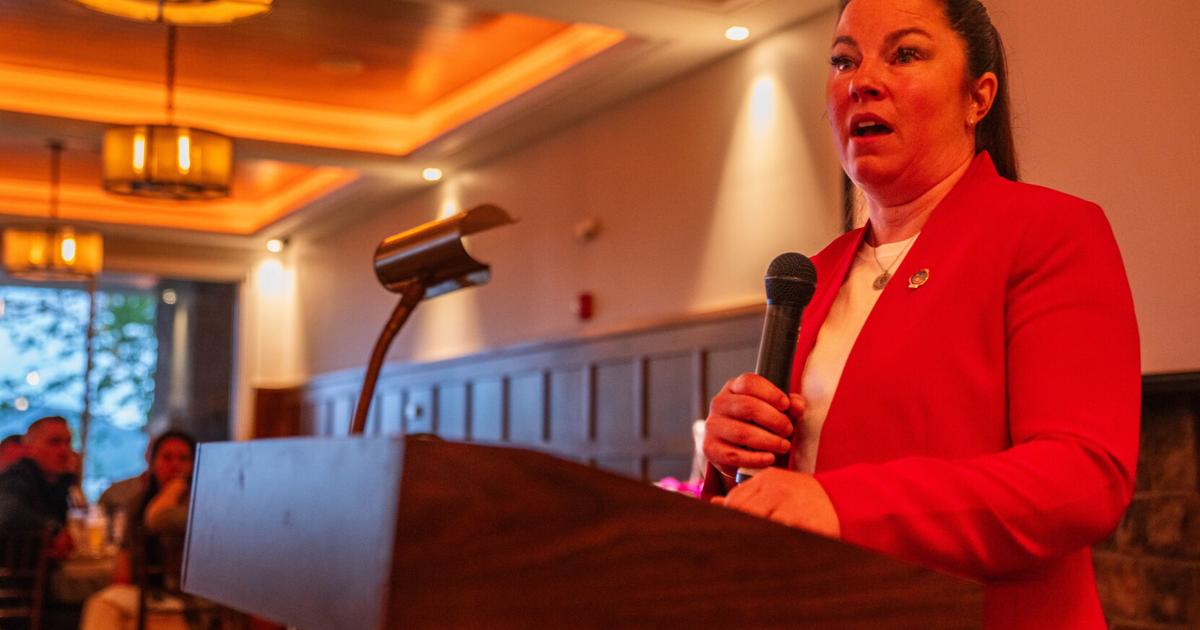
Keynote speaker Nicole Ferry, a military veteran, former police officer and longtime Berkshires EMS worker, urged the room full of first responders to abandon what she described as the profession’s unwritten pledge to stay silent around mental health struggles and psychological trauma.
“We take many vows in this life,” she warned. “Your vow of silence needs to be the one vow you break.”
According to the Massachusetts Division of Violence and Injury Prevention, the average annual rate of suicides among first responders is 1.5 times higher than the overall rate. About 37 percent of EMS workers have PTSD, versus about 6 percent of the general public. Rates for depression and anxiety among EMS workers are 5 to 10 times higher than for everybody else.
Amanda Forgett was an honoree at the EMSCO awards Friday.
A military veteran and former police officer who served as a Berkshires EMS worker for 24 years, Ferry tumbled downhill when her longtime police partner and friend stabbed himself to death.
Ferry shared with her EMSCO audience her harrowing journey of bottling up the pain she felt following his suicide, followed by a 30-day stint at a trauma treatment center — ostensibly undertaken at first not to treat her own trauma, but to ride shotgun for a partner she felt needed the help.
At the suggestion of a canny therapist who saw through Ferry, she stretched her stay for her own treatment, eventually to a staggering 142 days. After her long treatment came debilitating depression, a debilitating medication to treat the depression, crippling exhaustion, screaming on the bathroom floor, nightmares and night terrors, suicidal ideation, and inevitably, her own near attempt.
Almost too late, Ferry began climbing out of the hole only when she began opening up — to her husband, to friends, to colleagues. Talking about the things that are hard to talk about. Knowing nods from her audience seconded her experience.
EMSCO wards keynote speaker Nicole Ferry with Cash, her service dog.
The warning came after an evening spent honoring the lifesaving work performed by Berkshire County first responders.
From the podium came 11 brief stories, each delivered with the clinical detachment of a bedside chart, while more than 200 family members, colleagues and a few of the rescued listened quietly from the dining room.
There was a college athlete who collapsed into sudden cardiac arrest at a track and field meet. A teenage skier treated on the slope after suffering multiple injuries, including a compromised airway. A woman whose allergic reaction to a yellow jacket sting sent her into anaphylactic shock and then cardiac arrest.
Saving lives in the field is a team effort. First responders see themselves as links in a chain extending from the dispatcher sending them to the scene to the patient’s discharge from the hospital, said longtime EMSCO President Brian K. Andrews.
EMSCO President Brian K. Andrews takes in the moving keynote.
The story for most awards concluded with the coldly reported datum that the patient was eventually discharged “neurologically intact.” Getting the patient to the hospital alive isn’t a win. A win is when the patient walks out of the hospital a day, a week or a month later without a trace of the brain damage hypoxia can inflict when cardiac arrest, a compromised airway or anaphylactic shock is treated too late, or treated ineffectively.
But they don’t talk about wins. Or losses. Or the emotional trauma they accumulate across decades of fixing others’ physical trauma.
And that’s the problem, Ferry said.
As admirably modest as a refusal to discuss heroism seems, the same inhibition spills over into a reluctance to talk openly about anything at all that might be uncomfortable to say. And that unwillingness to open up, Ferry said, leads to dark places for those living the first-responder life.
Now a mental health advocate, Ferry’s plea to her first responder crowd was simple to say, but harder to do: Talk about it.
Read the Original Article
This article was originally published by Berkshire Eagle. Click below to read the full article on their website.
Visit Berkshire Eagle