
At Berkshire Humane Society, helping animals starts with helping people
PITTSFIELD — An animal shelter might seem like a straightforward operation: people drop off pets, others come to meet them, and hopefully, they leave together.
But the Berkshire Humane Society is something more all-encompassing — and more human.
“For me, it’s always been about people,” said Executive Director John Perreault, who has spent more than four decades working in animal welfare.
Volunteer Joanne Billow accepts donations at the Berkshire Humane Society in Pittsfield. “I’m amazed at the commitment of the staff and what they do for this community,” she said.
That people-first philosophy shapes everything the organization on Barker Road does, from surrender and adoption to education and crisis support. It even affects hiring.
“I’d rather hire a people-person and teach them the animal stuff,” Perreault said. “Animal problems almost always need to be communicated to people.”
The goal, he said, is to “meet people where they’re at. When we help them, we help their animals.”
This makes the humane society’s work not just about placing animals.
“Everybody likes those feel-good stories,” Perreault said. “But what we’re really trying to do is help people with their animals and whatever issues they have.”
That approach has turned the humane society into as much a community center as a shelter, one focused on keeping families with pets together whenever possible.
Rather than simply accepting surrendered animals, staff first try to address the underlying problem — whether it’s the financial strain of a pet, behavioral issues or access to veterinary care.
Berkshire Humane Society Executive Director John Perreault said the organization uses a "people-first" approach when helping animals. The goal, he said, is to “meet people where they’re at. When we help them, we help their animals.”
“If we can’t offer a solution, the animal ends up with us,” Perreault said.
As an open-admission shelter, the organization accepts animals regardless of age, breed, health or temperament. Euthanasia is limited to medical or safety reasons — not space. Adoptable animals are not subject to time limits.
To support their clients, the shelter operates a pet food bank for families facing financial hardship and provides supplies to local food banks when possible. Its separately located Wellness Clinic offers affordable preventive and urgent veterinary care at a time when costs are rising and vets are harder to find.
Nicole McKeen greets Starr at the Berkshire Humane Society's drive-through pet food pantry distribution of dog and cat food in December 2025. Rather than simply accepting surrendered animals, staff first try to address the underlying problem, such as helping families feed their animals.
The organization’s Safe Pet program temporarily houses animals when owners are hospitalized or otherwise in crisis.
Even offering to trim a cat’s claws can keep a pet at home. Each month, shelter staff visit a senior housing community to provide nail clipping for residents who cannot travel.
But responding to crises is only part of the shelter’s mission. Preventing them is equally important, and that often begins with education.
Tricia Phillips, director of community outreach, manages everything from coordinating volunteers — who gave more than 23,000 hours last year — to education programs in local schools.
“I love working with kids,” Phillips said. “They need to know about spaying and neutering; what it takes to care for an animal. Animals have needs.”
Even a seemingly simple pet like a rabbit requires more care than people realize.
“If you don’t do your research, you don’t realize it needs time out of the cage,” she said.
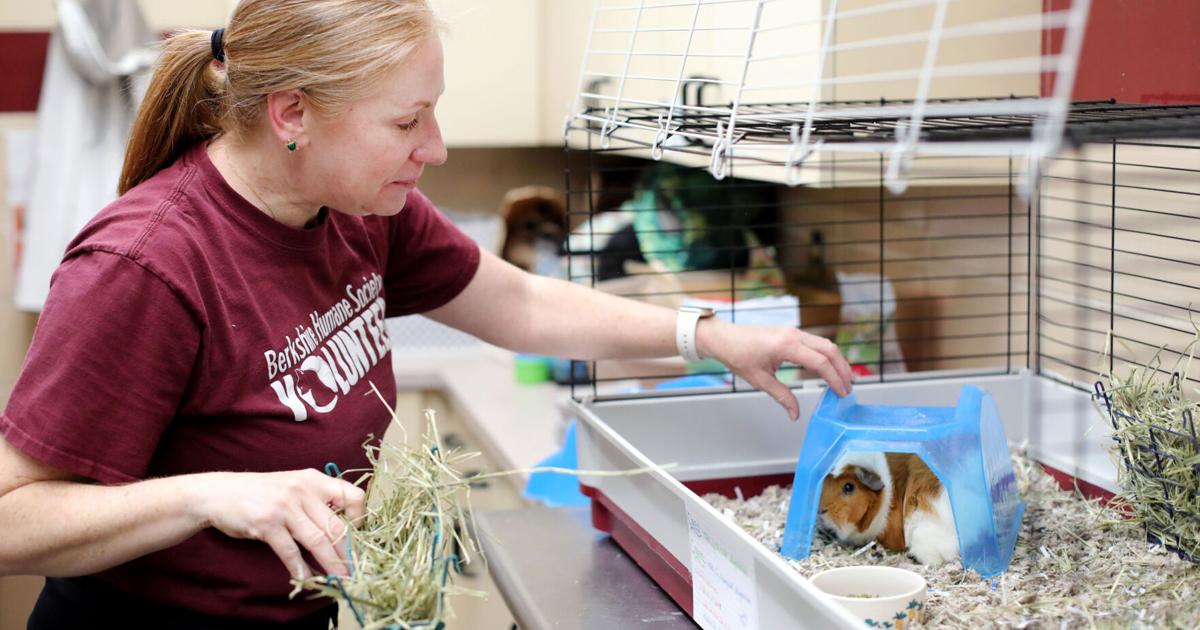
Volunteer Christin Fetterolf cleans the small animal enclosures. “I came here to do a selfless thing, but I walk out feeling selfish,” she said. “The bunnies hop to you, the ferrets curl up on you — it’s amazing how much they give with no expectation of anything back.”
Both Phillips and Perreault point to the shelter’s partnership with Reid Middle School, some of whose students visit the shelter several times a year, as a meaningful example of the organization’s work.
Phillips recalled one girl who initially “would just sit with her head down. She wouldn’t make eye contact.”
Over time, that changed. “The second month she came, she picked her head up. The third month, she was smiling. She actually took pictures.”
Kids also learn to safely approach animals and understand their behavior.
“A lot of children think the first thing you do is stick your hand out,” Phillips said. “That’s the last thing.” They are taught to read an animal’s body language and respect boundaries.
“You have to ask permission if they’re not yours,” she said. “Even if you trust your animal, you don’t leave it alone with your child.”
The shelter’s work is supported by a large group of volunteers.
“Without our volunteers, we would not be able to do what we do,” Phillips said.
Volunteer Joanne Billow, who staffs the front desk, said she was initially surprised by the scope of the shelter’s work.
Volunteer Joanne Billow accepts donations of cat accessories from a visitor at the front desk at the Berkshire Humane Society in Pittsfield.
“I’m amazed at the commitment of the staff and what they do for this community,” she said.
Billow also sees firsthand the generosity of donors.
“I can’t tell you how many times a truck will come in from Chewy with a gigantic box of pet supplies,” she said. “And we have no idea who it’s from.”
Donations extend beyond new items. The shelter redistributes used beds, toys and other supplies to those who need them.
For Billow, the most meaningful part of volunteering is witnessing what she calls “the happy endings.”
She recalled Mina — ”the sweetest animal” — a deaf 9-year-old pit bull. A friend of hers happened to stop by, spent time with Mina and ultimately took her home.
For volunteer Christin Fetterolf, who works with small animals like rabbits, guinea pigs and ferrets, the experience has been equally meaningful.
Volunteer Christin Fetterolf cleans the small animal enclosures and feeds any current residents, which include a bonded pair of guinea pigs, a hamster and a few pet rats, at the Berkshire Humane Society in Pittsfield.
“They want to interact and want love, just like a dog does,” she said. “I struggle that animals never have a voice. They never have an opportunity to say ‘I was mistreated,’ or ‘I’m hungry.’ I want to be a voice for them.”
What she did not expect, she said, was what she received in return.
“I came here to do a selfless thing, but I walk out feeling selfish,” Fetterolf said. “The bunnies hop to you, the ferrets curl up on you — it’s amazing how much they give with no expectation of anything back.”
Pets are often considered part of the family, and Perreault sees the shelter’s mission as helping to create, grow or stabilize families.
He recalled one man living in his car with several dogs. The shelter helps where it can — with food, supplies and medical care.
“And he keeps his dogs,” Perreault said. “They’re extremely well cared for. That’s his family.”
That shift in the public perception of pets has helped the shelter improve outcomes. Where once even young animals struggled to find homes, today older pets are commonly adopted.
“If you bring me an animal in the double digits, as long as it’s friendly, I can find a home,” Perreault said.
But he is clear about one thing.
“At the end of the day, this is still an animal shelter,” Perreault said. “These animals get more walks than my dogs, but it’s still not a home.”
Read the Original Article
This article was originally published by Berkshire Eagle. Click below to read the full article on their website.
Visit Berkshire Eagle