
At Cricket Creek Farm the cows leapt for joy at Spring Pasture Turn Out
WILLIAMSTOWN — A joyous stampede.
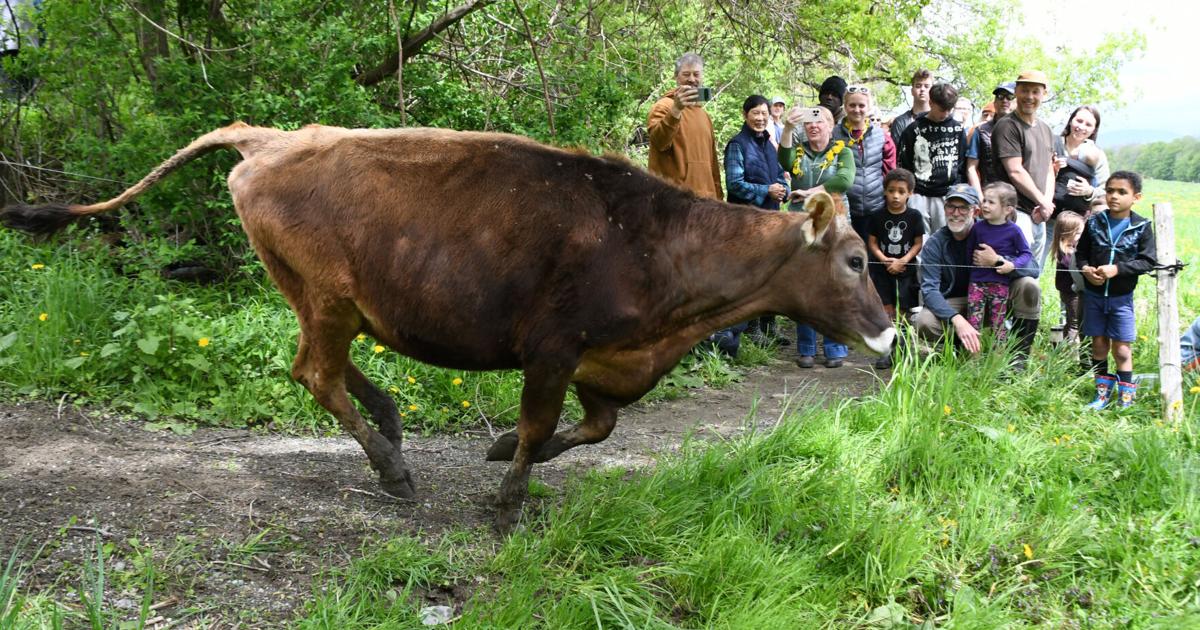
That’s what many of the cows did as they emerged from a long winter in the barn and leapt to their first taste of clover, dandelions, rye, orchard and fescue grass this season on Sunday.
As the cows leapt to freedom at Cricket Creek Farm, the more than 50 humans who came to watch this rural rite of spring were confined to a cordoned area behind an electric fence.
Spectators watch as Cricket Creek Farm's dairy herd enthusiastically go back to the open fields to feast on fresh, verdant grass off of Oblong Road in Williamstown on Sunday afternoon. The annual spring pasture turnout was attended by several dozen people.
But those watching the cows run to the pasture for the first time seemed universally happy. With cellphones at the ready, and a sketchbook in at least one case, children and their parents gathered with anticipation.
“What better way to spend Mother's Day than seeing a bunch of cows come out for the spring,” Danielle Colby said. ”It’s a very country life thing to do. I love it.
“I’ve never seen cows move so fast,” she said. “They were bounding out and leaping with excitement which is how we all feel after the long, cold winter.”
Colby is an artist whose major subject has lately been on the representation of motherhood.
Cricket Creek Farm's dairy herd feast on fresh, verdant grass on Sunday afternoon.
“All we see, usually, in advertising and on social media, is the happy side, and thin pretty bodies that bounce right back,” she said. “So my work sort of investigates the other side.”
And while she hadn’t given much thought to cows and what motherhood might mean to them, “I do recall when I was breastfeeding feeling a bit like a cow, and feeling a bit like a beast of burden,” she said. “So, yeah, there’s a tie there for sure.”
Samantha Sadowski was carrying Zinnia, 7 months, and was with her husband and two older children.
“It’s really lovely to be with all these mama cows,” she said. “I feel like I can relate to running wild in a field and just having the sunshine on me. It’s wonderful seeing these cows so happy.”
Sadowski and her husband are both teachers and try to take their children outside as often as possible.
Cricket Creek Farm's dairy herd feast on fresh, verdant grass on Sunday afternoon as visitors join them.
Her daughter, Maple, 3, and her son, River, 5, both gave her dandelions and wished her a happy Mother’s Day.
And while Sadowski accepted their gifts, the cows rejected garlands made from the same yellow blossoms.
So Jen Mygatt, whose husband, Topher Sabot, owns and manages Cricket Creek Farm, handed them out to as many mothers as she could find.
Mygatt spent exactly 23 minutes running a lowkey 4-K pasture scamper, as she called it, on trails on the 450-acre farm. Cricket Creek Farm holds a race in the fall as well and grooms trails during the winter for skiers.
Mygatt’s time placed her second overall and as top women finisher. Winning first was Andrew Holland, at 19:25. With just 10 people in the race, Mygatt downplayed the event, but like the invitation to the public to attend the Spring Pasture Turn Out, it’s part of the plan of the Sabot family to keep the farm in the eye of the community.
Brixton Moran, 13, pets Shifa, a cow, as Cricket Creek Farm's dairy herd feast on fresh, verdant grass on Sunday afternoon during their annual spring pasture turnout.
“Existentially, Topher and I believe people need to be outside and engaging with the landscape, and I think with turnout they can see the cows doing that,” she said. “It’s a stunning place. I think the community takes us for granted. And we are trying very, very hard to keep the farm open. And it is in no ways a sure thing.”
Cricket Creek runs partly on volunteer labor to feed and care for calves and pigs twice a day on a schedule — which Sabot described as both fun and hard work.
He said the turnout represents a transition, not just for the cows but also for their keepers.
While the cows are in the barn for the winter eating fermented hay known as baleage, the farmers who care for them spend a lot of time indoors as well.
Turning out the cows means that the farm workers’ tasks change — from feeding the cows in the barn and cleaning the barns daily as well as changing their bedding to moving cows, setting up, checking and moving fences.
As part of regenerative rotational grazing, Cricket Creek's 85 cows move from field to field on a daily basis. Of those, 35 are milking dairy cows, a few are for beef and the rest are young heifers and calves.
“We don’t do a lot of tillage,” Sabot said. “So we try to minimize any type of plowing and planting, because it is very destructive to the soil.”
There are certain grasses ideal for grazing and for hay.
“The goal is a lot of variety because different grasses do well with different weather conditions and different seasons,” he said. “So orchard grass grows well in the cool spring but doesn’t grow as well in the hot summer, so you want a mix to kind of cover all your bases.”
Read the Original Article
This article was originally published by Berkshire Eagle. Click below to read the full article on their website.
Visit Berkshire Eagle