
At Terrace 592, tenants say trespassers and trash are making them feel unsafe
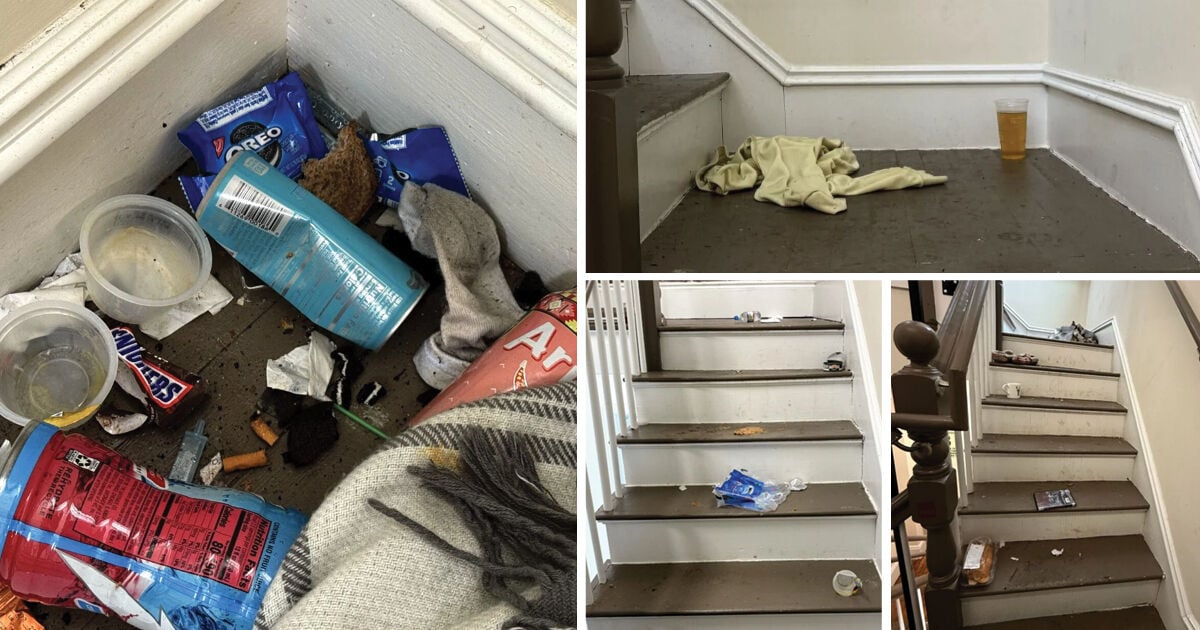
PITTSFIELD — At the top of the stairwells inside Terrace 592, piles of clothing, food wrappers, a cup of pungent yellow liquid and discarded plastic baggies have become a familiar sight. Tenants say the mess is not left by residents, but by outsiders who find their way into the building.
For those living at the affordable housing development at 592 North St., the conditions have left them feeling uncomfortable and unsafe in their own shared living spaces. Building owners and property managers say stopping trespassers — and addressing concerns about tenants who may be letting them in — is legally complex, while physical fixes like upgraded security infrastructure take time.
The concerns are rooted in a longer history at the property, one that predates the building’s conversion into affordable housing.
After a fire in 2017 left the property vacant, the 592 Terrace complex became a refuge for people experiencing homelessness and others who entered the building unlawfully. At that time, the back alley was filled with "garbage, ruined clothes, drug paraphernalia and human waste," according to an Eagle article published on Nov. 10, 2022.
In 2023, Regan Development Corp., a New York-based housing developer, bought the vacant and boarded-up building for $900,000. It completed the $18.5 million project eight months ago, and tenants moved in in August.
Terrace 592 in Pittsfield is home to 41 affordable housing apartments. In 2023, Regan Development Corp. bought the vacant and boarded-up building for $900,000.
Now, tenants are seeing conditions similar to when the building was vacant, with some questioning if they want to live there at all, according to a tenant who asked to remain anonymous fearing for their safety in the building.
Although tenants' anger has zeroed in on Hearthway, the nonprofit that manages the property, it only has so many avenues to combat these problems. Tenants have some of the strongest protections in the country living in Massachusetts, meaning evictions can take years.
"The tools that we have are somewhat limited," said Eileen Peltier, CEO and president of Hearthway. She said the nonprofit has called police to remove nonresidents from the building, but they keep coming back.
Meanwhile, tenants still deal with trash and nonresidents daily.
"We can't even go in our public common areas because they've taken it over," the tenant said. "It's like you feel like a prisoner in your own apartment."
The tenant said moving isn't an option for many of the residents. The affordable apartments are all they can afford, they said.
"[Residents] feel that they're witnessing things that they know is a lease violated or whatever, it's not not OK to behave that way and they're behaving correctly," said Eileen Peltier, CEO and president of Hearthway. "They just think that I see this action happen and this person should get removed from from the building today."
"This place was like gorgeous back in September, October, November," the tenant said. "And then, once the cold weather came, that's when we started having everyone living in the hallways."
Both Regan Development Corp., the owner's of Terrace 592, and Hearthway, the property managers, have been working with local law enforcement to create a plan to improve security at the affordable housing complex.
These nonresidents slip in after tenants open the door, which stays open for 20 seconds after a fob unlocks it, the tenant said.
Sometimes, tenants feel unsafe when bringing in groceries, holding the door open for a nonresident to avoid conflict, Peltier said. Some residents have also knowingly let people in.
During a visit to the building on Thursday, the top of two stairwells was littered with Oreo wrappers, half-eaten sandwiches, open beer cans, cigarette stubs, broken glass, worn slippers, a spoon, small plastic baggies and more.
While the mess is intermittently cleaned up, it returns soon after, the tenant said.
The city Health Department opened an investigation for the building on Wednesday, according to Health Director Andy Cambi.
Terrace 592 in Pittsfield, pictured in June 2025 shortly before it reopened. The $18.5 million project brought the building back to life after a fire in 2017 left it vacant. Now, residents say the once clean hallways are littered with garbage and signs that people are living in the commons areas.
"With residential spaces, especially common areas, residential units, the Health Department does have a role in the inspection component of it and then ensuring that there's safe, sanitary conditions for occupants," he said.
If the property manager doesn't rectify the unsanitary conditions, correction orders, fines and, eventually, housing court can follow, Cambi said.
When The Eagle visited Terrace 592 on Thursday, cigarette butts, discarded clothing, trash, small plastic baggies and a cup filled with yellow, pungent liquid covered the stairwells in the common areas.
Keeping those spaces clean and safe is easier said than done, Peltier said.
"Our team is talking with residents regularly and calling the police and checking the property as much as we can," she said. "The challenge is, I'm not comfortable having my team go there at midnight."
That is when most of the incidents and issues occur, Peltier added.
Pittsfield Police have been dispatched to the building multiple times, said Police Chief Marc Maddalena.
Tenants face their own painful dilemma — one that pits compassion against safety. In the bitter cold of winter, one tenant said it can feel impossible to force someone outside.
“Do I live with that?” the tenant said. “This guy froze to death because I didn’t want him in my stairway?”
The people leaving trash in the stairwells are not tenants and can typically only be cited for trespassing — a response that often amounts to little more than a verbal warning, Peltier said.
To address this, the building's owners and management team have been working with the police to create a plan, said Jeremy Regan, a development coordinator at Regan Development Corp.
But changes will take time, he said, "so we just ask for a little bit of patience, some grace, and we [will] continue to work hard at this."
Terrace 592, formerly White Terrace, became a refuge for people experiencing homelessness and others who entered the building unlawfully after a fire in 2017. Today, similar items can be found at the top of the building's stairwells.
Both Regan and Peltier said there is a safety-improvement plan in place, but declined to share further details.
The Pittsfield Police Department has been working with management and other involved parties to improve the situation for tenants, Maddalena confirmed, adding that property officials have been receptive to the department’s recommendations.
That doesn't address the problem of residents letting people in, which is an easy solution to identify but harder to enforce.
Cause evictions — ones where a tenant is breaking the lease or partaking in illegal activity — usually require a 30-day notice to quit with evidence of wrongdoing, said Brad Gordon, executive director of Upside 413, a nonprofit that provides legal counsel for housing issues.
Until that violation or illicit activity is proven, a tenant does not have to vacate the premises. If the tenant chooses not to leave, a landlord can bring the case to court, Gordon said.
The process takes between two and four months, he said.
"We cannot just kick people out because something happens," Peltier said. "I think there's a misperception about what legally we can do."
Building upgrades and any potential evictions will take time. However, in the meantime, tenants are encouraged to contact the Health Department if the common areas are unsanitary or if they have a question about what constitutes unclean conditions, Cambi said.
Residents are also encouraged to call the police if they [see] people behaving unsafely in the building or anyone performing illicit activities, Regan said.
"It's the residents who are living there, trying to just live their lives and be safe, that's priority one," Peltier said.
Even amid the frustration, some residents say they still believe the building can return to the clean, safe environment it offered when it first reopened.
"As a community, what do we do?" the tenant said. "How do we, instead of being part of the problem, how do we be part of the solution for these people?"
Read the Original Article
This article was originally published by Berkshire Eagle. Click below to read the full article on their website.
Visit Berkshire Eagle