
At the Boston Symphony, more discordant notes over Music Director Andris Nelsons’ role
LENOX — The dispute over the Boston Symphony Orchestra’s decision to end Andris Nelsons’ tenure as music director after the 2027 Tanglewood season continues to intensify.
Tensions remain between musicians who support Nelsons and BSO leaders, including trustees Chair Barbara W. Hostetter and President and CEO Chad Smith, following a meeting between musicians and management Saturday at Tanglewood.
The BSO announced late on March 6, a Friday afternoon, without advance notice to the musicians, that it would not extend Nelsons’ long-term rolling, or “evergreen,” contract beyond August 2027.
The decision continues to anger musicians and audience members who support Nelsons as he approaches his 13th and final season with the orchestra.
Now, in a written response revealed at Saturday’s meeting and obtained by The Eagle, Andris Nelsons’ management team says the BSO had agreed in principle to extend his contract beyond August 2027, and that the orchestra never discussed a “quiet exit” with Nelsons and did not offer him a conductor emeritus role before trustees decided to end his tenure.
Those assertions — made by Nelsons’ management representative Karen McDonald, managing director and president of the New York office of KD SCHMID — directly challenge what BSO leaders previously told musicians.
They also conflict with Smith’s explanation to The Eagle and other media outlets that Nelsons’ tenure was ending sooner than previously expected because the music director had said he was “not aligned” with management’s new strategic vision. That vision calls for broader programming and expanded community outreach to help address the nonprofit’s financial challenges and reverse declining concert attendance.
Nelsons’ representatives proffered the letter to BSO musicians after they asked for an explanation of conflicting accounts surrounding the decision not to renew his contract.
McDonald contended that BSO leadership’s version of events was “inaccurate and not a faithful reflection of the truth.”
The BSO Players Committee had asked Nelsons and his agency to verify statements a trustee made to several musicians in April. The trustee claimed Nelsons had declined an offer to serve as “conductor emeritus,” or under a similar title, along with a three-year contract extension.
Nelsons’ management team said no three-year guest conductor role had been offered.
His representatives also said the trustees’ decision came as a surprise in February, just weeks before it was announced, rather than as the result of exit strategy discussions that Smith has said began the previous September.
McDonald also wrote that Nelsons was never told how he supposedly was misaligned with the BSO’s new strategic plan.
McDonald wrote that Nelsons had meaningful involvement in the strategic plan at only one meeting, in September 2025. She said Nelsons had helped convene the meeting in an effort to bring the parties together.
“The key outcome of that meeting was the restoration of an explicit commitment to ‘making music at the highest level of excellence’ within the organization’s mission statement which was missing from the previous drafts shared with the various stakeholders,” McDonald wrote. “This amended version was subsequently presented to the Board for ratification.”
At a celebration marking the opening of the BSO’s Tanglewood season last weekend, Hostetter and Smith appeared resolute in their decisions and expressed optimism about the future of the BSO and Tanglewood.
On Tuesday afternoon, following Saturday’s meeting with the musicians, BSO management released a letter from Hostetter addressed to “Dear Players of the Boston Symphony Orchestra.”
Hostetter described the gathering as “an important step toward the more direct and open dialogue that we all agree is necessary.”
“We hope to meet more regularly to continue to build trust as we work together to build a stronger BSO,” she wrote.
Hostetter acknowledged that “no single meeting was ever going to resolve every disagreement or answer every question.”
“But progress is not measured only by agreement,” she continued. “It is measured by a willingness to engage one another honestly, to listen carefully, and to continue the conversation especially when it is difficult.”
After describing the musicians’ questions as “thoughtful, candid, and important,” she noted that there were “many moments when we gained a better understanding of one another’s perspectives and found areas of genuine common ground.”
Hostetter also criticized the tone of portions of the meeting.
“There were other moments when conversation veered off course, with personal attacks and rhetoric directed towards leadership that fell well short of the standard of civility this institution deserves,” she wrote.
“We know we don’t stand alone in this concern — we have heard from a number of Players describing how deeply uncomfortable they were with the tone from some of their colleagues and questioned whether the meeting advanced the dialogue we all hoped for,” she added.
In her most detailed remarks made available to the media so far, Hostetter wrote that “the Board believes that every member of this community deserves to be treated with professionalism and respect.”
“This is an organization built on the pursuit of excellence in everything we do,” she continued. “Excellence is not only what happens on our stages. It includes how we treat one another when we disagree.”
She also challenged some of the statements made during the meeting.
“Several factual assertions were also made during the meeting that the Board believes do not accurately reflect what transpired,” Hostetter wrote. “Honest dialogue depends on a shared commitment to the facts.”
Hostetter said the BSO’s negotiating team separately provided the Players Committee with documentation supporting its account.
She also referred to “additional media coverage of the BSO expected in the coming days and weeks.”
“We have engaged in conversations with the media with the same commitment we brought to Saturday’s meeting: to participate thoughtfully, answer difficult questions honestly, and represent this institution with integrity,” Hostetter wrote.
“We cannot control every headline or every opinion expressed about the BSO. We can control how we conduct ourselves. We hope all of us — trustees, musicians, and staff alike — will continue to engage one another and the broader public in a manner that reflects the values of this extraordinary institution.”
Hostetter concluded by saying that “the BSO faces significant challenges that require honest discussion, mutual respect, and a shared commitment to our long-term success.”
“What gives us optimism is not that every disagreement or point of tension was resolved on Saturday,” she wrote. “It is that so many in the room demonstrated, in different ways, how deeply they care about the future of the BSO. We may disagree about how we arrived at this moment or the best path forward, but we believe we share the same ultimate goal: ensuring that this remarkable institution continues to thrive for generations to come.
“Advancing the negotiations and strengthening the quality of our dialogue are the Board’s highest priorities,” she concluded.
Several musicians told The Eagle that Saturday’s meeting with trustees failed to repair the breach of trust between the players and BSO leadership over the decision to end Nelsons’ tenure and the reasons behind it.
“With new revelations, it is now clear that the management and the board never sought the alignment on vision with Nelsons they claim they lacked, and that they cited as the primary reason for terminating his contract,” said Todd Seeber, chair of the Players Committee, which represents the BSO’s 94 musicians.
Seeber has played double bass with the orchestra since 1988.
Further complicating the tensions at Tanglewood, the committee is negotiating a new contract with BSO management. The parties face an Aug. 23 deadline to reach a new three-year agreement.
Several musicians interviewed by The Eagle asked not to be identified because they feared possible repercussions for their comments.
One BSO musician described last weekend’s meeting with trustees as “disheartening.”
“For four months we have been ignored by our Board and leadership,” the musician said. “As a result, news of this meeting came as a welcome step, although I will admit I was skeptical if the intent was for genuine dialogue or if it was for optics. However, we showed up in good faith, as did the board members.”
The musician said “difficult questions were asked about the voting procedure that allowed the Board to terminate Andris essentially on a whim; about how leadership planned to rebuild trust; about the workplace environment; about contradictory information we had been reading in the press about Andris’ contract and future programming.”
But too many questions remained unanswered, the musician said.
“Sadly, I am none the wiser as to why Andris was terminated, or how programming will change going forward,” the musician said. “As those are the two top artistic priorities for any orchestra, I am at a loss as to why we are still in the dark about them. I find this deeply troubling.”
Another musician said BSO leadership was “completely and totally keeping everybody in the dark, on purpose.”
“It is a strategy,” the musician said. “They don’t consult their artists about artistic decisions. They are trying to remake the Boston Symphony Orchestra and its mission. It’s very, very destructive.”
“They don’t see the firing of Andris Nelsons as a big deal, they don’t get it,” the musician told The Eagle. “It’s like talking to people who live on a different planet, in a different universe. They don’t understand what we do. They have no idea. They don’t understand what this institution has been about for 145 years. They’re trying to remake an institution that doesn’t need to be remade.”
A third musician said the meeting did little to restore trust.
“After meeting for an hour and 45 minutes, the players still have no credible, coherent explanation for why our board fired Nelsons, or why our CEO and board are refusing to meet with the Red Flower Campaign,” the musician said. “It felt like we were meeting with a brick wall. Our board and CEO didn’t at all succeed in beginning to rebuild trust with the orchestra.”
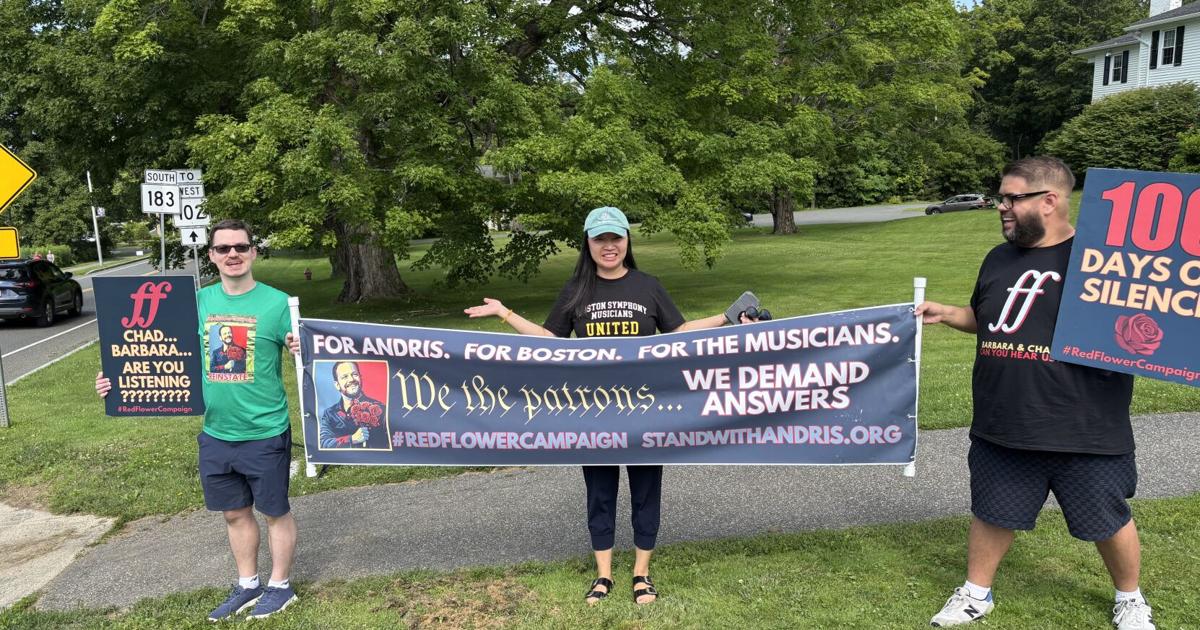
The Red Flower Campaign is visible throughout the Berkshires, with many orchestra members and audience members wearing floral buttons as a show of support for Nelsons. The buttons are being distributed at several South Berkshire businesses, including Elm Street Market, Sidetracks gift shop and Bizen Restaurant.
Organizers George Whiting and Quinn Mackenzie have rented a storefront at 6 Elm St. in Stockbridge for July to coordinate the effort.
On Saturday morning, campaign leaders staged a sign-waving demonstration at the intersection of Main and West streets in downtown Lenox. Drivers heading to an open rehearsal at the Koussevitzky Music Shed honked in support.
The BSO Patrons Network, formed in Boston in March, has collected more than 3,000 signatures on a petition seeking Nelsons’ reinstatement and helped organize the Red Flower Campaign.
Read the Original Article
This article was originally published by Berkshire Eagle. Click below to read the full article on their website.
Visit Berkshire Eagle