
At the BSO, musicians stage open revolt against the firing of Music Director Andris Nelsons
This story has been updated to clarify that the BSO has chosen not to renew Nelsons' contract.
When the Boston Symphony’s Music Director Andris Nelsons arrives at Symphony Hall on Tuesday to begin rehearsals for the final two weeks of the classical season, he’s likely to get a rousing solidarity standout from the orchestra players.
In his 13th year leading the BSO, Nelsons retains “honeymoon” devotion and support from the musicians — unlike some maestros who start wearing out their welcome in their second decade of leadership.
But without any involvement or advance notice to the 92-plus players, the board of trustees and President/CEO Chad Smith announced on March 6, late on a Friday afternoon, that Nelsons’ “evergreen” contract would not be renewed at the end of the 2027 Tanglewood season.
The news sent shock waves through the orchestra, especially since no specific reason was cited in the brief announcement other than that Nelsons was “not aligned” with the management’s “future vision.”
The conductor issued a statement assuring the orchestra that the rupture with the CEO and trustees was not what he wanted or anticipated.
The fallout is one of the greatest crises facing the BSO since it was founded in 1881, according to The New York Times.
Smith told The Times last Friday that the decision not to renew Nelsons' contract was not sudden.
“While this feels abrupt, and we sense the anger and frustration at the moment,” he told the Times, “this was a very deliberate process that the board went through and the decision was very deliberate.”
The board's decision was due to a lack of agreement on how to resolve serious challenges, "including a 40 percent decline in attendance over the past two decades, mounting deficits and a need to deal with $90 million worth of deferred maintenance at Symphony Hall and at Tanglewood," according to the Times.
Since the pandemic, overall attendance for orchestral programs at both venues remains down about 20 percent, according to published reports.
“We are, like many arts organizations, facing an inflection point where what has worked in the past is not working going forward,” Smith told the Times. “The decision that the board made to not renew was about focusing on looking ahead.”
The Eagle’s review of the nonprofit BSO’s most recent available tax records showed a net income loss of $6.6 million, based on nearly $124 million of expenses and $117 million of revenue for the fiscal year ending in August 2024.
Losses totaled $17.4 million the previous year, while, prior to the pandemic, losses and surpluses varied year by year going back to 2011.
But the orchestra’s endowment has been pegged at $536 million, likely the largest in its field.
The pushback from BSO musicians has been intense.
Boston Symphony violinist Tatiana Dimitriades, who joined the orchestra in 1987, wrote on Facebook that the decision not to renew “was a deliberate humiliation of the Music Director and a complete disrespect to the orchestra.”
Boston Symphony Music Director Andris Nelsons conducts the Tanglewood Music Center Orchestra of advanced young musicians in July 2024. The deposed maestro considered his work with Fellows of the BSO's summer academy one of his most important and rewarding priorities. His dismissal by the BSO trustees and President/CEO Chad Smith is effective at the end of the 2027 Tanglewood season.
Several players called the BSO action a “decapitation” of their maestro, who is considered one of the leading conductors in the U.S. and Europe. He’s also music director of the Leipzig Gewandhaus Orchestra in Germany and frequently guest conducts the Berlin Philharmonic and the Vienna Philharmonic, two of the world’s greatest orchestras.
It’s common for in-demand conductors to hold two major podium positions. Nelsons conducted the BSO for 16 weeks during the 2025-26 season, including four weeks at Tanglewood — as much if not more than the orchestra’s previous music directors.
Despite that, he was described as “spread too thin” and unable to attract large audiences to Symphony Hall during the subscription season, according to a trustee who spoke to The Eagle confidentially.
The leader of the Players Committee, double-bassist Todd Seeber, who joined the BSO in 1998, said he was “blindsided” by the abrupt and unheralded termination of Nelsons’ contract.
The symphony’s players delivered a blistering critical formal letter addressed to Barbara Hostetter, the philanthropist who heads the board of trustees, the board members and BSO leadership.
Citing “alarm about the course the organization is pursuing,” the letter obtained by The Eagle from a BSO insider declares that, “We know of no other instance in the modern classical music world in which a conductor of this stature, in the prime of his career, who is respected by the orchestra and admired by audiences worldwide while leading performances of exceptional distinction, is terminated without the voice of the orchestra being considered, sought or heard.”
The BSO musicians asserted that “this troubling unilateral artistic decision made by the Board effectively destroys both trust and confidence in the Board and Management. … That this decision occurred without any engagement with the musicians signals a complete disenfranchisement of the orchestra from the most critical artistic decisions. The musicians of the BSO are strongly opposed to the characterization that the orchestra and Maestro Nelsons were not aligned in vision.”
The players contend that the decision will discourage top-tier players from auditioning and will have “a chilling effect on the ability to attract a top-tier Music Director. We have great concern that we will lose our most devoted audiences.”
Citing “a deep dysfunction,” the musicians called for rebuilding trust and securing “a future in which the orchestra remains at the center of a cohesive, and sustainable organization. The Players are career stakeholders who want the BSO to succeed.”
A work-in-progress strategic plan for the orchestra’s future does not mention Nelsons nor the music director’s position, referring obliquely to “Conductors” as just one cohort in the forward-looking scenario.
A draft of the plan, released to The Eagle by a BSO source, lists enhancing connections between Tanglewood and Symphony Hall, positioning the Boston venue for restoration and revitalization as a year-round cultural hub “fostering inclusivity and broader engagement” while enhancing community connections and contemporary programming.
The plan also envisions building on orchestral excellence, celebrating diversity and innovation through artistry, deepening audience engagement and relevance, and elevating Tanglewood as “a center of creativity where artists connect with one another, with audiences and with enablers of innovation.”
According to the musicians’ letter citing longstanding concerns about the current strategic direction, the players did not vote to support the strategic plan.
Individual musicians have posted strongly worded protests.
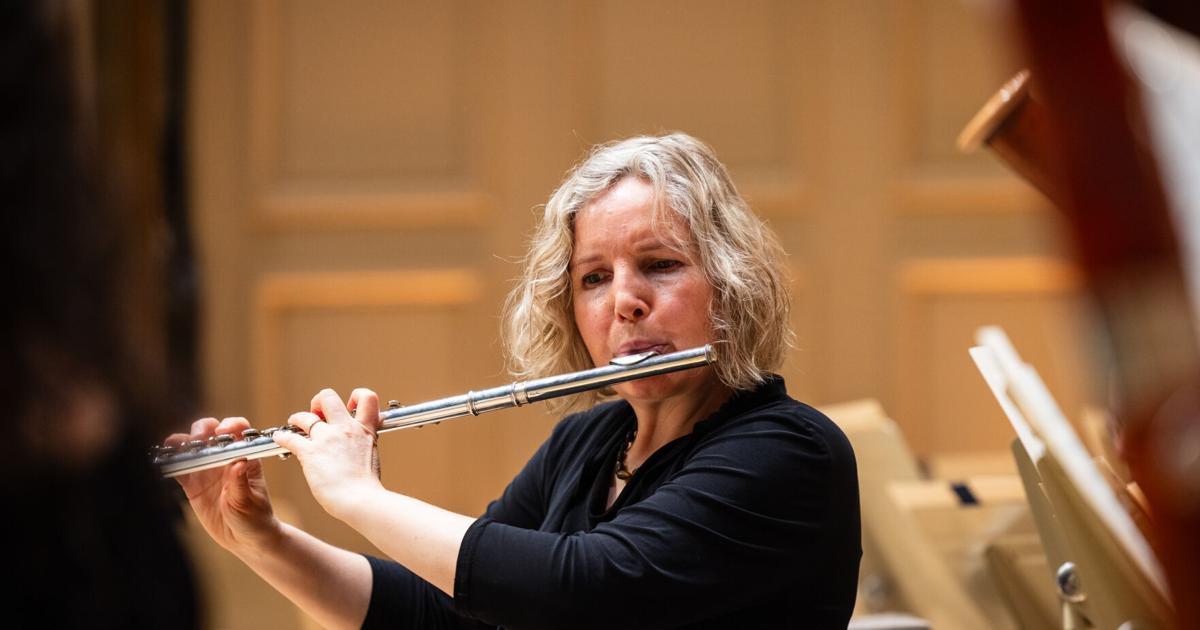
“I am devastated, heartbroken, angry and incredulous,” wrote Lorna McGhee, a key player as the recently hired principal flutist who made her Tanglewood debut last summer.
“To work with Andris is to work at the pinnacle of our profession,” she stated on Facebook. “He is one of the most sought-after, highly respected music directors the world over. He is the deepest, most humble, most sincere, truest musician I have ever worked with. Working with him at the BSO has been the artistic highlight of my life.”
McGhee said that “the decision not to renew Andris’ tenure is a form of artistic suicide. It represents the greatest squandering of artistic capital I have ever witnessed. I believe we are making a terrible mistake.”
Contending that Nelsons has been subjected to “very public humiliation,” she questioned her decision to come to the BSO and how long she should stay.
In a separate letter to the trustees, double-bassist Tom Van Dyck, who joined the BSO in 2013, warned that “the breakdown [of] trust that has resulted from this action is in all likelihood irreparable.”
Violist Michael Zaretsky, hired by the late music director Seiji Ozawa in 1973, wrote that “playing under the baton of Andris Nelsons for the past 13 years has easily been one of my greatest joys. An artist of his magnitude, warmth, musical acumen and pure commitment to artistic excellence stands out among active conductors of his generation.”
Zaretsky, an emigre from the former Soviet Union chosen by Leonard Bernstein to study at Tanglewood’s summer institute in 1973, declared that “the termination of Andris’s contract, when the bond between orchestra and conductor is undeniably at its highest, is nothing less than a complete erosion of the BSO’s traditions and values, as well as embarrassing and hurtful. At a time we should celebrate and elevate the contributions Maestro Nelsons has made to sustaining the BSO’s world-class reputation, we are instead left asking why he will not be leading the orchestra into its future.”
In what may be viewed as a significant harbinger of things to come at the BSO, Chad Smith, then the newly hired CEO, was quoted in the corporation’s 2023-24 annual report as stating: “Internally, change is hard, but change happens by making change. It’s going to take investment, and a lot of listening and experimenting. But now is when we have to take the big swings.”
Read the Original Article
This article was originally published by Berkshire Eagle. Click below to read the full article on their website.
Visit Berkshire Eagle