Berkshire County loses another dairy farm as independent producers struggle
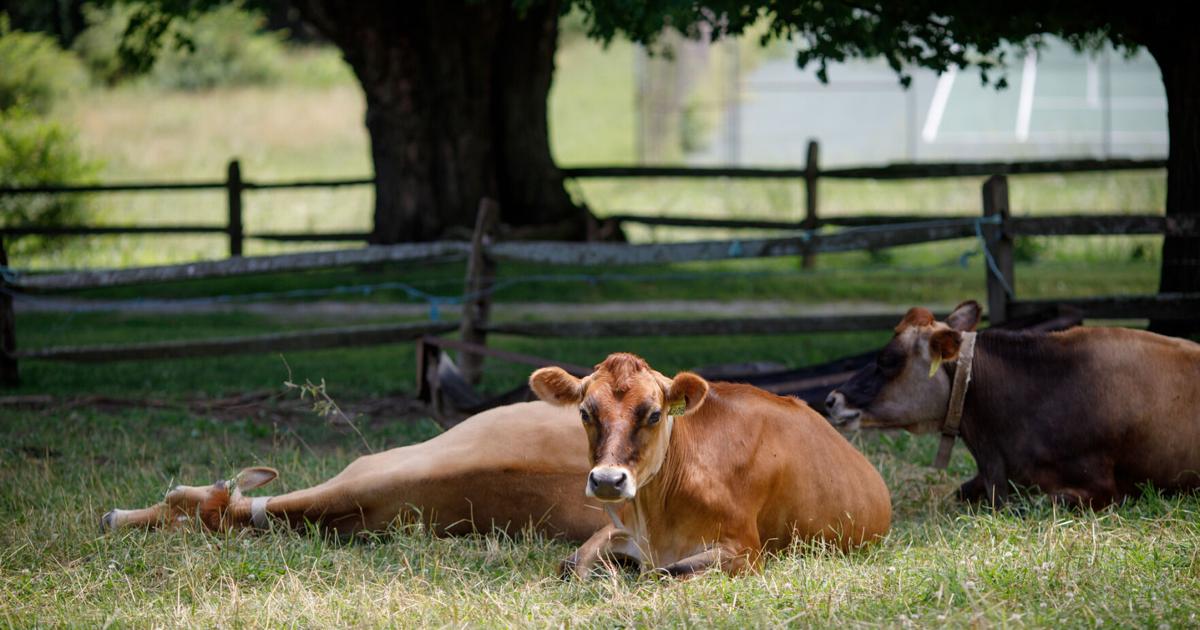
TYRINGHAM — After 48 years milking Jersey cows, Hav's Farm is the latest independent dairy farmer in Berkshire County to stop producing milk.
After losing Agri-Mark Cooperative as its milk distributor — which used the farm's milk in dairy products sold under the Cabot and McCadam brands — and facing the ongoing challenges of independent farming, farmer Fred Havrill said he is now looking to sell his dairy herd.
Fred Havill, 84, and his dog Daisy at his dairy farm, Hav’s Farm, in Tyringham. "When I moved into this area, there were over a hundred dairy farms shipping milk," said Havrill. "I'm the only one still left in town."
"When I moved into this area, there were over a hundred dairy farms shipping milk," said Havrill. "I'm the only one still left in town."
Havrill's decision reflects a broader decline in Berkshire County's dairy industry.
"There used to be four farms in town alone. Now there’s nothing in this area anymore," Havrill said. "That’s the trouble."
Sarah Gardner, a professor of environmental studies at Williams College, said there are around 10 dairy farms left in the Berkshires, not including Havrill's. One of those will also stop production by the end of the year, she said.
Despite their importance to the state economy, dairy farmers are being forced out by the financial realities of producing milk, Gardner said.
Many of the dairy farms that do survive are able to do so as a result of producing other, more profitable crops besides milk, said Paul Turner, who owns Turner Brothers Farm in South Egremont with his brother Bill and nephew, Darrell.
"We diversified," Paul said. "We sell a little hay, we're in the corn business. There's no way to make money on milk anyway."
Dairy farmers have little control over the price they receive for milk. Federal milk pricing formulas largely determine what processors pay producers, and Gardner said those economics are especially difficult in the Northeast.
Dairy farming maintains 113,600 acres of open space and land preservation in Massachusetts, according to state officials. But as farms shut down due to economic pressures, some worry what will happen to the land and the industry.
Farmland in the Northeast is the most expensive in the country, Gardner said, which results in smaller farms that can't benefit from the economies of scale that others elsewhere in the country can.
"The work farmers do is not appreciated enough," Gardner said. "It’s very serious to lose a farm, but it seems like we’re just letting them go."
Also, managing a farm in this climate, where weather is often unpredictable and prone to swings, presents a challenge of its own, she said.
"It doesn't often make economic sense to be a farmer here," Gardner said. "One mistake, one bit of bad luck, one big snowstorm that collapses the roof of your barn can put your farm right out of business.”
But the Turners keep at their milk-producing operation, with help from state tax credits for dairy farmers to keep the business viable.
"The credit keeps us going," Paul said.
The Turners also rely on automatic milking "robots" and a machine that cleans the barn unsupervised, like a Roomba, to reduce the workload of dairy operations, Bill said.
"If it weren't for the machines, we probably wouldn't still be milking cows," Darrell said.
A calf stands next to its mother in the barn at Hav’s Farm in Tyringham. Despite their importance to the state economy, many dairy farmers are being forced out by the financial realities of producing milk.
However, machines like the Turners' cost hundreds of thousands of dollars, making them a significant investment for most farmers. Havrill, who rents his farm, faces the added challenge of not being able to borrow money against his land to pay for upgrades.
Many farmers like Havrill who can't buy new machines are out of luck, Gardner said, a problem with far-reaching implications.
"This state is more self-sufficient for dairy than for any other food product," she said. "When we lose a dairy farm, we lose a big piece of our agricultural economy. And we become more reliant on importing dairy products from other states."
The farmers in Berkshire County and in the surrounding parts of New York and Connecticut who do hold out have a strong sense of the tradition of local farming, Bill said.
"Grandpa Turner came here sometime in the mid-1920s, and dad was born here in ’27," Bill said. "So, no matter what, we have figured out how to make things work here.”
Like the Turners, Havrill is committed to running his farm, even if he won't be producing milk. Havrill aims to start raising beef once he can sell his dairy herd, he said.
“Even if it’s not worth it, we’ve got to take care of the farm," Havrill said. "We’ve got to keep it."
Yet with the end of dairy production at Hav's Farm, the Tyringham landscape will lose Havrill's Jersey cows and Massachusetts will lose the economic stimulation they bring.
"It’s not just like some unfortunate farmer lost his herd," Gardner said. "This has a real impact — for the economy and for the Berkshires."
Read the Original Article
This article was originally published by Berkshire Eagle. Click below to read the full article on their website.
Visit Berkshire Eagle