
Berkshire urgent cares see surge in tick-related visits — and two cases of Alpha-gal syndrome
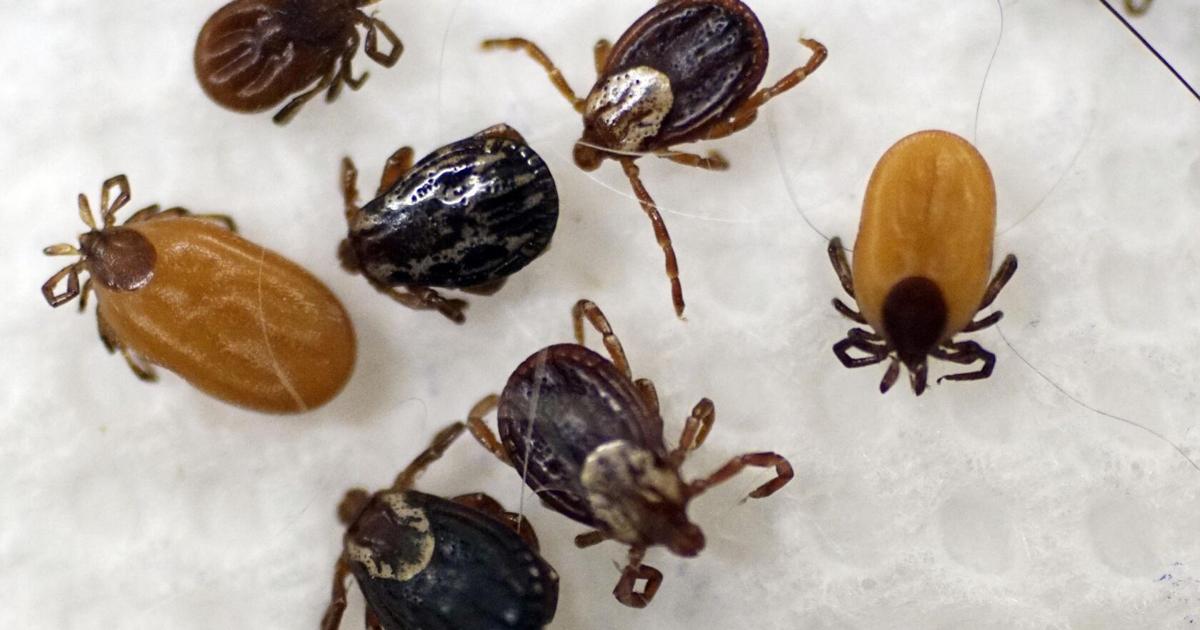
EGREMONT — As warmer weather returns to the Berkshires, local health officials and medical providers are seeing an increase in tick bites — including two cases of Alpha-gal syndrome.
“We’ve seen that even though we had a harsh winter, the ticks are out in abundance,” said Juliette Haas, director of the Egremont Board of Health director.
Berkshire Health Systems has reported an uptick in tick-related visits at all three of its urgent care centers across the county, a trend that mirrors increases being seen across the Northeast, according to Robert Shearer, administrative director of urgent care for BHS.
A close-up shows an adult female deer tick, a dog tick, and a Lone Star tick are shown in the palm of a person's hand. A bite by the Lone Star tick, more commonly found in Southern states, has resulted in at least one case of Alpha-gal syndrome in the Berkshires this season.
One of the two reported Alpha-gal syndrome cases involved an Egremont resident who was bitten by a Lone Star tick, a species more commonly found in Southern states and named for the star-shaped marking on the female tick’s back.
“We have not seen any outbreak or any real concern in the community, but it's always something that we want to watch out for,” Shearer said, emphasizing that it’s important to be aware of it.
Alpha-gal syndrome is a relatively new tick-borne condition in Massachusetts that can trigger allergic reactions to red meat and dairy products. Symptoms and severity can vary widely, according to the Massachusetts Department of Public Health.
“Thanks to climate change and warming winters, we're going to see these types of diseases travel north, so it's not necessarily only tick borne; it could be mosquito-borne,” Haas said. “We're seeing, because of warmer winters and warmer summers, we're seeing more chances for these tropical southern types of vector-borne diseases here up in Massachusetts.
According to Centers for Disease Control and Prevention data, emergency department visits related to tick bites in the Northeast reached 188 in April, up from 131 during the same month last year and the second-highest April total recorded since 2017.
Most tick bites do not require a trip to the emergency room, Shearer said. However, if someone cannot safely remove the entire tick, believes the tick was attached for more than 24 hours or is concerned about a tick-borne illness, urgent care is often a faster and more appropriate option.
“If you had a tick, and you removed it within 24 hours, the risk is very low, and probably does not require any treatment,” Shearer said. “If there's still part of the tick that's in, and/or it may have been 24 hours or more, we are recommending that you come into urgent care and we'll remove the tick; we'll do a little more detailed investigation.”
For those unsure whether they need medical attention, Shearer recommends calling the BHS nurse hotline, where staff can advise patients on tick-related concerns.
Though Alpha-gal syndrome can sound alarming, Haas noted that the condition remains rare and that not everyone bitten by a Lone Star tick develops the allergy.
The best defense, Shearer said, is preventing ticks from embedding in the first place. In addition to checking the body after spending time outdoors, he recommends placing clothing in a dryer on high heat for at least 10 minutes after coming inside.
“That will kill them, and they'll fall off your clothing, and you'll probably find them in the lint trap,” Shearer said. “It's a pretty easy way to manage them when you come in from a hike or a walk, or just outside in the grass.”
Shearer also cautioned against viral social media methods for removing ticks, saying some techniques can increase the risk of infection.
Instead, he recommends using a tick spoon, the same tool commonly used at BHS urgent care centers.
“We've bought boxes of hundreds of them, and when patients come in, we'll use the tick spoon to remove the tick and hand them the spoon and say, 'Take it home, keep it in your pocket,'” Shearer said. “That's a really great tool.”
Read the Original Article
This article was originally published by Berkshire Eagle. Click below to read the full article on their website.
Visit Berkshire Eagle