
Body cam, state police report detail October Hinsdale police forced entry, three months before Kauvil's death
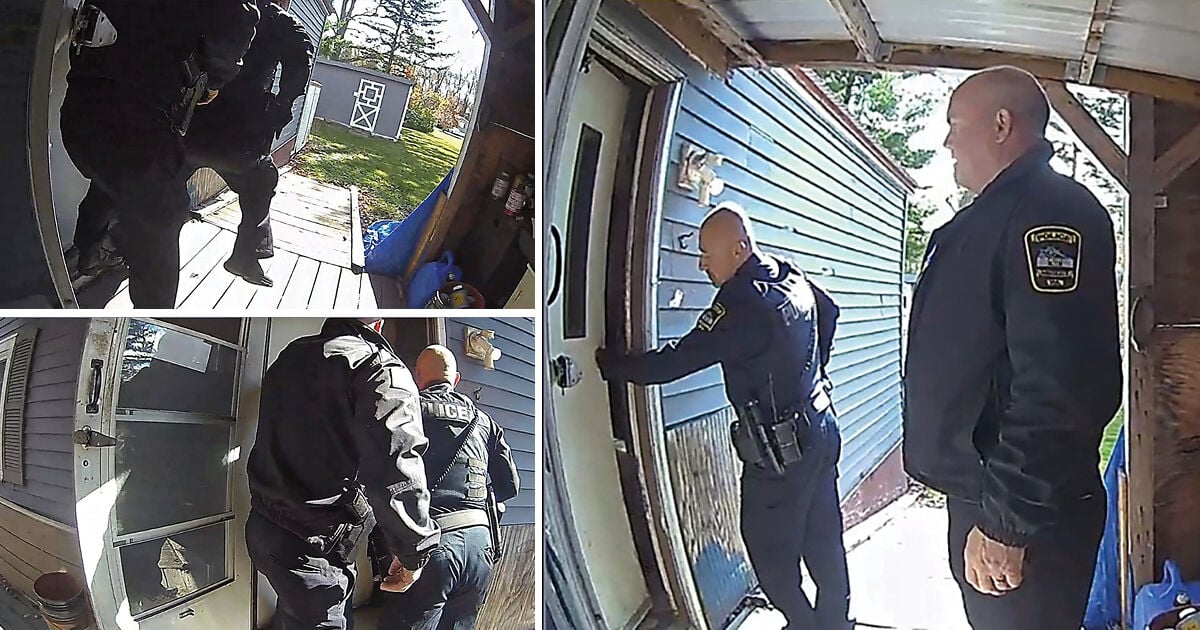
HINSDALE — Three months before Hinsdale Police forced entry into a bedroom where Biagio Kauvil had barricaded himself during a mental health crisis — an encounter that ended in the 27-year-old’s death — Police Chief Shawn Boyne and another officer forced open the front door of another home during a separate well-being check.
Within seconds, the man inside that home shot himself in the head.
Details of the Oct. 23, 2025, response — captured on a Dalton police officer’s body-worn camera and obtained by The Eagle — have emerged after Dalton Police Chief Deanna Strout suspended routine mutual aid to the Hinsdale Police Department last month, citing her concerns over Hinsdale's leadership and training that she said endangered officers and the public.
Dalton officers witnessed those problems on “multiple occasions,” Strout wrote in an April 14 letter to Hinsdale officials. Berkshire District Attorney Timothy Shugrue has separately raised concerns about how Hinsdale officers responded to Kauvil’s crisis.
Last October, Hinsdale officers responded to another high-stakes call, this one on Country Road at a mobile home where police had been called before.
By the time Hinsdale Police Officer David Tarjick and Hinsdale Police Chief Boyne pushed open the door on Oct. 23, court filings show the department had documented information that the man inside, James L. Luczynski, had been a high suicide risk and might have a weapon in the house.
In both cases — less than 2 miles and three months apart — Hinsdale officers had information that the person inside struggled with suicidal thoughts and may have had access to a firearm, yet forced entry before crisis negotiators or mental health specialists were in place.
A call came in to dispatch at 11:11 a.m. Oct. 23 from a probation officer who had gone to Luczynski's home to follow up on a possible violation. The probation officer called for police and the fire department because of a leaking fuel tank behind a residence at the Country Road Co-op Mobile Home Park, according to a Dalton police call log.
Tarjick and Boyne were on scene within minutes. At 11:30 a.m., state police were notified that Luczynski, 66, was “refusing to come out of residence,” and Dalton police were dispatched as backup.
Seconds after two door knocks and twice calling out, "Hinsdale Police," Hinsdale Police Officer David Tarjick is seen holding open the exterior door at 6 Country Road. Hinsdale Police Chief Shawn Boyne is seen standing behind Tarjick. These views are from the body cam of Dalton Police Officer Jacob Tiffany who, along with state troopers, responded in a mutual aid to the scene.
Dalton Police Officer Jacob Tiffany arrived at 12:03 p.m., his body-worn camera rolling.
On scene, John Lander, the chief probation officer of Pittsfield District Court, told officers that neighbors reported Luczynski “at one point” had a gun.
Fuel was leaking into the ground; Luczynski had drilled a hole in it and punctured two storage drums of kerosene, said Tom Reynolds, the president of the mobile home co-op where Luczynski lived.
About 225 gallons leaked into the ground, Reynolds said. On a tank, Luczynski wrote “F--- You Country Road A-------,” according to Reynolds.
According to the body camera footage, officials at the scene worried Luczynski would try to set the property on fire.
Tarjick told state police troopers that “we’ve been trying to get this guy for a while,” referring to James Luczynski.
Timothy Luczynski, James’ brother, estimated that Hinsdale officers had dealt with his brother “a minimum of 10 times” over the years.
Hinsdale officers had indeed responded to Luczynski's mobile home before, and the department had records stating that Luczynski was previously a serious suicide risk.
In April 2024, former Hinsdale Police Officer Jose Gonzalez was dispatched to the home, after Luczynski’s longtime partner called police claiming he had locked her in her room and that there was a shotgun in the house, according to a police report.
Gonzalez, who resigned from the force the following year, wrote that he had “dealt with” Luczynski on “several occasion[s]” before that response.
When he was booked that evening, Luczynski told Hinsdale officers he was suicidal, that he had a plan, and that he had “the means at home,” according to the report. Officers placed Luczynski on a Section 12 mental-health hold and admitted him to Berkshire Medical Center.
Timothy Luczynski told The Eagle that his brother James joined the U.S. Air Force at 19, serving almost four years as a diesel mechanic stationed in Arkansas. Afterward, he worked in construction, as a welder and a mechanic. He struggled with substance and alcohol use.
Reynolds, the co-op president, had known Luczynski as a neighbor for years. He described him as a skilled welder — a man who, he was told, could “weld rust to rust and make it hold.”
On his medications and sober, “you couldn’t ask for a nicer guy,” Reynolds said. Off them and drinking, Reynolds said Luczynski could be belligerent: “Where’s your meds? What are you doing? You’re scaring people.” Reynolds tried to bring him into the fold — inviting him to help with tasks on the grounds. Luczynski showed up on time and was sociable.
On Sept. 24 of last year, 17 months after his arrest, James Luczynski pleaded guilty to witness intimidation and permitting “abuse, neglect or mistreatment” on an elderly or disabled person. Police initially charged him with kidnapping, but prosecutors dismissed that case after his partner filed a written statement recanting, writing that she lied because she was “drunk and angry.”
Luczynski was sentenced to two years’ probation in Drug Court, a specialized court program that offers people with substance use disorders supervised treatment and recovery services as an alternative to incarceration.
Before his death, James Luczynski had told a cousin that he would kill himself before going back to jail, according to what his brother said he later learned.
On Oct. 9, officials filed a notice that Luczynski was in violation of his probation. A Drug Court hearing the following week was canceled because, the docket says, he was “not complying with court ordered treatment.”
Eight days after the canceled hearing, Hinsdale officers were at the door of his home.
Outside the home, Boyne asked Hinsdale Fire for bolt cutters to remove the padlock off the door.
Tarjick goes to push open the main door to gain entry into the home. Boyne stands by.
“I don’t know what kind of mental health state he’s in,” Tarjick told other officers at the scene.
Tarjick and Boyne approached the door, and Tarjick announced, “Hinsdale Police.” Tarjick and Boyne pushed open the door. A recliner had been positioned just inside, against the door.
Tarjick and Boyne then push open the door, which still doesn't open easily.
Within seconds, the officers rushed out of the doorway. A single gunshot sounds; Luczynski had turned the gun on himself.
Reynolds said he was talking with a firefighter when he heard a muffled sound he could not place. Moments later, he heard an officer yelling, “Get back, get back, get back,” after officers retreated from the porch.
Seconds later, Tarjick and Boyne force the door open to the point Tarjick almost fully enters. Then Tarjick suddenly jumps back, and then a gunshot is heard. from inside the residence, which prompts the officers to retreat, as seen in this image.
At 12:08 p.m., Hinsdale officers radioed dispatchers that shots had been fired, and called for an ambulance.
On the body camera, officers talked about how they weren’t sure whether Luczynski’s partner, who was in and out of hospice, was home.
Reynolds, who later went inside the trailer to help assess the damage, said he saw on a table a printout calculating how much black powder was needed for a given size of lead ball. He said everyone eventually learned Luczynski had been alone.
Investigators later found two firearms in the trailer — an unfired .44-caliber black-powder revolver and 16-gauge single-barrel shotgun containing one spent shell casing, according to a state police report of the incident.
Tiffany, whose body-worn camera was documenting the response, was directed to move his cruiser and move to the end of Country Road to block non-emergency traffic.
The Hinsdale Police Department does not equip its officers with body-worn cameras.
Tarjick and Boyne push open the door enough so that Tarjick sees the resident inside.
Peru Police Chief Bruce Cullett — who was later named acting chief of the Hinsdale department after Boyne was placed on administrative leave following Kauvil’s shooting — arrived and touched base with Tiffany.
About 20 minutes after the gunshot, Tiffany was cleared to leave the scene. He started driving back to Dalton, and stopped on the way to talk to another officer through his cruiser window.
“They’re having SRT come?” the other officer can be heard asking off camera.
He was referring to the Berkshire County Special Response Team, the regional SWAT unit that responds to high-risk incidents countywide, including those involving barricaded subjects, warrants and people in severe mental health crises.
“They should have had them come in the first place,” Tiffany replied.
It ultimately was a state police tactical unit, known as the STOP team, that arrived at 1:29 p.m., along with a crisis negotiator.
A drone unit confirmed at 3:20 p.m. that Luczynski was deceased. According to the report, members of the state police bomb squad arrived just after 5 p.m. and cleared a "suspicious device” that was taped on a table — a hairdryer with its handle sawed off and wires sticking out.
Luczynski's body was removed from the residence at 7:04 p.m., according to the state police report. Investigators closed Luczynski’s case on March 27, finding no foul play.
Reynolds estimated that as many as 30 officers responded that day after the gunshot, drawn from Dalton, Becket, the Berkshire County Sheriff’s Office and state police units.
Months later, Tiffany was among the Dalton officers who responded to Kauvil’s well-being check in Hinsdale. Tiffany resigned from the department and left policing entirely after that event, according to Strout, Dalton's police chief.
Strout said Tiffany had been with the force for about a year and a half and was well-regarded by colleagues.
Strout said Tiffany's departure "devastated" the department.
"We loved this kid," Strout said.
While Strout did not list any specific prior incidents in her April 14 mutual aid letter, she wrote that Dalton officers had witnessed problems within the Hinsdale department on “multiple occasions.”
Roughly three months after the Oct. 23 response on Country Road, Boyne authorized Hinsdale Sgt. Dominick Crupi, who was unarmed and off duty, to bust open the door to a bedroom inside of which Kauvil had locked himself during a mental health crisis.
Before doing so, Hinsdale had been alerted by the FBI that Kauvil, sleepless for days, had called the agency and reported distrust in local police. An FBI bulletin stated that Kauvil thought officers were following him, and were trying to lure him toward a machine that induced suicidal thoughts.
Kauvil was holding a handgun, which discharged as officers tried to subdue him, striking Crupi’s hand and Boyne’s bulletproof vest. Officer Jeffrey Spratt shot Kauvil, killing him. An investigation by state police assigned to the office of Berkshire District Attorney Timothy Shugrue found Spratt acted in lawful self defense.
Boyne was interviewed during that investigation, and said that family told him Kauvil had a license to carry a firearm, but that they didn’t think he had a weapon, according to a transcript of his post-incident interview with state police.
Dalton Police Officer Chelsea Eichstedt, another backup officer on the call, told state police separately that she’d raised the possibility with Boyne that Kauvil might be armed.
“When they were all leaving, [Kauvil’s] mom looked at me and said, ‘He has an [License to Carry],’” she said, according to a transcript of her interview. “So I looked at Boyne and I said, ‘Hey, he might have a gun. Just like, so you know, he has an LTC.’”
Chief Boyne declined to comment when reached by The Eagle. Officer Tarjick did not return a voicemail seeking comment Thursday. A spokesperson for the Massachusetts Probation Service said the agency “does not have anything to add to your story regarding this matter.”
Reflecting on his brother’s death Thursday, Timothy Luczynski said James’ case was another that involved mental health. He said police knew that James “had problems,” and he wondered whether things could have ended differently.
In subsequent messages Friday, he said "my brother had a premeditated plan to kill himself if the police came to bring him back to jail."
"I'm not sure that there was anything that was going to change that plan, regardless of who or how they approached the trailer," he wrote.
“The only good part is, he doesn’t wake up sick today,” Timothy said on Thursday.
Read the Original Article
This article was originally published by Berkshire Eagle. Click below to read the full article on their website.
Visit Berkshire Eagle