
BRTA may restore proposed route cuts by summer as hiring ramps up
NORTH ADAMS — With a new operator and recruitment team in place, proposed route cuts at the Berkshire Regional Transit Authority could be reversed as soon as this summer, officials said.
But in the meantime, Northern Berkshire residents may see new micro-transit options roll out to help get them to where they need to go.
BRTA Administrator Kathleen Lambert spoke to the city's Public Services Committee on Monday about how public feedback has changed some of the agency's proposed cuts, which would reduce service from Pittsfield to North Adams and circulator routes in both cities. The cuts were proposed as a short-term solution to BRTA’s driver shortage — only 25 drivers are available to service 36 weekday runs.
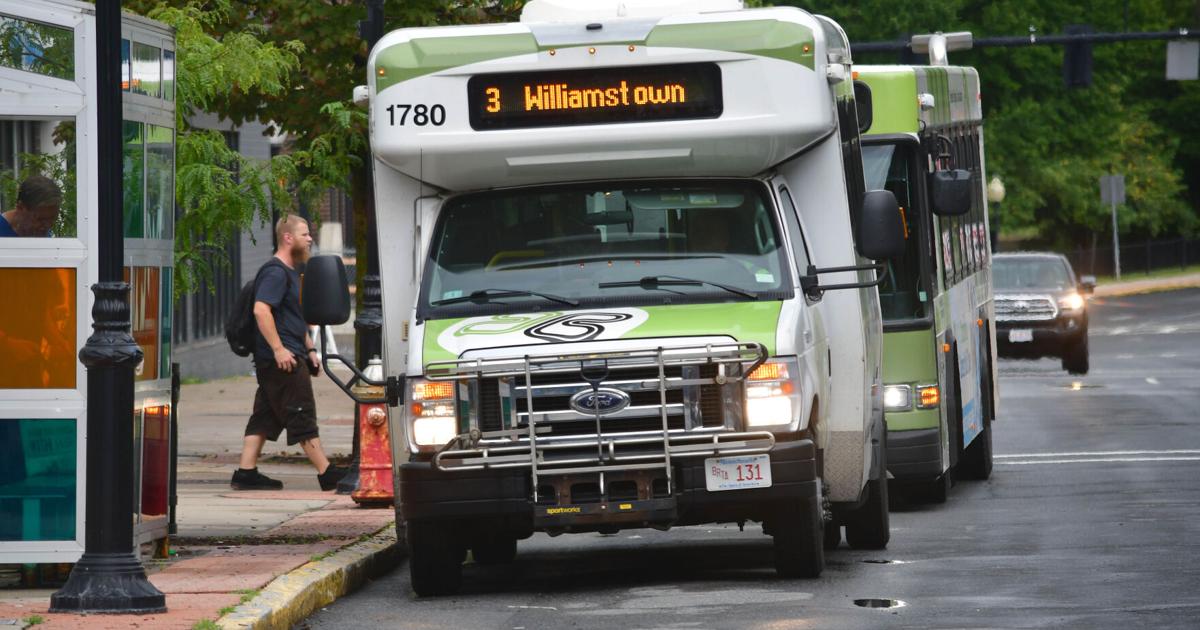
En route to North Adams, a BRTA bus approaches a North Street bus stop in Pittsfield. Proposed cuts by the BRTA would reduce service from Pittsfield to North Adams and circulator routes in both cities.
Earlier this year, BRTA proposed cutting weekday service in half on two of its busiest routes — Route 1 (Pittsfield–North Adams) and Route 2 (Pittsfield–Lee) — and reducing evening service on others, including Route 11 (Berkshire Community College) and Route 15 (West Pittsfield–Lebanon Avenue). The plan also proposed a new Route 999, an “express” line connecting major destinations in North Adams, Pittsfield and Great Barrington.
The proposed cuts have drawn concern from riders, including Brisby Stinson, who said a temporary reduction could undermine confidence in the system.
“Public transportation needs to be seen as not just an alternative, but a viable alternative to driving,” he said during the meeting. “If we’re not careful, we can end up cutting services in such a way it reduces faith in the transportation system, which would lead to further cuts in the future.”
Berkshire Regional Transit Authority Administrator Kathleen Lambert explained proposed route cuts to the North Adams Public Services Committee meeting on Monday.
In early March, the authority’s advisory board postponed a vote on the changes, citing concerns that more feedback and discussion with riders was needed. The board is expected to revisit the issue at its March 26 meeting, with public comments accepted through Saturday.
“Ridership after 7:30 p.m. every day, we run one person or less than one person,” Lambert said. “We’re hoping the evening trip isn't going to affect a lot of people.”
Lambert said the transit agency had planned to reduce evening service for Route 11, which services Berkshire Community College, but after hearing that students use the bus during that time often, "it won't be trimmed at all."
Similarly, circulator Route 34 in North Adams is now proposed to end early at 8:15 p.m. but make its last stop at Williams College as Route 3 after feedback that kitchen staff rely on that service back down south.
Route 12 in Pittsfield, which reverses direction in the evening, will now operate in one direction all day because there are not enough operators to run the reverse route.
Lambert said the authority recently signed with a new operations company, Keolis, which also operates the MBTA Commuter Rail, and officially takes over July 1.
“But they are already on the ground,” said Lambert, and Keolis has its own recruiting team that promises to have a “full complement of bus drivers by July."
When some asked how long the route reductions would go on, Lambert said BRTA needed 10 more drivers and it would reinstate the normal route service as drivers are hired.
“As soon as we have the drivers, [Routes] 1 and 2 go back to hourly,” she said. “The money is there to hire the drivers. We're fully funded.”
Lambert said the authority has struggled to retain drivers for years, some leaving for as little as 50-cent higher pay elsewhere.
“Right now our drivers may not earn the top cash money [in the region], but if you include all the benefits and vacation, it's $38 an hour, which I don't think is too shabby," she said.
When Lambert said that BRTA covers the cost of commercial driver’s license training — which can cost between $5,500 and $7,500 — City Council President Ashley Shade suggested that be advertised more prominently.
Lambert said she realized this was an “emergency situation," and that she gets calls and messages every day from concerned residents.
“It's not OK in my book and not OK for you folks,” she said. “We’re working at this from all angles.”
As a short-term fix, BRTA is also rolling out smaller, flexible shuttle service.
To help with the driver shortage, Lambert said BRTA is introducing a new position, the community shuttle driver, as part of a “precursor” to more micro-transit work the agency plans to introduce in the future.
Routes 11 to Berkshire Community College and 15 from West Pittsfield to Lebanon Avenue would run 15-passenger wheelchair-accessible buses as “deviated fixed routes” that can detour to pick up riders who request a ride. The 11 would turn around and become the 15, and vice versa.
“If we need to pick somebody up in a neighborhood, or we need to go up to Hillcrest … Or there's a pile of people waiting at BCC that are just getting out of class, then the bus can turn around and go get them and bring them in, instead of just doing that run all day,” Lambert said.
She added that the approach could make service more efficient in areas with lower ridership and eventually people will be able to request pickups from these routes on their phones.
Additionally, that shuttle bus does not require a commercial driver's license, Lambert said, and can “fill in on trips that are being missed on the 1 and 2 [routes]."
“If we need an extra bus on Route 2, we'll send out the shuttle if we don't have a driver.”
Lambert also told the committee that the BRTA expects to continue offering fare-free service for the next fiscal year if the governor’s proposed budget is approved.
Read the Original Article
This article was originally published by Berkshire Eagle. Click below to read the full article on their website.
Visit Berkshire Eagle