
Can tiny wasps save Berkshire ash trees? Researchers hope to slow the emerald ash borer
GREAT BARRINGTON — Within the mixed hardwood forest, the three ash trees at Three Mile Hill were instantly recognizable by the thin band of safety orange tape girdling them at eye level.
On closer inspection, they had unusual trappings: a metal eye-ring and wire attached to a 6-inch section of a branch set atop a pint-sized plastic container with water and plant food.
Doug Brown at Berkshire Natural Resources Council is devoting time to research a parasitoid wasp that targets larvae of the emerald ash borer.
These ash bolts were deliberately infested with emerald ash borer larvae by none other than the U.S. Department of Agriculture.
The government agency is studying what happens when tiny wasps from Central Asia are introduced to the area in an effort to control the emerald ash borer, the invasive that is decimating ash forests in 37 states, including Massachusetts, and six Canadian provinces.
Ash forests have been decimated by the tiny emerald ash borer. The green insect literally gets under the skin of trees to lay its eggs, depriving the trees of water and nutrients.
Migrating by cargo ship, the emerald ash borer was first seen in Michigan in the late 1990s. Its first sighting in Massachusetts was in Dalton in 2012 and is now in 11 counties in the commonwealth, but the Berkshires has been hit particularly hard.
It continues to spread.
Doug Brown points out the site of a study Berkshire Natural Resources is participating in regarding the emerald ash borer at Three Mile Hill in Great Barrington.
Three Mile Hill is one of Berkshire Natural Resources Council’s holdings. The land trust owns close to 14,000 acres, making it Berkshire County’s largest private-land holder. Its participation in basic research is a first step toward monitoring and perhaps preserving the ash on the landscape — before it’s too late.
On a recent Monday, Doug Brown, director of stewardship at Berkshire Natural Resources Council, donned boots to hit the trail through the state-owned Fountain Pond State Park and into the neighboring woods, then bushwhacked to the site where four weeks ago he set out the bolts.
Later, he headed to the Thomas & Palmer Brook Reserve to pull three more bolts off trees there.
The hope was that these bolts would attract those parasitoid wasps that were released in the Berkshires in 2017 in an attempt to control the emerald ash borer.
“They are studying to find out if that parasitoid wasp is still operating in the landscape,” Brown said. “Has it successfully become part of the ecosystem here?”
The emerald ash borer leaves a distinct trail: a D-shaped exit hole from its host.
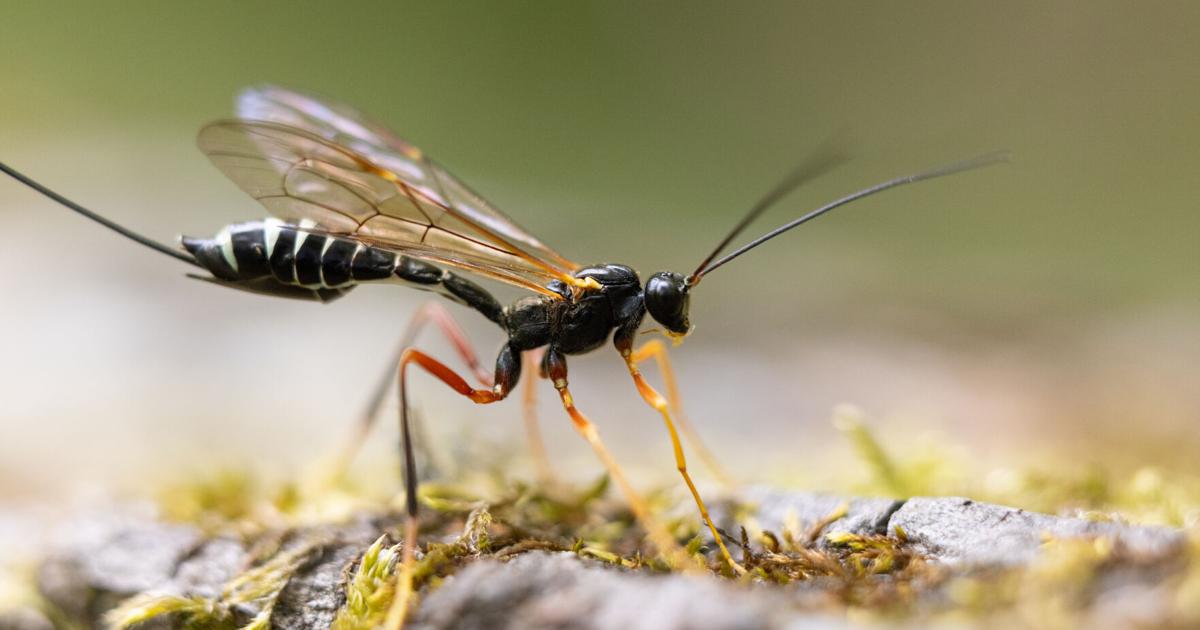
These wasps don’t have stingers, but they do have long ovipositors — tube-like organs used by female insects to deposit eggs — that people sometimes mistake for stingers. They sniff out emerald ash borer larvae under the bark of the ash and then lay their eggs inside the larvae of the iridescent beetle. When this occurs, the emerald ash borer doesn’t live to maturity.
“Currently, emerald ash borer does not have any natural controls on its population dynamic because it’s an invasive species,” Brown said. “So that was a first go of seeing, could this do the work?”
Before he removed the bolts, Brown recorded data about each tree, including its size and the health of its crown.
He also noted signs of stress, specifically blonding, the term for bark peeled away by woodpeckers; tiny branches coming out of the stem known as epicormic sprout; and the signature trademark of the emerald ash borer — D-shaped holes in the tree's interwoven bark.
Doug Brown at Berkshire Natural Resources Council is participating in research on a parasitoid wasp that targets larvae of the emerald ash borer.
“These collectively can say whether there’s emerald ash borer here,” Brown said. “[In] all three of the trees that I selected for the samples here, I didn’t find any evidence of ash borer, none of those characteristic exit holes.”
The next day, University of Maryland faculty research assistant Leah W. Estes received the bolts that Brown collected.
The USDA has infested bolts of ash with emerald ash borer larvae to study whether parasitoid wasps that were released in 2017 are effective at controlling the ash borer.
They were bound for an incubator of sorts, a growth chamber set at 65 percent humidity and 70 degrees. There, they will sit in floral foam inside deli cups for four weeks.
Leah W. Estes at the University of Maryland dissects ash bolts to determine whether wasps introduced to control the emerald ash borer are still alive and at work.
“They’ll develop in the (emerald ash borer) larvae under the bark, and then they will basically chew their way out and emerge as an adult,” Estes said. “We can still see signs of parasitoids (wasps), even if we don’t rear adults from the logs.”
After four weeks, Estes will dissect the bolts.
“I use a box cutter and cutting gloves, and we very carefully peel the bark back,” she said.
It’s too early to say how effective the release of the wasps has been, Estes said.
“I will say that we were getting parasitoids from these logs last year,” she said.
In studying the Berkshire Natural Resources Council’s largest holding in Monterey and Tyringham, Konkapot Reserve, a survey found a stand of ash on the edge of Steadman Pond that appeared to be healthy.
Last week, the Berkshire Natural Resources Council invited two researchers to view that stand of ash to see if trees there might qualify for treatment with emamectin benzoate, an insecticide that targets the emerald ash borer.
“People are seeing that there is some percentage of ash that aren’t impacted, and we don’t really know the why,” Brown said. “What’s likely to come from that is the creation of a number of long-term plots to monitor the health of those trees and treating a handful of those trees, particularly the female ash trees.”
One of the researchers was Paul Catanzaro at the University of Massachusetts, who is both a professor in the forest ecology and conservation program as well as the state extension forester. He also co-directs the Family Forest Research Center, a partnership between the USDA Forest Service and UMass.
Catanzaro was one of two invited speakers at a Berkshire Natural Resources Council event for landowners called “Forests Close to Home” at the Greylock Glen Outdoor Center in Adams on June 24.
There he spoke about ecological forestry, which has a goal of creating diversity and resiliency on the landscape by sustaining all parts of a forest’s natural succession through a variety of techniques, including cutting and control of invasives.
In his talk, Catanzaro stressed the need for partnerships among land owners in preserving the landscape.
“The Berkshires, of course, are a wonderful place to do this, because in Massachusetts it's the highest density of ash, because of these beautiful, rich soils,” he told The Eagle. “With one preservation patch of ash on BNRC land, it provides a foothold or a foundation for us to reach out to other landowners, both public and private, within that landscape.”
Ash trees are home to 98 insects, and without them, it's hard to know how the forest will change, but it will change.
David Orwig, forest ecologist at Harvard Forest in Petersham, was the other researcher on that walk in Monterey.
Orwig has been watching the dynamics of insects and disease on forests for his entire 31-year career. He’s already mapped the loss of the hemlock by the woolly adelgid, which has progressed slower than he anticipated.
The emerald ash borer has been far more efficient. Orwig has seen ash stands in Dalton and at Harvard Forest that have lost more than 90 percent of their ash in a decade.
“The vast majority of the western part of the state has lost a ton of ash,” he said. “We're losing our opportunity to protect the remaining ash, so now it's a good chance to go into some of these areas where they still have the ash and try to treat them chemically and try to preserve some genetic diversity.”
Brown hopes that Berkshire Natural Resources Council will lead the way at the 1,728-acre Konkapot Reserve.
"We just took the first step last week," he said, "If we can keep a pocket of ash on that property and provide access to our research colleagues to study, that's a pocket of hope."
Read the Original Article
This article was originally published by Berkshire Eagle. Click below to read the full article on their website.
Visit Berkshire Eagle