
Cheshire is tightening its pay-as-you-throw program. Here's how
CHESHIRE — Corey McGrath wants you to separate your trash.
While Cheshire has adopted a “pay as you throw” system based on volume, the 600 permit holders are still heaving a large volume into the 30-cubic-yard roll-off that eventually heads to the Clinton County landfill in Morrisonville, N.Y.
Now the Department of Public Works director hopes that will change.
“The numbers are just out of whack,” McGrath said. “It’s not a true pay as you throw.”
He’s tightening up the system as of July 1. With Board of Health backing, Cheshire is moving away from dedicated blue bags, which add weight and might actually discourage residents from separating trash, in favor of orange stickers.
Corey McGrath, Cheshire's Department of Public Works director, says the numbers for the town's transfer station are "out of whack."
The annual permit to use the transfer station will go up from $125 to $150 as of July 1. The stickers will cost $1 and be good for bags holding up to 15 gallons. People using 33-gallon bags will need two stickers — unless they’re using a blue bag, which will count for one.
“Now you are responsible for your own trash,” McGrath said.
Cheshire used to subsidize all costs of running its transfer station. In the current fiscal year, the budget is $143,194, with a $37,104 subsidy. As of July 1, the transfer station will be self-supporting with an annual budget of $148,890.
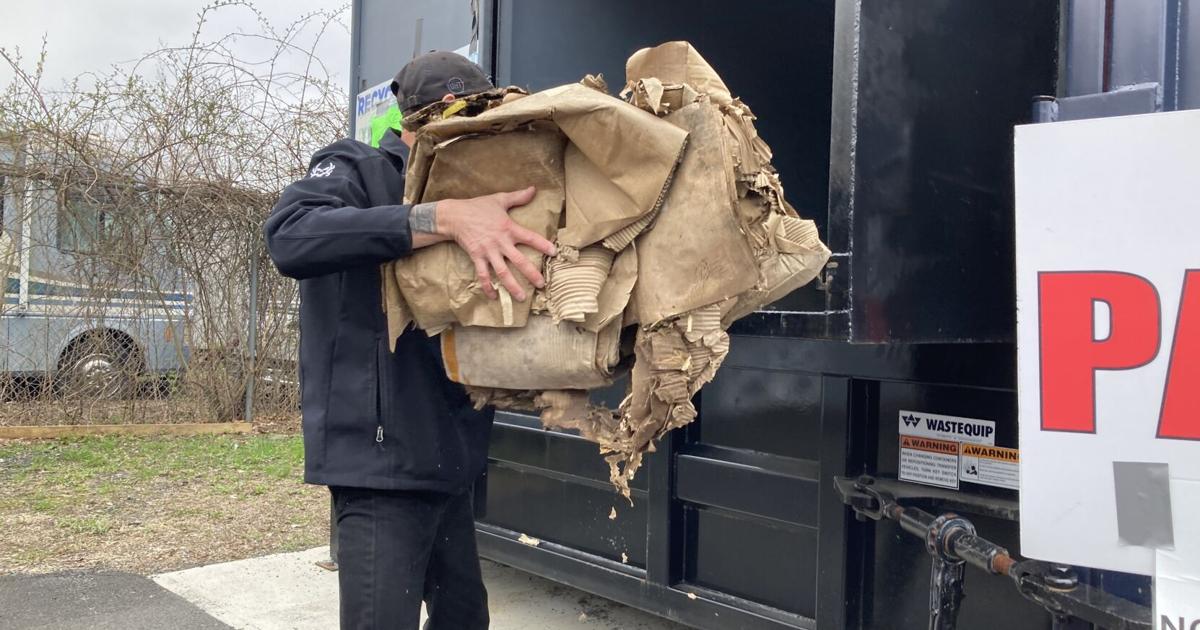
Jason Davis recycles cardboard at the Cheshire transfer station.
Northern Berkshire Solid Waste District's contamination rate for recycling is just 5 percent. Black plastic is not allowed.
In 2024, Cheshire residents threw out 377 tons of trash. In 2025, that amount was 346 tons.
Here’s a more recent statistic that McGrath prepared: 36 tons.
That’s the amount of trash Cheshire residents tossed into the bin in January, or an average of 120 pounds per household.
By comparison, with 1,043 permit holders, Williamstown’s total trash haul was just over 15 tons in January. The average household there threw out less than 29 pounds.
Dalton's average household trash in the same month was 76 pounds. Adams' was 52.
In recent years, the state DEP has been basing grant awards on the performance of pay-as-you-throw programs. In 2024 and 2025, Cheshire hasn’t measured up and its awards decreased from a high in 2023 of $5,250 to $4,900 and $3,960 the following years.
“Honestly, I think that a lot of items that are going into the trash could be diverted to either our dual service recycling, or to demolition, or to our other programs,” said Linda Cernik, director of Northern Berkshire Solid Waste District, of which Cheshire is a member. “I think the bags are overloaded.”
Linda Cernik, director of Northern Berkshire Solid Waste District, and Corey McGrath, Department of Public Works director in Cheshire, both believe Cheshire residents can divert more from the local waste stream.
Cernik pointed out that removing food waste from trash could reduce waste by as much as 25 percent.
Composting appears to be catching on, but slowly.
In 2025, residents diverted 4.5 tons. This year, some will come back as compost in a pile at the transfer station for residents to take home.
Mike Clarke of Cheshire says he doesn't mind separating food waste from household trash.
In 2025, Cheshire got a $20,000 cardboard compactor using Recycling Dividends Program grant funds from DEP, with the town responsible for $6,000 for a concrete pad and electrical components.
That’s expected to pay for itself quickly, both by saving on hauling and by sending 5.6 tons of paper out at a time rather than just 2 tons. In addition, it adds safety and saves an attendant’s time and energy.
“There weren’t eyes on what was being dumped,” McGrath said. “So that was one of the big things that made me want to get this.”
This year, McGrath installed a $10,000 catwalk next to the recycling bins. Money for that also came from the Recycling Dividends Program grant.
Residents will soon find a new divided shed that will hold universal waste, compost and returnable bottles and cans.
Finally, with a $6,000 Sustainable Materials Recovery grant through DEP, Cheshire will soon be getting a swap shop.
“It’ll be like a little shopping mall for free,” McGrath said. “Take something. Leave something. It’s a benefit because it’ll keep it out of the waste stream.”
Read the Original Article
This article was originally published by Berkshire Eagle. Click below to read the full article on their website.
Visit Berkshire Eagle