
Declarations of Independence: From Stockbridge to Pittsfield, July Fourth became a stage for liberty’s hard truths
There is no shortage of reasons to celebrate the United States of America’s 250th birthday. It’s not hard to find something that makes you happy or proud to be an American.
For some Berkshire men and women, though, Independence Day was about much more than parades, fireworks and barbecues (wonderful as they are).
Arguably just as patriotic as the founders, they felt patriotism means loving America enough to dare it to fulfill its founding ideals.
Those principles, enshrined in the Declaration of Independence, adopted on July 4, 1776, will always be revolutionary. That document is not just yellow parchment; it’s a siren call to action.
Sadly, the truths that “all men are created equal” and “are endowed by their Creator with certain unalienable Rights” — among them, “Life, Liberty and the pursuit of Happiness” — are not self-evident. Nor are they self-enforcing.
Americans inheriting the Revolution before its centennial often seized the Fourth of July to declare their independence. They knew its values became true only to the extent that Americans and their institutions honored them. When they believed their government, established “to secure these rights,” and deriving its “just powers from the consent of the governed,” did not honor those ends, they practiced “the Right of the People to alter or to abolish it.”
Protesting on July 4 may be as quintessentially American as the parades and pageantry that surround the holiday.
Barnabas Bidwell, born in 1763 at Monterey, knew “the cause of America” was “in a great measure the cause of all mankind.”
Twenty years after Thomas Paine penned those immortal words, Bidwell delivered a Fourth of July oration at Stockbridge. The French Revolution, though imperfect, validated Americans’ example of “rational liberty and elective representative government” — so much that British and Russian monarchs were attacking France.
Most people, Bidwell confessed, were “bound in hopeless slavery.”
“The hardy Russian” could be conscripted by the tsar, at any moment, compelled to “bid adieu to his beloved family, and be sacrificed, he knows not why,” or be “banished for life.” How could anyone pursue happiness, asked Bidwell, when it depended on “the passion, the prejudice” and “caprice” of a “royal swindler” intoxicated by “absolute power”?
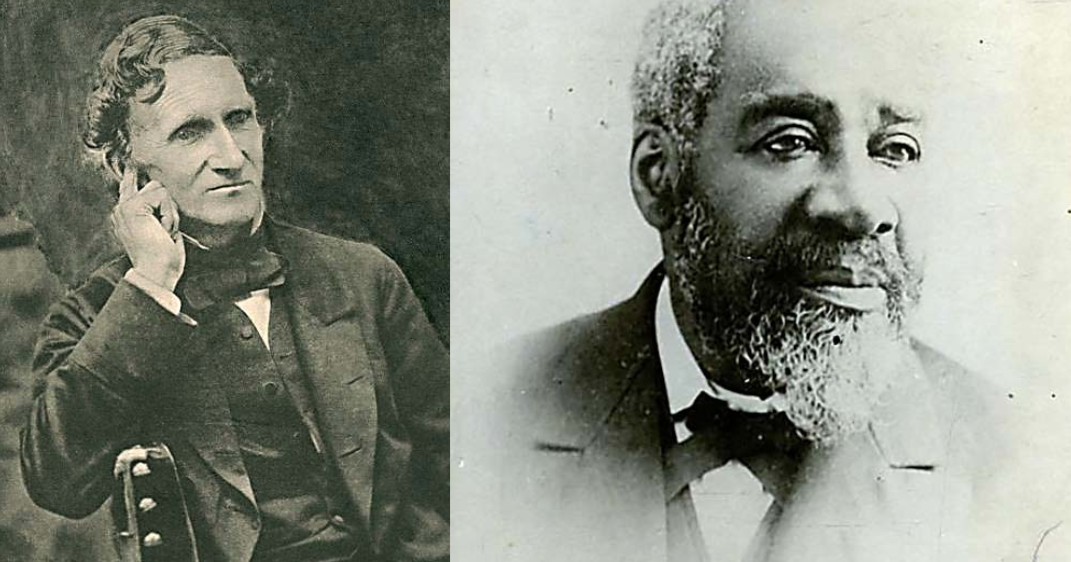
Barnabas Bidwell, a lawyer, statesman and early American orator who delivered influential Fourth of July addresses and later served in Congress and the Massachusetts state government in the early 19th century.
Taught nothing “but implicit obedience, no moral obligation except … command,” Russian soldiers “formed into the machinery of modern discipline,” “governed by the whip.” They never questioned “whether the war they are engaged in is just.” They lacked “even the wretched privilege of complaining” about “the honor of shedding their blood.”
“For what? To defend their personal liberties and rights? … They have none to defend,” answered Bidwell.
Bidwell, perhaps facing Stockbridge’s Agrippa Hull, alluded to his friend Gen. Tadeusz Kościuszko’s desperation to free his country from Russian, Prussian and Austrian domination. Poland was “bleeding at every vein, her strength exhausted” and “her spirits crushed beneath the iron rod of oppression.” Her “liberties” laid “prostrate in the dust, her cities pillaged, her territories partitioned, and her peasants bought and sold, like cattle.”
Tyranny always lurked in liberty’s homeland. By 1803, Pittsfield’s the Rev. Thomas Allen felt reassured by Thomas Jefferson’s presidency.
Still, during his Fourth of July speech that year, Allen warned Americans must “know our rights and liberties” if they wished to “preserve” them.
The Constitution, Allen cautioned, instituted a government for the “protection, safety, prosperity, and happiness” of “the People” — not “the profit, honor, or private interest of any one man, family, or class of men.”
The Berkshires’ pulpit patriot rejected “the infallibility” of any elected man. Allen was “accountable for his conduct” just “as much as others.”
Lest liberty’s crusade spill blood endlessly, some Berkshire Christians demanded peace.
At New Marlborough on July 5, 1813, during a second conflict with Great Britain, deeply unpopular in New England, the Rev. Jacob Catlin preached on “the horrors of war.” An “inevitable tendency of war and conquest” — “the rage of the present day,” he noted — was “to transfer power to a single man.”
“War,” warned Catlin, was “the highway to despotism.”
New Marlborough’s Elihu Burritt, the “Learned Blacksmith” lauded poetically by Henry Wadsworth Longfellow, was a pro-temperance pacifist. Like many Yankees, Burritt in the late 1840s opposed a war against Mexico that southerners instigated to expand slavery westward. The United States welcomed Texas and annexed a third of Mexico’s republic.
Elihu Burritt, the abolitionist and pacifist known as the “Learned Blacksmith,” who used his writings and lectures to promote peace and social reform in the 19th century.
Burritt published an 1848 editorial, “The Fourth of July,” inviting the reader to imagine a parading soldier, carrying a flagstaff topped by a “sleepy eagle.” The noble bird cried it would fly if “not for these cannons, anchors, and arrows in my talons,” weighing down “outstretched wings.” Burritt declared “a cold water army,” armed with “pitchers of God’s best beverage,” could vanquish any “hostile” foe.
The struggle to abolish slavery generated America’s most stirring July 4 protest. At Rochester, N.Y., in 1852, Frederick Douglass, who had escaped enslavement, 19th-century America’s most accomplished orator, asked his audience to consider the holiday’s meaning for the enslaved.
Independence Day, he objected, “reveals to him, more than all other days in the year, the gross injustice and cruelty to which he is the constant victim.”
To the slave, “your celebration is a sham; your boasted liberty, an unholy license; your national greatness, swelling vanity; your sounds of rejoicing are empty and heartless; your denunciations of tyrants, brass fronted impudence; your shouts of liberty and equality, hollow mockery; your prayers and hymns … mere bombast, fraud, deception, impiety, and hypocrisy — a thin veil to cover up crimes which would disgrace a nation of savages.”
Nearby, two Fourth of Julys later, the leader of a nation disregarded as savages, driven from the Berkshires, adopted Douglass’s scathing tenor. At Reidsville, near Albany, N.Y. — the ancestral homeland of his Mohican people — John W. Quinney addressed 2,000 people.
It seemed strange, Quinney remarked, to commemorate “the free birth of this giant nation.” Its people had conquered, occupied and “usurped the possession of the territories of my fathers” — inflicting a “train of terrible miseries” that would end only “when my race shall have ceased to exist.” Independence Day, for Quinney, marked the “transfer of the miserable weakness and dependance [sic] of my race from one great power to another.”
“The spot on which we stand,” Quinney noted, had “never been purchased or rightly obtained” by Dutch landlords or English settlers. “By justice, human and divine,” it was still “property” of “the remnant of that great people from whom I am descended.” Forced to leave by the “tortures of starvation,” they never ceded the land; “their title” had “never been extinguished.”
“To legalize and confirm titles thus acquired,” narrated Quinney, “laws and edicts were subsequently passed,” which Americans called “justice!”
“What a mockery to confound justice with law!” “Look steadily at the intrigues, bargains, corruption and log-rolling of your present Legislatures,” he enjoined listeners. Did they “see any trace of the divinity of justice?”
“Your holy book,” Quinney observed, taught “that individual offences are punished,” “when time shall be no more.” “The annals of the earth,” on the other hand, implied “that national wrongs” were “avenged, and national crimes atoned for in this world.”
The crime of slavery cost Americans dearly between 1861 and 1865, killing 700,000.
The Rev. Samuel Harrison intimately knew the price of freeing 4 million men, women, and children. His Black comrades paid it, too, with life and limb.
In an 1876 sermon at Pittsfield’s Methodist Episcopal church, Harrison, its minister, argued the founders’ equivocating over slavery prompted God to visit “the iniquities of the fathers” on their sons.
The Rev. Samuel Harrison, a Pittsfield minister and Civil War chaplain of the 54th Massachusetts Infantry, who later advocated for equal pay and civil rights for Black soldiers and citizens.
Black Americans long ago proved their loyalty. Crispus Attucks, noted Harrison, suffered “the first blood shed in Boston.” Even slaveowner George Washington recognized the honorable service of men like Agrippa Hull.
Harrison had his chance. In 1863, he was commissioned chaplain of the 54th Massachusetts Infantry, America’s first regular African American volunteer regiment. To doubting white countrymen, the 54th proved Black men’s bravery. In July 1863, they assaulted Battery Wagner, a Confederate fortification guarding Charleston, S.C. The 1989 film “Glory” dramatized the battle.
Harrison demanded African American soldiers, paid $3 less than white counterparts, be paid equally for equal sacrifice; he won. By the war’s end, 200,000 Black men fought for Union and liberty.
By 1876, their victory was in peril. The same government that guaranteed equal citizenship to the South’s freed people, and the vote for Black men, now stood at the precipice of reversing these gains. Southern white Democrats were preparing to use bullets to drive Black men from ballots. Claiming America was “a white man’s government,” they were about to kill Reconstruction — and with it, the political representation that secured equal civil and voting rights.
Anticipating civil rights pioneer W.E B. Du Bois, born in Great Barrington in 1868, Harrison knew democracy also rested on educating millions of white and Black Southerners who had long been denied public schools. “Ignorance may be bliss to some,” he said, but it was “death” for a republic.
A free nation’s “real greatness,” the learned veteran opined, was found “not in its military prowess” or “naval armament,” nor “its literary and scientific attainments,” but in “the true morality” of those granted the rights and duties of self-government.
Citizenship’s equal privileges and responsibilities, regardless of sex, were demanded that year by at least one Berkshire woman.
On July 4, 1876, a daughter of the town of Adams suddenly rushed the stage at Philadelphia’s Independence Hall during centennial ceremonies. Seconds earlier, Richard Henry Lee, of Virginia, a descendant of the delegate to the Continental Congress who officially proposed independence, had read the original Declaration of Independence.
Then Susan B. Anthony, accompanied by four other women, read aloud “The Declaration of Rights of the Women of the United States.” Her co-author was Elizabeth Cady Stanton, also a leader of the National Woman Suffrage Association.
“The broad principles of human rights proclaimed in 1776,” intoned Anthony, were not just “abstract truths” but “the corner stones of a republic.” Yet “while all men of every race, and clime, and condition” now enjoyed “full rights of citizenship under our hospitable flag, all women still” endured “the degradation of disfranchisement.”
Anthony “impeached” men for denying women the same rights the patriots demanded for themselves. She invoked Abigail Adams’s letter to her husband at Philadelphia in 1776: “We will not hold ourselves bound to obey laws in which we have no voice or representation.”
If “the rights of human nature” for which America’s revolutionaries fought were “ignored in the case of one-half the people, the nation is surely preparing for its downfall.”
“Recognition of a governing and a governed class,” she contended, was “incompatible with the first principles of freedom.”
From the Revolution onward, “woman” had “shown equal devotion with man to the cause of freedom,” standing “firmly by his side in its defense.” “Together,” they “made this country what it is.” “Woman’s wealth, thought and labor,” insisted Anthony, “cemented the stones of every monument man” had raised to liberty.
Anthony and sisters declared “our faith in the principles of self-government” and “our full equality with man in natural rights.” “Woman,” they cheered, was “made first for her own happiness, with the absolute right to herself — to all the opportunities and advantages life affords for her complete development.” Suffragists denied the legal “dogma … that woman was made for man — her best interests, in all cases, to be sacrificed to his will.”
Women desired “no special favors, no special privileges, no special legislation” — only “justice,” “equality” and “all the civil and political rights that belong to citizens of the United States” for “us and our daughters forever.”
Regrettably, nothing is forever. Rights gained can always be lost.
Maybe Berkshire’s grandsons and granddaughters of liberty modeled how to celebrate American independence. Today, perhaps, if no other, we could renew our faith in freedom, for ourselves and our posterity, by submitting such facts to a candid world.
Read the Original Article
This article was originally published by Berkshire Eagle. Click below to read the full article on their website.
Visit Berkshire Eagle