
Demolition plan for Curtis Paper Mill in Adams draws criticism
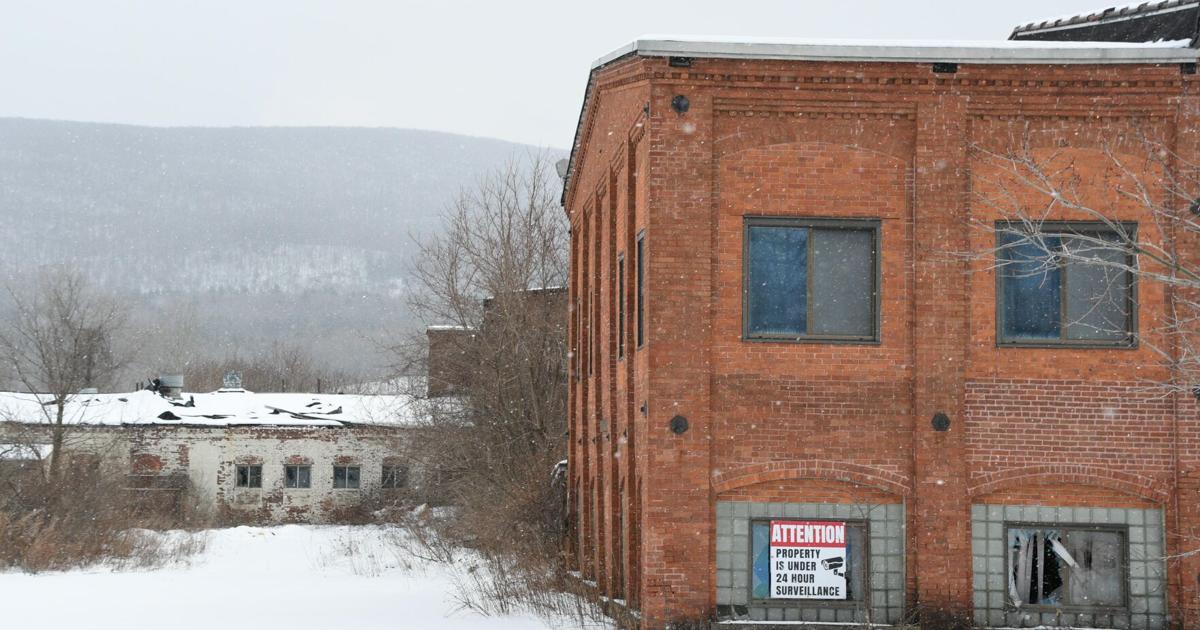
ADAMS — The former Curtis Fine Papers complex long has been called an eyesore, but it turns out not everyone in town is behind plans to tear down four of its five largest buildings.
In public comments submitted to the town, some residents advocated for the preservation of three of the buildings, citing their unique features, historic preservation and potential reuse.
Some of the buildings at Curtis Fine Papers mill have gaping holes in the roof.
The town is seeking a $4 million grant from the EPA to clean up the 11.8 acre site at 115 Howland Ave. so that it can be redeveloped for commercial use, creating jobs, mitigating a public health threat and expanding the tax base. The EPA is expected to announce winners in June and release money in October.
Under the plan, which was presented during a public hearing last month, only the office area at the south end of the site, identified as Building 5, is proposed for reuse. The other four main buildings are slated for demolition based on environmental and structural concerns.
But in public comments submitted in the wake of the hearing, a group of residents took issue with the scope of the proposal.
Donna Cesan, Adams interim community development director, said the residents' comments also will be included with the grant application, along with responses from the town.
Caroline Scully prepared personal comments, as well as submitting comments on behalf of “Friends of the Curtis paper mill and Mill building admirers.”
Joining her in the group remarks were Adams resident Mary Ciuk and Cummington residents Leni Fried and Mike Augspurger, who own The Old Stone Mill Center on Route 8.
Ciuk, Fried and Augspurger walked the interior of the buildings. Their comments are informed by that experience, as well as Fried and Augspurger’s reuse of the Old Stone Mill.
“We don’t want to be adversarial,” Fried said. “But we do have criticisms of, to us, an unimaginative approach. And also, what is community development? If there’s complete demolition, what is going to be built there? Another office park? Is that really something that is the best for Adams?”
Augspurger said he favors removing hazardous materials and “anything that might hurt someone, like a piece of falling roof … and then I would stop there and just have friends come over and see what they think.”
Mike Augspurger pointed out the windows and concrete slab in Building 4, the finishing room of the Curtis Fine Papers site in Adams. Augspurger is among a group of residents advocating for keeping this building for reuse.
The group challenged the assumption that soil below a concrete slab under Building 4 is contaminated.
The town's response said that while concrete slabs can be impervious, trenches and floor drains can provide pathways for subsurface contamination.
It also pointed out that the draft analysis by Weston & Sampson states that three buildings (or parts of them) could be repaired: the shop, the finishing room and the offices, respectively identified as buildings 1, 4 and 5.
The town's response pointed out that any site work in historic buildings will need to comply with the National Historic Preservation Act and come under coordination of the State Preservation Office.
The group listed several potential advantages to keeping these buildings: less dust and exposure, a lower cost to repair than to build new, a shorter time frame for reuse, and potential interest in reuse.
The group identified special features as “huge, tiled vats that were used in paper making for the paper pulp. These are in good condition and should be preserved. The brick rooms in the basement are also amazing.”
The town pointed out the extensive vandalism, break-ins and squatters.
In addition, the group commented, “The sheer size and length of building 4 seems to scream ‘find a way to reuse me.’ The town is desperately in need of indoor recreation options. Could this building be a solution?”
The town attempted to solicit a private developer and received no responses based on the extent of contamination, according to its response.
Scully told The Eagle she understands the importance of this cleanup and hopes that Adams will win this highly competitive grant.
“In truth,” she wrote in her comments, “tearing down large buildings often causes more environmental damage than preserving them.”
She called asked for flexibility.
“Like the demolition of Penn Station in New York City in 1963, might we regret destroying our history?” she wrote.
Read the Original Article
This article was originally published by Berkshire Eagle. Click below to read the full article on their website.
Visit Berkshire Eagle