
Disagreements flare in Lenox over land, funding and future of workforce housing
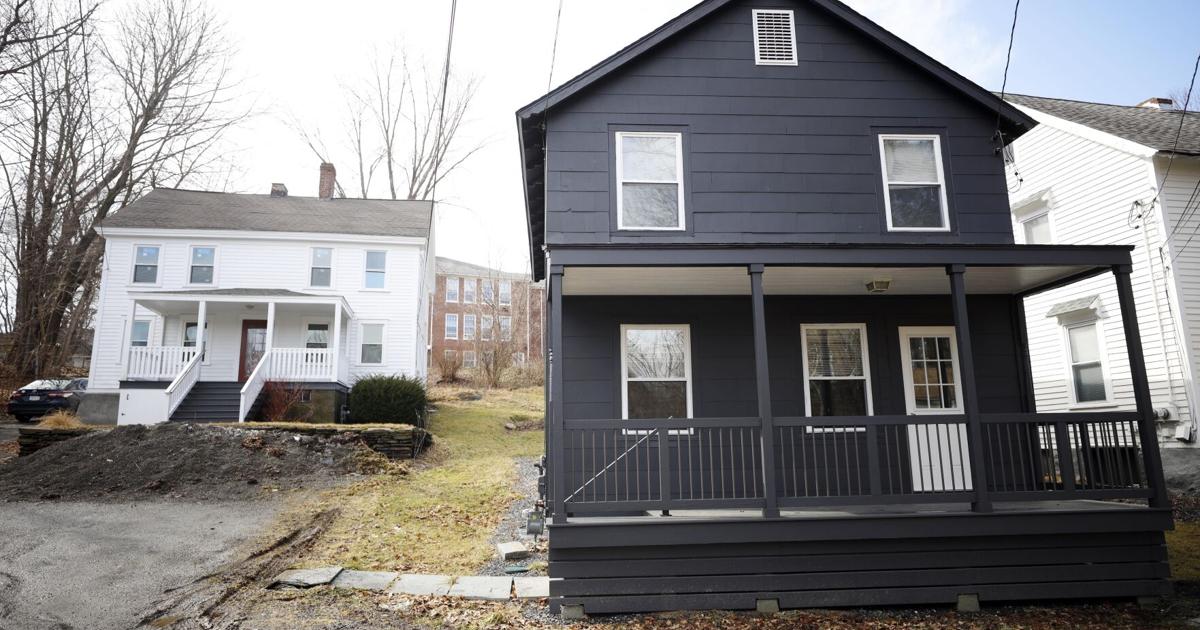
LENOX — A request to reclaim $300,000 in unspent affordable housing funds sparked a contentious exchange between two town committees, exposing deep disagreements over how — and whether — the town can build workforce housing.
The flareup at last month’s Community Preservation Committee meeting involved the Affordable Housing Trust’s application to recapture the unspent funds from Town Hall coffers. The money would be used to identify and acquire land to build ownership housing for low- and moderate-income individuals and families, including workforce residents and seniors.
Low income is defined as less than 80 percent and moderate income is less than 100 percent of the federal median income for the area — $86,400 for an individual, $123,400 for a four-member household.
Affordable Housing Trust Chairwoman Kate McNulty-Vaughan told the committee that the $300,000 request is for the funds originally designated for the proposed Sawmill affordable housing rental development that failed to win the necessary two-thirds vote at the 2019 annual town meeting.
The Housatonic Street site at the Route 7 and 20 bypass intersection is now the town's new public safety complex.
McNulty-Vaughan said the trust has just over a million dollars on hand for potential projects, though $410,000 is already earmarked for ongoing programs.
This year, the Community Preservation Committee is tasked with reviewing a near-record nine applications for support of community housing, open space and recreation, and historical preservation. Based on committee recommendations, town meeting voters will have the final say in May. The state’s Community Preservation Act is primarily funded by local property tax surcharges — in Lenox, 3 percent.
The town has a little over $1.7 million in Community Preservation Act funds, including just over $1.4 million for undesignated uses and $86,000 designated for affordable housing. The rest of the money is designated for open spaces and historical preservation projects.
No specific plan has emerged for the requested $300,000 transfer, but McNulty-Vaughan explained that the funding should be readily available if and when potential land for a home ownership development is identified.
Several committee members seemed skeptical.
“This request is quite a departure from what the [Community Preservation Committee] mechanism is supposed to be,” Chuck Koscher said. “You’re asking us to essentially abdicate the CPC’s review of specific projects.”
But new preservation committee member Kevin Mitts voiced confidence that the Affordable Housing Trust, along with the committee, would ensure that the funding would be spent appropriately.
A point of contention then sprang up over a separate application from mixed-income housing developer Pennrose for $500,000 to support its proposed, town-permitted second rental housing project for 68 units at a 238 Pittsfield Road wooded site, opposite Lime Kiln Road.
The company’s initial 65-unit development, called Forge, opened recently for income-qualified applicants at Brushwood Farm across from the Courtyard by Marriott hotel.
Community Preservation Committee founding member and former chairman Frederick Keator asked McNulty-Vaughan if she was aware of Pennrose’s $500,000 request for its second project. She said she was not aware of the amount.
Committee member Jared Weber noted that the two applications totaling $800,000 from Pennrose and from the housing trust were especially sizable for affordable housing.
At a follow-up meeting of the Affordable Housing Trust, McNulty-Vaughan described the Community Preservation Committee session as “very contentious, overall.”
She disputed any notion at that meeting that the $300,000 funding request for the Affordable Housing Trust could be turned over to Pennrose for additional support of its potential 238 Pittsfield Road project.
“Personally, I feel it was defamatory, I was being called a liar,” said McNulty-Vaughan. “There’s been a line crossed here beyond what I’ll ever put up with, that somehow this was a bait and switch and that we were going to shovel this money to Pennrose.”
At the same housing trust meeting, member Jackie McNinch, senior vice president for mortgage originations at the Adams Community Bank in Lenox, questioned the drive to acquire land for affordable housing.
Zillow’s median listing price for houses in the town is nearly $600,000.
“Why are we continuing down this path of [buying] land?” she asked. “I don’t think we should without a plan and the money. We don’t have builders willing to come in and do this.”
McNinch emphasized that “we don’t have the money to build houses or the expertise. We’re not going to get people to come in and build $500,000 houses. That’s why they’re not being built, because nobody can build them. It can’t be done.”
She pointed out that “the land is the easy part. If we have a plan, the land will come. ... The hard part is getting a project together, putting the pieces together to keep it affordable.”
“Land is step one,” McNulty-Vaughan responded. “It will depend on the neighborhood, what we can build there. We don’t have the expertise, but we can certainly try to get more of it over the next few months.”
She plans to leave the Affordable Housing Trust in June amid other openings on that committee.
"We know we’re embarking on an impossible journey here,” McNulty-Vaughan acknowledged. “But if we don’t at least get in the boat and start to sail, we’ll just keep talking about the same things over and over. This is now like the Wild West in terms of building, and it’s crazy.”
Read the Original Article
This article was originally published by Berkshire Eagle. Click below to read the full article on their website.
Visit Berkshire Eagle