Eversource line workers practice for a Regional Rodeo that measures both safety and time
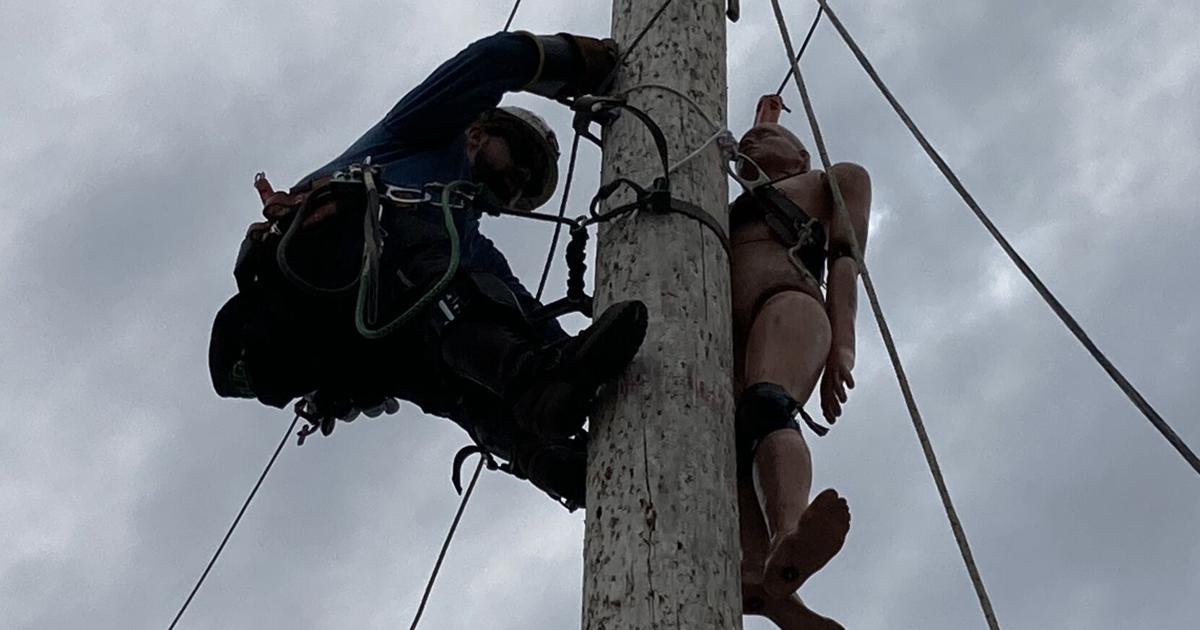
SPRINGFIELD — After someone yells, “Put your knife away,” a plastic dummy on a rope drops from the top of an electrical pole and hits the ground.
Then, the dummy is roped up and hoisted back up.
On Wednesday, a half-dozen Eversource overhead line workers did timed trials for the utility's annual Regional Rodeo in Berlin, Conn., on Saturday. They practiced zipping up to the top of a pole, rescuing an injured line worker solo and with the help of a second worker at the utility's work area in Springfield.
Wearing a hard hat, each one donned a climbing belt, along with a hand line, ankle gaffs or hooks, rubber gloves and safety glasses.
As line workers shimmied up, they left a rain of wood chips in their wake.
For the rescue, they switched belts when they came to the first line on the pole, then continued up to the dummy, where they tied a rope around its chest and then let it drop.
Eversource overhead line workers practice their skills on Wednesday in Springfield ahead of Saturday's Regional Rodeo in Berlin, Conn.
Required annual certification for line workers includes Hurtman Rescue, which has a 4-minute maximum per OSHA.
As they practiced, they called out to one another.
“Nice knot,” one said, regarding the knot used to secure the dummy prior to their launch through the air to the ground.
Errors happened. More than one line worker's foot slipped off the pole in the rush of the moment. Another caught the dummy’s arm in the rope, then had to fix that before completing the rescue.
Overhead line workers at Eversource train in Springfield on Wednesday for the utility's Regional Rodeo in Berlin, Conn., on Saturday.
Both of these errors cost time in a rescue and points at the rodeo.
Michael Fraga, operations manager of Eversource overhead electric operations in Western Massachusetts, said he can only remember one incident when a line worker was incapacitated at the top of a line.
“We’ve had incidents, but where we actually had to perform a rescue, where that person is incapacitated, I just could count very few in the 20 years I’ve been here,” he said.
He has a simple goal for this competition.
Michael Fraga shows an overhead line worker's safety belt.
"New Hampshire's had the throne for the last couple years," he said. "And we're looking to dethrone them."
Safety counts in this rodeo. Think of it as a qualifier.
"If you go so fast that you're making a mistake or you're slipping or you're you're out of control, then those would be deductions," Fraga said.
At the International Lineman's Rodeo in Kansas, Eversource had the fastest pole climber in 2025, Bob Michaud of New Hampshire, at 33 seconds.
"A fast rescue is under three minutes," Fraga said.
Cole Shinnick says he checks his gloves every time he works, before and after.
Cole Shinnick, 25, started working at Eversource as an apprentice in January 2025. He expects to hold that status as he works toward becoming a journeyman, which requires 8,000 hours over about four and a half years.
He’s already got some of the licenses and certifications he needs in order to do this work.
“Electricity is, you know, you can’t see it, so you have to be aware of all hazards around you at all times, understanding how it operates,” Shinnick said. “How to keep yourself safe, keep your equipment safe.”
Gloves are rate tested every three months at Eversource, but line workers are responsible for inspecting them more often.
“You inspect them each use, before every time, and after,” he said.
He talked about the over-gloves called "keepers."
An overhead line worker practices his skills Wednesday while training for Saturday's Regional Rodeo in Berlin, Conn.
“If you’re dealing with nails or stapling something or using your hammer pinch points, those will take the bite before your gloves do,” he said. “And your gloves are the only lifeline between you and electricity.”
Buckets are also insulated, but they’re not always available, he said. “The main ones (are) your minimum approach distances, your rubber cover, and then your rubber protective equipment, meaning your gloves and sleeves — and then using your head to stay out of the dangers.”
Shinnick grew up in Chelmsford, graduated from St. John’s Preparatory School in Danvers, studied economics at the University of Massachusetts and then took a job as an assistant superintendent at Shawmut Design and Construction in Boston. He later decided to move to the trades and attended a 15-week training at Southeastern Lineman Training Center in Trenton, Ga.
This will be his first rodeo. He’d hoped to compete last year but was too new so he cheered on his co-workers.
"I want to do it every year and see if I get slower or faster, and just kind of benchmark it from there," he said. "Obviously, the longer you do it, the more skillful you should be.”
Read the Original Article
This article was originally published by Berkshire Eagle. Click below to read the full article on their website.
Visit Berkshire Eagle