
For Thomas Jefferson and Sally Hemings' descendant, America's 250th is a celebration — and a reckoning
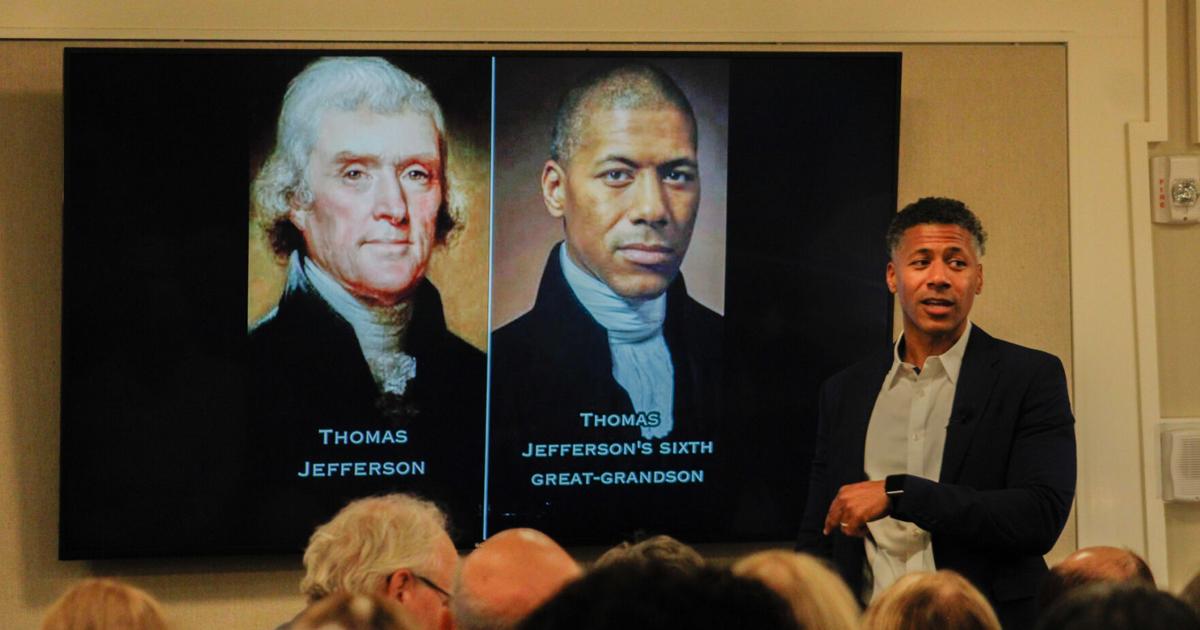
STOCKBRIDGE — For Shannon LaNier, a sixth-generation descendant of Thomas Jefferson and Sally Hemings, the woman Jefferson enslaved and with whom he had children, celebrating America's 250th birthday is complicated.
The nation's milestone is a reminder for LaNier — whose family tree traces to both a Founding Father and an enslaved woman — that America's founding ideals and the reality of slavery have always existed side by side.
"We're all mixed up, we have the color of the rainbow within this one family," LaNier told a crowd of about 100 people Tuesday evening at the Norman Rockwell Museum.
Alongside photojournalist and author Jane Feldman, LaNier discussed Jefferson's legacy, historical memory and his family's story, arguing that America can't be fully understood without acknowledging slavery and the people whose labor helped build the nation.
Feldman's work is currently on view at the museum and some of her photographs were originally included in the book "Jefferson’s Children: The Story of One American Family," which she co-authored with LaNier.
Photojournalist and author Jane Feldman has two pictures of Shannn LaNier, a sixth-generation great-grandson of Thomas Jefferson, on display at the Norman Rockwell Museum.
Jefferson, the third U.S. President and author of the Declaration of Independence, asserted that "all men are created equal," but also enslaved hundreds of people, including Hemings.
By acknowledging both sides of his ancestry, LaNier said he's an example of how the U.S. can hold its heroes and its injustices together in one story.
That is why, he said, despite what some might assume, he doesn't choose between celebrating Independence Day and Juneteenth.
"I'm celebrating both," LaNier said. "Because both are as important, and I need to make it clear how integral the slave community was in the foundation of this country, that we would not have a 250th anniversary if not for that enslaved community, so they gave their blood, their sweat and their tears to make it possible."
For generations, LaNier said, relatives passed down their connection to Jefferson through oral history, even as many historians dismissed the claim. Jefferson and Hemings' descendants are still fighting to have their family history recognized.
Shannon LaNier speaks to guests during a reception after speaking at the Norman Rockwell Museum on Tuesday about the complexity of America's 250th.
Feldman met LaNier at Monticello in 1999 during a reunion of Jefferson descendants, about a year after DNA evidence strengthened the case that Jefferson had fathered Hemings' children.
But because of oral history being passed down through generations, LaNier knew before the DNA results came out that he was a descendant of Jefferson — it even got him in trouble at school.
"I remember in second grade we were studying the president, I was like, 'Oh, I'm gonna tell everybody,' so I stood up and said, 'Thomas Jefferson is my great great great great grandfather,' and the teacher said, 'sit down and stop telling lies," LaNier recalled.
Before the discussion began, a clip from the musical "Hamilton" played over the speakers: "Who lives. Who dies. Who tells your story."
"It really is what it's about," Feldman said. "Who gets to tell the story? White men in power have always told his story, right?"
Photojournalist and author Jane Feldman speaks alongside Shannon LaNier about Thomas Jefferson's legacy Tuesday at the Norman Rockwell Museum.
The two spoke about how open and sometimes uncomfortable conversations about that legacy are necessary for healing and a more complete understanding of the nation’s past.
The pair urged audience members to help tell a broader version of America's past — one that includes the voices and experiences of enslaved people and their descendants alongside those of the nation's founders.
“If you're silent, that's an agreement, so you're complicit. If you hear something, say something," LaNier said. "All jokes aren't funny, especially if they're putting other people down, or if they're racist jokes."
Read the Original Article
This article was originally published by Berkshire Eagle. Click below to read the full article on their website.
Visit Berkshire Eagle