
Former hostage recounts how faith helped him survive 738 days in Gaza
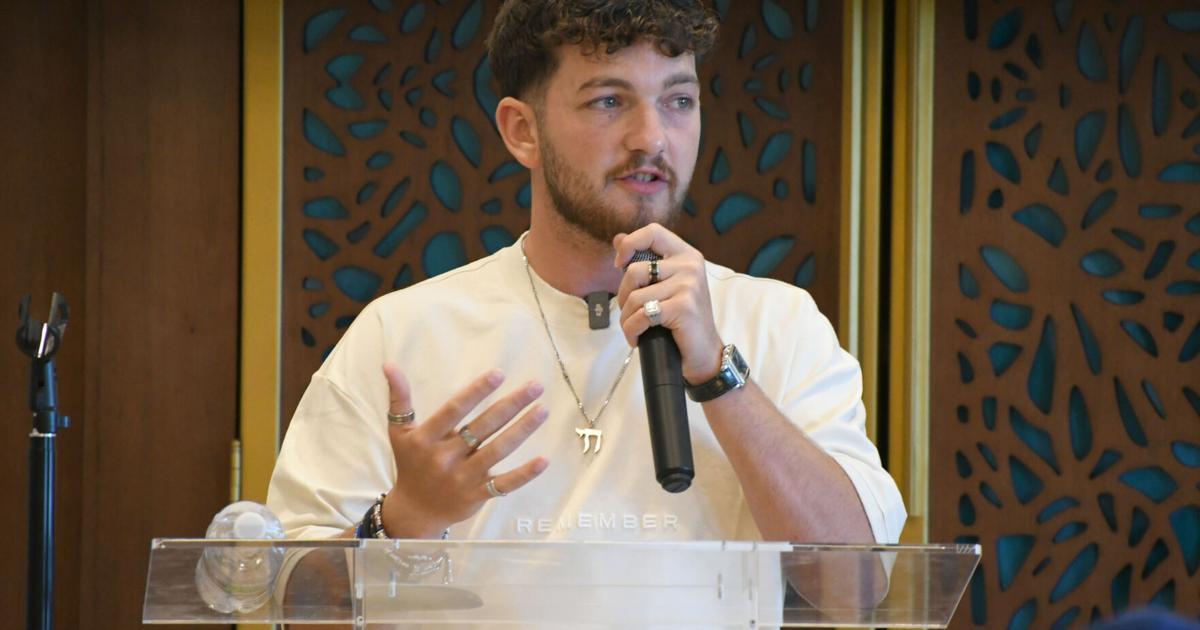
LENOX — The applause for 24-year-old Bar Kupershtein began before he reached the front of the room.
By the time the former Hamas hostage took the microphone to speak at Chabad of the Berkshires, the crowd had been on its feet for nearly a minute, singing "Hevenu Shalom Aleichem" — "We bring peace upon you."
“My name is Bar and I’m a survivor,” he said to even more applause.
Audience members applaud Bar Kupershtein, who was held hostage in Gaza for 738 days, following his talk about his harrowing experience at the Chabad in Lenox on Tuesday evening.
As the crowd settled, Kupershtein recounted how he survived 738 days in captivity, much of it underground in Gaza. Already, audience members had begun wiping away tears. Others sat silently, bracing for a story of starvation, beatings and not knowing whether he would see daylight again.
The first time the world saw Kupershtein, he was 21 and being dragged into Gaza by Hamas militants.
For those who gathered Tuesday evening at Chabad of the Berkshires, hearing him speak was more than listening to a survivor's story — it was an act of solidarity, remembrance and hope.
Over the next hour, Kupershtein told the story of how his entire life changed in one day.
At 6 a.m. on Oct. 7, 2023, Kupershtein was working as a security guard and paramedic at the Supernova music festival near Israel's border with Gaza. Four hours later, he was a hostage, on the brink of what would be two years of captivity — one of the longest among Israelis abducted during the attack.
That morning, Hamas militants launched a coordinated assault on southern Israel, attacking around 20 communities and the music festival. About 1,200 people were killed and 251 were taken hostage. The attack sparked a war that would last throughout Kupershtein's captivity, killing tens of thousands of Palestinians and displacing hundreds of thousands more.
Kupershtein said his instinct to save others ultimately led to his own kidnapping.
When rockets began striking near the festival, he helped evacuate attendees. As militants closed in, the only remaining escape route was a hidden emergency exit that could be reached by all-terrain vehicle. Kupershtein repeatedly drove an ambulance carrying people to a safer area and returned to rescue more.
After about 10 trips, he was shot and taken hostage.
Footage released by Hamas showed him bound in the back of a vehicle alongside other captives. At first, he said, he was in disbelief that his life had changed so suddenly.
Kupershtein was released in October 2025 and was among the final living hostages freed from Gaza. During more than two years in captivity, he spent much of his time in underground tunnels with a small group of hostages, enduring severe hunger, physical abuse and the constant threat of execution.
What helped him survive, he said, was his faith and the bonds he formed with the other hostages. They told each other their life stories and found ways to observe Shabbat, Hanukkah and other Jewish holidays from inside the tunnels.
An audience members hold the hands of Bar Kupershtein, who was held hostage in Gaza for 738 days, following his talk about his harrowing experience at the Chabad in Lenox on Tuesday evening.
He found hope through a small radio his captors had given the hostages to listen to the Quran. After days of breaking and rebuilding the radio out of boredom, he discovered a Hebrew station.
The broadcasts became a connection to the outside world and gave the hostages a routine. They listened to news for about two hours each day.
One day — which happened to be his birthday — he heard a special guest being introduced on the radio.
It was his mother.
“In the first second I started crying, because this is the first time I hear my mama after one and a half years,” Kupershtein said. “I think a lot, how it happened, how I hear my mom 100 feet under the world with a black radio, and I understand this is not just my mom, this is God sent me the message I need.”
For Kupershtein, hearing her voice was proof he had not been forgotten.
After he was released and reunited with his loved ones, he chose to leave home again to tell his story around the world. His speaking tour has brought him to schools, synagogues, churches and community groups across the United States.
“For me to share my story, it’s healthy and it helps to keep me busy all the time,” he said in an interview after his speech. “After I speak, I see a lot of people listen to my story, and they do something for themselves. They aren’t the same person they were before my speaking.”
Audience members speak to Bar Kupershtein, who was held hostage in Gaza for 738 days, following his talk about his harrowing experience at the Chabad in Lenox on Tuesday evening.
Kupershtein said people often struggle to understand the horrors hostages endured until they hear the stories directly from survivors.
“They can’t believe it really happened,” he said.
Rabbi Levi Volovik said Kupershtein’s story reflects the “unwavering strength and enduring spirit” of the Jewish people.
“Bar's story is not only one of survival, but it is also a testament of faith, resilience and an unbreakable bond that unites all the Jewish people,” Volovik said.
An audience member embraces Bar Kupershtein, who was held hostage in Gaza for 738 days, following his talk about his harrowing experience at the Chabad in Lenox on Tuesday evening.
Kupershtein said he hopes his story encourages Jewish people around the world to embrace their identity without fear.
“They take the [religious necklace] outside of clothes and they say, ‘I’m Jewish and I’m not afraid,’” he said. “Maybe I can be the person who can unite all of the Jewish people in the world, I will do that.”
His message, he said, is ultimately one of gratitude — appreciating life, freedom, family and even the smallest things many people take for granted.
“People need to appreciate everything. They can go to the kitchen, open the refrigerator and take the food,” Kupershtein said. “For people, it’s regular. For me, I had to dream about it. For anything I have now, I say thank you.”
Read the Original Article
This article was originally published by Berkshire Eagle. Click below to read the full article on their website.
Visit Berkshire Eagle