
From aquifer to faucet: How Adams’ water system works
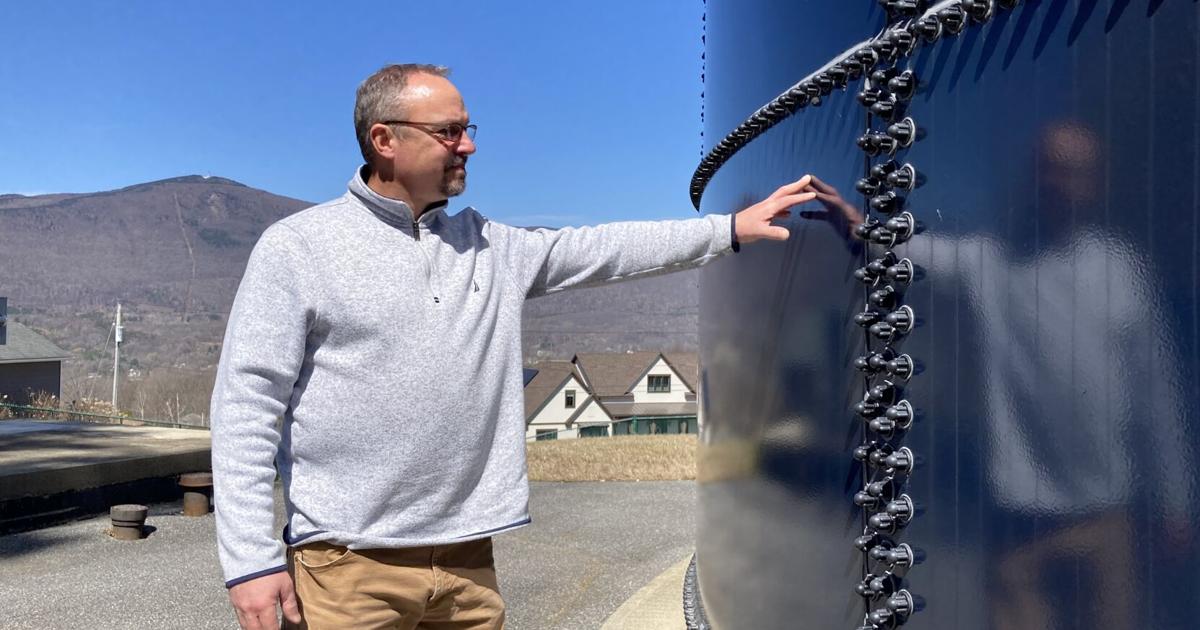
ADAMS — How does drinking water travel from an aquifer, across land and more than 1,000 feet in elevation, into the faucets of 2,900 homes and businesses?
John C. Barrett wrestles with the answer every day of the year.
As superintendent, Barrett oversees the Adams Fire District, which oversees 56 miles of pipe, a network of pumping stations, tanks, pressure reducing pits and 366 color-coded fire hydrants — maintained by five employees, including Barrett.
This is one of the paper monitors that will be eliminated at the Glen Street pumping station.
“When our assets fail and they haven’t been maintained, people don’t have water or fire protection,” Barrett said. “So it’s crucial to keep these assets functioning and not failing. And it’s very hard to do nowadays.”
Among the projects Barrett is preparing to manage include work at the Glen Street pumping station and the East Orchard Terrace water tank, two related projects that he estimates will cost $203,500. The work includes infrastructure upgrades and new communications systems at both sites.
Ultimately, Barrett said this would allow him to take the oldest tank on Upper East Hoosac Street and the East Road pumping station offline by having the East Orchard tank serve that area. He said this would allow the Fire District to expand coverage to a part of town that doesn’t have fire protection and relies on private wells.
Adams Fire District voters will have the final say on this project in a warrant article at the district’s meeting on May 27. It would be funded through water rates.
The Adams Fire District uses paper records at the Glen Street pumping station.
Both the tank and the pumping station use an outdated pulse duration system run through a Verizon phone line, a system that Verizon is preparing to abandon.
“When it fails in the middle of the night, there’s nobody coming,” Barrett said. “It’s not reliable.”
He plans to instead use the Adams Fire District’s dedicated radio frequency to monitor — and control — the flow from the pump to the tank and to monitor pressure and flow at both locations.
“The pump chart recorders are 1980s technology and they’re not very well suited to be doing this kind of task anymore,” he said. “The SCADA system is going to eliminate all of this.”
SCADA is the acronym for supervisory control and data acquisition.
“The SCADA system will then communicate, decipher the communication, data log that to my office, so that I can see everything that went on at all times, so it’s an electronic documentation instead of paper,” he said. “So rather than having paper copies, I’m going to have electronic files. And instead of having to come out here, I can sit at my desk and see what’s going on.”
With a sweep of his hand, Barrett showed that the paper recording devices as well as the switching technology inside the Glen Street pumping station will be eliminated.
The 500,000-gallon steel tank at the top of East Orchard Terrace was installed in 2009. It has glass-lined panels, so water never contacts the steel.
Barrett and his staff inspect the tank — and all of the pumping stations — on a monthly basis, checking for leaks and damage, down to every nut and bolt
And the tank has been resealed for leaks a couple of times. Repaired leaks appear as white marks along the tank’s seams.
The Fire District has a drone to document the top of the tank, which rises 60 feet.
“You don’t want a guy climbing the tank every month,” he said. “It’s just dangerous.”
Every nut and bolt of the East Orchard Terrace tank is inspected on a monthly basis, as is all the hardware owned by the Adams Fire District.
“We assess if we see any cracks, if we see any leaks, if we see any rust bubbles, if we see any issues that would create a detriment to the tank — because if you don’t catch it in early stages, the cost to replace this tank is in the millions, and you don’t want that,” he said. “Just like your house, you want to maintain this asset as much as possible.”
The tank is surrounded by riprap in case the pump overfills the tank. In addition, there’s a pipe to take overflow off the tank.
“This is how we can control the overflow of water,” he said. “It’s an engineered, controlled system.”
The tank’s mixer helps prevent water stratification by temperature.
While the East Orchard tank is cleaner than concrete, it also requires more maintenance because of the thermal expansion of the steel.
“In the summer, it maintains pressure better at height, and in the wintertime, moving water doesn’t freeze as easily as stagnant water,” he said.
Communications and infrastructure are both in line for work at the Adams Fire District.
Adams water isn’t filtered.
“We are lucky to have a very good water source,” Barrett said. “It’s called the Hudson aquifer and it goes through essentially a waterway that is comprised of dolomite. So it doesn’t really leach contaminants into our water.”
He said there’s no iron or manganese and the pH level hovers at between 8.0 and 8.2, more alkaline than acidic.
“And the water has never seen the atmosphere, so it doesn’t get polluted like surface water does,” he said.
Barrett has more than 920 alarms across the system.
“Nothing ever shuts down,” he said. “Very seldom do we make it a month without any calls. We have over 2,900 customers. Our calls come in from police, SCADA, alarms in Berkshire County and Dig Safe. It’s a 24/7 operation.”
Read the Original Article
This article was originally published by Berkshire Eagle. Click below to read the full article on their website.
Visit Berkshire Eagle