From federal policy to local protest: The stories that shaped Berkshire County in 2025
The biggest stories of 2025 in Berkshire County all speak to a single word: Change.
Whether it’s the Trump administration reinventing the role of government, Berkshire residents reacting to and in some cases resisting that reinvention, or local institutions finding new ways of doing things, by necessity or by choice, change has been a constant in the past 12 months.
While any number of stories could be included on a list of the most important of any given year, there were several that undeniably dominated community conversations and institutional decisions because of the change they heralded.
Here's a look at the top stories that captured headlines in 2025.
If there’s one thing the people of Berkshire County learned in 2025, it’s how much power the federal government holds — and how much impact it has on our daily lives.
After President Donald Trump was inaugurated to his second term in office, grants that had been promised by the federal government were placed on hold with little explanation other than review of whether they reflected the president's agenda.
Some initiatives, such as plans to sell the Silvio O. Conte Federal Building as "surplus," were floated and then disappeared.
The Silvio O. Conte Federal Building on Center Street in Pittsfield was on a list of federal "surplus" buildings that could be sold, but was later removed from the list.
State-allocated federal education funding, such as the $9.4 million that funds Title I and special education programs in the Pittsfield Public Schools, was placed in jeopardy when Massachusetts officials refused to end their commitment to diversity, equity and inclusion in education. That was later reversed in reaction to a lawsuit joined by state Attorney General Andrea Joy Campbell.
Williams College was among schools facing a loss of funding due to the Trump administration’s opposition to affirmative action and diversity, equity and inclusion policies. The college resumed acceptance of federal research grants in October, after revising the faculty handbook — retaining anti-discrimination language but removing specific references to affirmative action.
The year ended with more uncertainty. During a federal shutdown brought on by Congressional Democrats seeking to restore Affordable Care Act health insurance tax credits, the Trump administration halted SNAP funding. That led to weeks of uncertainty — and an outpouring of charitable support by local businesses and residents.
Mary Spina packs bags for delivery at the South Community Food Pantry on April 1. During the federal shutdown, the Trump administration halted SNAP funding, leaving food pantries to figure out how to meet the growing need.
On May 30 in Great Barrington, masked agents with U.S. Immigration and Customs Enforcement arrived at Creative Building Solutions on Maple Street to apprehend a pair of landscape workers on the job. ICE raids had been taking place in the county since a wave of apprehensions in March. Another resident was detained during a routine check-in in August and later released.
But this time, the agents got pushback from the business owners over enforcement practices, including their masks and the lack of arrest warrants. They left with just one of the two people they’d come for.
Lee Everett holds a sign of protest at the “No Kings in America! Rally for Democracy” on March 9. The rallies drew thousands of sign-carrying protesters to locations across the county, most notably at The Common in Pittsfield.
Though that moment was dramatic, it was hardly the only sign of resistance to the Trump administration offered in Berkshire County in 2025.
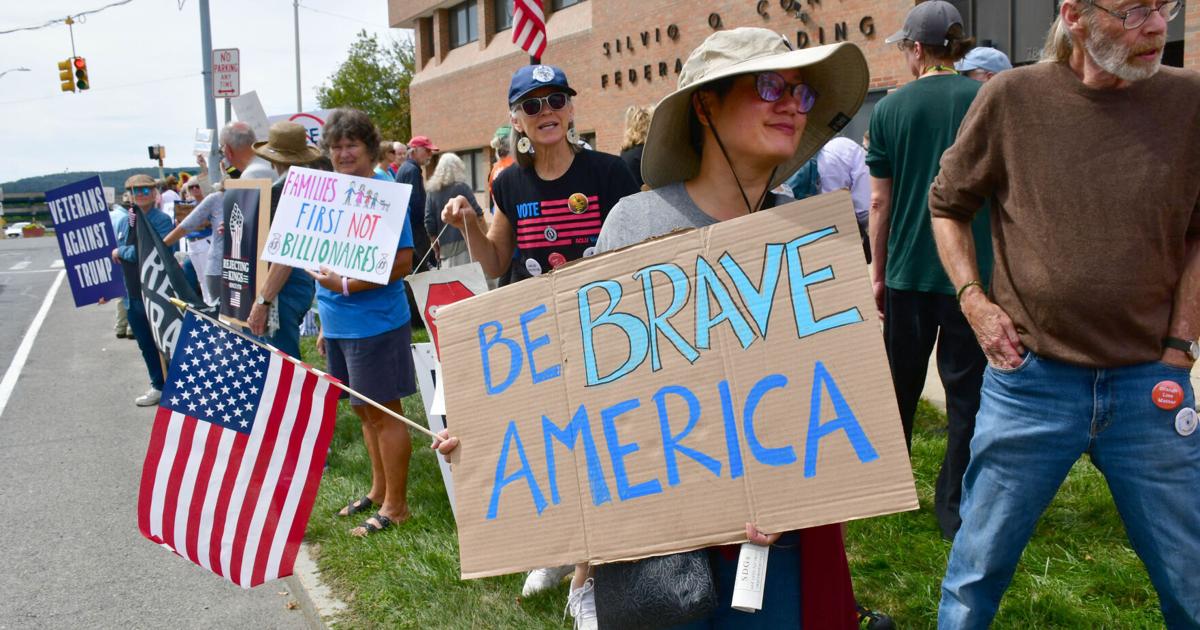
In June and again in October, locally organized “No Kings” rallies were held — part of a national movement opposing the president’s consolidation of power, ICE raids and deployment of military personnel in U.S. cities. The rallies drew thousands of sign-carrying protesters to locations across the county, most notably at The Common in Pittsfield.
"No Kings" rallies — like this one held in Pittsfield on June 14 — were held across the country to protest the Trump administration's consolidation of power, ICE raids and deployment of military personnel in U.S. cities.
"Action is the antidote to fear, it’s the only way," Robin O'Herin, an organizer with Stand Up Berkshires, said at the second round of protests, on Oct. 18. "We are saying no kings, yes to democracy, yes to freedom."
According to Berkshire Interfaith Organizing community organizer Fernando Leon, as of October, ICE had taken 23 people in Berkshire County.
In February, amid a difficult year for the Pittsfield Public Schools, Superintendent Joseph Curtis announced he was retiring, two years before his contract expired. And all but one elected member of the School Committee declined to seek reelection.
In February, Pittsfield Public Schools Superintendent Joseph Curtis announced he was retiring, two years before his contract expired.
Latifah Phillips, an assistant superintendent in Lowell with past state-level supervisory experience, was hired as interim superintendent in the summer, and later signed a one-year extension through June 30, 2027. She was joined by several other new leaders in the administration, four newly appointed building principals, and in November, by five newly elected School Committee members.
Students leave for the day at Herberg Middle School in Pittsfield in December. In 2025, Pittsfield School Committee members pushed forward with plans to reconfigure the district's two middle schools into serving specific grade spans rather than regions.
There are still questions about whether the district can pull off the shift to a pair of city-wide middle schools by next fall as planned. And some struggles continue, most notably a chronic absenteeism rate twice the state average and the district’s continued difficulties in filling positions with licensed educators. But Phillips’ first months on the job have been well-received by School Committee members and top school officials.
Pittsfield was not the only school system welcoming new leaders. Tim Callahan succeeded Barbara Malkas in North Adams; Michael Henault succeeded Leslie Blake-Davis at Central Berkshire; and Beth Regulbuto’s departure brought Brian Ricca to Southern Berkshire as an interim superintendent.
Change was set in motion at both of the county’s public college campuses as well. As the fall semester began, Berkshire Community College President Ellen Kennedy and Massachusetts College of Liberal Arts President James Birge both announced they would be stepping down at the end of the 2025-26 academic year.
But the change at Simon's Rock at Bard College in Great Barrington was final: The early college held its 56th and final commencement in May and then closed. But its Kilpatrick Athletic Center, which has served as a community workout center, will remain open until March 30 as the sale of the 270-acre campus proceeds.
Simon's Rock at Bard College in Great Barrington officially closed in May after it held its 56th and final commencement ceremony.
Pittsfield is not the only New England city dealing with chronic homelessness.
Homeless residents sleep outside of the Berkshire Athenaeum. In 2025, the debate over how to handle the homeless population in downtown Pittsfield held the attention of residents, business owners and city officials.
But many residents see the condition of Pittsfield’s downtown business district as a barometer of the city’s overall health. And some prominent downtown businesses are adamant that current conditions are driving away customers.
Downtown Pittsfield business owners Steve and Evan Valenti, center, listen during the public open forum portion of a meeting of the Rules and Ordinance Committee meeting on banning camping in July.
Where those two viewpoints intersect is where city leaders, human service providers and advocates for homeless people spent much of 2025 trying to reach common ground.
The flashpoint was an ordinance proposed by Mayor Peter Marchetti's administration that would ban people from sleeping or creating temporary shelters on all public property in the city.
Pittsfield Mayor Peter Marchetti listens during a meeting of the Rules and Ordinance Committee meeting in July. In 2025, Marchetti proposed an ordinance that would ban people from sleeping or creating temporary shelters on all public property in the city.
The reaction was immediate and passionate, as speakers filled the City Council chambers to oppose the plan at multiple meetings.
“Before we add another law that pushes people further into jail and institutions, we need to take a step back,” Kamayue Gomes said on Aug. 13.
Amid criticism that the proposal would criminalize homelessness and poverty, the City Council sent the proposal back to Marchetti for changes. An August meeting of the Homes Not Handcuffs Coalition, attended by several council members, proved a turning point in the community decision.
Ann Carey joined a group of people gathered at Park Square in August to protest against the proposed camping ordinance impacting the homeless population in Pittsfield. Amid criticism that the proposal would criminalize homelessness, the City Council sent the proposal back to Mayor Peter Marchetti for changes.
The most recent version of the ordinance no longer includes a previously proposed three-day camping limit on private property and provides violators with the option to complete community service in lieu of fines. It also removes language that directly criminalized homeless individuals, eliminates a clause that would have penalized those who provided supplies to people camping, and shifts enforcement authority to the Board of Health.
At Health Commissioner Andy Cambi’s suggestion, the council sent the proposal to the city Board of Health for review. Its recommendations and proposed implementation timeline are due in February.
The Rest of River cleanup of the Housatonic and its floodplains from Pittsfield south to Great Barrington has been in the planning stages for decades.
The site of the Upland Disposal Facility for the GE-Pittsfield/Housatonic Rest of River cleanup is south of Woods Pond in Lee. The Rest of River cleanup began to take shape — slowly — in 2025 with revised transportation plans and site clearing started.
But in 2025, plans moved forward for constriction of the cleanup’s most controversial facet: the Upland Disposal Facility in Lee, a landfill for 1.1 million cubic yards of PCB-contaminated sediments averaging 50 parts per million or less.
Conditional approval of General Electric’s landfill construction plan was granted by the U.S. Environmental Protection Agency in March, and clearance of the site, a former gravel quarry, began in November.
In May, EPA conditionally approved a revised transportation plan with much greater reliance upon hydraulic suction and rail to move contaminated sediments from the river — particularly behind dams in Lenox and Great Barrington — to multimodal handling stations that will be built along the Housatonic Railroad right of way specifically for the cleanup.
In the meantime, in Lee, where many residents still oppose the landfill, there are plans to assure the town’s voice is heard and GE is held accountable for meeting the conditions of its agreements with EPA.
Read the Original Article
This article was originally published by Berkshire Eagle. Click below to read the full article on their website.
Visit Berkshire Eagle