From Stockbridge to Kingsbridge and beyond: When the Mohicans fought for America — and lost their homeland
STOCKBRIDGE — Paradoxically, Stockbridge’s Indian burial ground signifies the presence of an absence. This sacred knoll overlooks the Great Meadow along the Housatonic River, once the site of a seasonal village that Mohican occupants called Wnathktukook, or “bend in the river.”
Today, it’s a golf course. Like manicured fairways and putting greens, the obelisk memorial installed here by white settlers’ descendants, marking this “ancient resting place” of “the friends of our fathers,” implies the area’s original Indigenous inhabitants have vanished. This is the landscape of the settler fantasy or myth of the disappearing Indian — a suburban pastoral evoking novelist James Fenimore Cooper’s romantic trope of the Mohican as America’s last remaining “noble savage.”
Yet the burial ground that best explains why most Mohicans left Stockbridge after the American Revolution lies 130 miles southward — in the Bronx. At the edge of Van Cortland Park’s “Indian Field,” a few yards from a New York City dog park, one finds another mass Mohican grave and memorial. This rock cairn, though, displays a plaque stating that here, on Aug. 31, 1778, “Chief Nimham and seventeen Stockbridge warriors, as allies of the patriots, gave their lives for liberty.”
Left unmentioned is the unhappy fact that their heroic sacrifice failed to restore to sachem Daniel Nimham the upper Hudson and Housatonic River valley lands upon which he and his Mohican ancestors lived for centuries: precisely the “liberty” for which they fought and died.
Diminished by decades of disease, dispossession and displacement, if not English acculturation, Stockbridge Indians joined the revolution to regain their “just rights.” Yet the clash at Kingsbridge — also called the Battle of Van Cortlandt’s Woods or, simply, “the Stockbridge massacre” — tragically sealed the Mohicans’ fate.
Historians now emphasize how much American colonists’ hunger for native lands motivated their revolt. By 1763, the British government, having defeated France and acquired Canada, wished to save blood and treasure by preventing more frontier clashes with Indians. The parliament prohibited settlers from occupying or purchasing land west of the Appalachian Mountains. Defiant land speculators, including George Washington, whose Ohio survey ignited the French war, and poor settlers coveting rich western farmland, and the independence owning it conferred, resented and ignored the law.
Stockbridge’s Indian burial ground is marked with a large monument installed by white settlers’ descendants, marking this “ancient resting place” of “the friends of our fathers.” It implies the area’s original indigenous inhabitants vanished, when in fact the Stockbridge Indians joined the revolution and lost their homeland in the process.
Stockbridge Mohicans also lost land as whites flooded a now-safe Berkshire frontier. By the early 1760s, a precontact Mohican population of 25,000, long-pressed in the Hudson Valley by Dutch and Anglo settlers, had been reduced by epidemics, warfare (often with Iroquois to the west) and land deals to 500.
Beginning in the 1730s, Mohicans took refuge at the new Stockbridge mission. Adopting Christianity and a sedentary agricultural life, they built English-style houses, raised livestock, fenced fields and studied English. Indians even co-governed Stockbridge, incorporated in 1739, with white settlers, serving as selectmen and minor officers.
Ironically, Britons’ victory against France precipitated their Mohican allies’ downfall. In 1756, sachem Daniel Nimham, approximately 30 years old, removed some 200 noncombatant Wappingers from the Hudson Valley to safety at Stockbridge so he and fellow warriors could join Robert Rogers' Rangers, an elite British scout unit employing “Indian fighting” methods. The military alliance didn’t return their lands. In 1766, Nimham and three Stockbridge sachems sailed to London to appeal to the Lords of Trade for more than 200,000 acres east of the Hudson, to no avail. The Wappingers settled permanently at Stockbridge.
New Englanders proved just as crafty as New Yorkers in swindling Mohican land by using alcohol, shady deals and a provincial law permitting Indians to pay mounting debts in real estate. In 1763, Stockbridge Mohicans owned 75 percent of all land in the region, or 23,000 acres, much in common. By 1775, they owned only 6 percent, or 1,200 acres. Some 50 families among Stockbridge’s 1,000 white settlers got the rest. That year, elders representing 300 Mohicans, augmented by other praying towns’ refugees, complained to Boston that “Traders” and “Designing People” were “Getting Away All that the Indians are possessed of.”
In early 1775, Whig revolutionaries’ token support for Mohicans’ land claims, if not these Indians’ dependence on white settlers for protection and income, pushed them into the patriot camp. As Massachusetts’ extralegal provincial congress offered the Stockbridge Mohicans friendship, and a blanket and red ribbon for every enlistee, 35 joined Capt. William Goodrich’s “minuteman” company; Jehoiackim Mtohksin, son of Johannis, a prominent elder, served as its second lieutenant.
On April 1, 1775, Massachusetts congressmen wrote “our brothers the natives of Stockbridge” cheering they seemed “ready and willing to take up the hatchet in the cause of Liberty, and their country.”
“If the Parliament of Great Britain takes from us our property and our lands without our consent, they will do the same by you,” they explained. “Your property, your lands will be insecure,” and “in short we shall not any of us have anything we can call our own.”
Three days after fighting at Lexington and Concord, Mohicans in Goodrich’s company rushed to Cambridge to join the army besieging the British at Boston. Erecting wigwams at modern-day Inman Square, they asked Yankee commanders to limit alcohol sales making a rabble of white militias. Their “temptation” to “drink to excess,” these Christian converts feared, would make them “disagreeable” and “unfit for usefulness and service.”
Their marksmanship and guerrilla tactics proved disagreeable to the redcoats. In September, British commander Gen. Thomas Gage groaned that the New Englanders had brought down “all the Savages they could have against us here, who with their Rifle men are continually firing on our advanced Sentries.”
Declaring “the Rebells have themselves open’d the Door,” Gage used the Mohican warriors’ presence to justify unleashing Native auxiliaries against patriots elsewhere. Sobriety and stealth didn’t preclude humor. English missionaries lamented that vulgar Yankees had “taught” the Stockbridges to “insult” redcoats by yelling taunts, brandishing scalping knives and “turning up their backsides.”
Mohican skill extended to intertribal diplomacy.
In May 1775, Daniel Nimham’s 30-year-old son Abraham and two fellow Mohicans trekked to Montreal to consult the Kahnawakes. The British arrested them and nearly hanged them, but interceding Kahnawake friends got them released. British regulars did beat and rob Abraham Nimham as he departed.
In late 1776, Stockbridge emissaries, possibly including Daniel Nimham, walked to Fort Pitt (today, Pittsburgh) to recruit the Shawnee and Delaware to the American cause. The English king “who formerly called us his Children,” one insisted, now “abused us, sold us, & gave our Lands to those who would conquer us.”
When this “Great King” “sent his warriors” to “this Big Island,” declared the Stockbridge emissaries, “I put him aside, I denied his authority, fire rose in my face, I took up my Hatchet.”
“Rise up against the Red Coats,” another emissary implored the westerners.
“They began this mischief, they have got proud & haughty, let us humble them,” one Stockbridge messenger urged.
“My Tomahawk is sharp,” one affirmed, “and already stained with their Blood.”
By August 1776, Congress authorized Gen. Washington to muster a separate “Stockbridge Company” of Mohicans. To distinguish them from enemy Indians, and prevent further “friendly fire” accidents that already killed two, he issued them red and blue caps. Over the next two years, the Stockbridge Company served in New York (including Fort Ticonderoga), New Jersey and Canada. In 1777, Mohicans led by Abraham Nimham scouted and skirmished for Gen. Horatio Gates during the campaign that culminated in triumph at Saratoga (and French recognition and intervention).
The Stockbridge Company’s overconfidence proved their undoing. In the summer of 1778, Washington’s army, camped at White Plains, harassed British forces bottled up in Manhattan and its immediate environs. The Mohicans, under Abraham Nimham (and joined by his father), were assigned to patrol a “no-man’s land” in southern Westchester County between Continental outposts and British lines in the Bronx, guarding the Kingsbridge crossing over the Harlem River. In late August, the Stockbridges ambushed redcoat patrols several times, killing several. British officers, informed by spies that the Indians felt “elated,” plotted payback.
On Aug. 31, on Daniel DeVoe’s farm, near the Van Cortland manor, some three miles northeast of Kingsbridge, 500 British troops set their trap. They included German Hessians commanded by Lt. Col. Andreas Emmerick; the Queen’s Rangers, Loyalist cavalry and light infantry modeled on Robert’s Rangers, led by Lt. Col. John Graves Simcoe (featured today on the AMC show “Turn: Washington’s Spies”); and 175 First Dragoon Guards under Col. Banastre Tarleton, a flamboyant and daring personality known for capturing a patriot general. Hiding in woods on both sides of the north-south Mile Square road to Yonkers, on the eastern edge of DeVoe’s farm field, the British waited patiently. That afternoon, the Stockbridge Company, between 40 and 60 strong, came into view. Marching south on the road, they ascended a ridge, in advance of a roughly equal force of white patriot light infantry.
Unaware they were outnumbered five to one, the Mohicans spotted Emmerick’s men and took the bait. Halting along a roadside fence, they opened fire. Simcoe’s Rangers, Grenadiers and Tarleton’s dragoons rushed their front. Stopped by a high stone wall, Tarleton’s cavalry retreated but maneuvered north below the ridgeline, unseen by the Indians, around their left flank. Only 10 yards from the Indians before they were noticed, the dragoons smashed into the Mohicans from behind and cut them off from their infantry supports. A brief, intimate and bloody melee ensued. Simcoe credited Daniel Nimham with shooting and wounding him; the Mohicans, he confessed, were “excellent marksmen.”
Surrounded, many Stockbridges couldn’t escape. Nimham refused to budge; according to Simcoe, he yelled to retreating warriors “he was old and would stand and die there.” Buying a few seconds for comrades with his life, Nimham was shot and mortally wounded by Simcoe’s orderly. In death, his son Abraham joined him.
Tarleton’s cavalry pursued Mohicans fleeing west across the fields, cutting them down with sabers, but some found safety by crossing Tibbetts Brook and hiding in woods and behind rocks. Simcoe claimed “the Indians fought most gallantly,” having “pulled more than one of the Cavalry from their horses.” A Hessian recorded the patriot Indians and whites “defended themselves like brave men.” At one point, Col. Tarleton tumbled from his horse trying to strike a Stockbridge; if the Indian hadn’t just fired his rifle, he would have shot Tarleton.
History might have been different if Tarleton hadn’t been so lucky. Two years later, at the Waxhaws in South Carolina, redcoats under his command massacred scores of surrendering militia. Outraged colonists in the divided South rallied to the rebel banner. (Tarleton is the basis for the ruthless character Col. William Tavington in “The Patriot,” the 2000 film starring Mel Gibson.)
Kingsbridge foreshadowed such brutality. In his diary, Hessian officer Capt. Johann von Ewald wrote “no Indians, especially, received quarter, including their chief called Nimham, and his son, save for a few.” Still, von Ewald, inspecting their corpses, claimed their faces showed they “perished with resolution.”
Daniel Nimham, mangled terribly, crawled to a nearby stream before he expired; local farmers discovered their dogs eating him, and two other Indian corpses, badly mutilated. DeVoe’s family buried the Stockbridges in a mass grave and piled rocks on it to prevent further “desecration.” The DeVoe family nursed back to health a “frightfully disfigured” Stockbridge warrior, “his face cleaved down by a sabre cut almost to the chin.”
The lopsided bloodshed, lasting just a few hours, devastated the Stockbridge Company, and with it the Mohican community. The British suffered only a few casualties, but a mere 14 of the Stockbridges returned to camp; three, taken prisoner, were later exchanged. At least 14 Mohicans were killed at Kingsbridge, but some estimate that as many as 40 Indians, including non-Mohicans, died there or were “desperately wounded.”
Mohican corpses littering DeVoe’s field so intrigued Capt. von Ewald that he described them in his diary with exquisite detail. The Hessian also sketched the only known contemporary illustration of a Stockbridge warrior. Von Ewald contrasted their “strong, well built and healthy bodies” with those of white patriots, “with whom they lay mingled on the ground.” The Indians, he noted, pulled out all facial and body hair with pincers and shaved their heads except at the crown; rings pierced ears and noses. They wore hats of bast, long coarse linen shirts and trousers, and deerskin shoes, and carried rifles or muskets, bows and arrows, and tomahawks which they “throw very skillfully.”
Despite the company’s decimation, and dissolution, and Washington’s pessimistic private opinion that “their services never compensated the expense,” Stockbridge Indians continued to serve. Thirty-two Mohicans volunteered for Gen. John Sullivan’s punitive expedition against the Mohawks in upstate New York in 1780. Destroying 40 Haudenosaunee villages and 160,000 bushels of corn they needed to survive the winter, the Americans devastated their Iroquois enemies.
Yet no Mohican ally ever received land bounties promised white American veterans, and in only a few years, the Stockbridge Indians lost what little remained of their lands. Widows and children, lacking male hunters, petitioned the General Court for clothing, blankets and financial aid; sometimes, they received it.
Surviving Stockbridge men appealed to Congress, New York and Vermont to restore their ancestral lands, unsuccessfully. In September 1783, they reminded Massachusetts officials that “in this late War we have suffered much, our Blood has been spilled with yours and many of our Young Men have fallen by the Side of your Warriors.”
“Almost all those Places where your Warriors have left their Bones, there our Bones are seen also,” they professed. Yet “we who remain are become very poor.”
In 1783, Oneidas in upstate New York, also suffering greatly for backing the Americans, welcomed destitute Mohicans to join them. George Washington gave them a certificate granting safe passage. The “Muhheekunnuk Tribe,” he reassured readers, “remained firmly attached to us and have fought and bled by our side,” and “we consider them as friends and brothers.” Within a year, no Indian was serving as a Stockbridge selectman; by late, 1785 most had moved to “New Stockbridge,” in Oneida territory.
By 1818, white settlers hungry for New York lands pushed the New Stockbridge Mohicans to Indiana. They reminded President James Monroe their tribe had helped “your great chief, Washington,” drive “back into the sea the unnatural monsters who had come up from thence to devour you, and ravage the land which we a long time before granted to your fathers to live on.”
In 1822, relentless white settlers pushed them to retreat to a 40,000 acre northeastern Wisconsin reservation purchased from Menominees and Winnebagoes. Today, some 1,500 Stockbridge-Munsee live there.
Tribal leaders and representatives frequent the Berkshires today. They’ve partnered with Williams College, created a Stockbridge walking tour and exhibits at the Mission House, reclaimed cultural artifacts, and seek repossession of the Burial Ground.
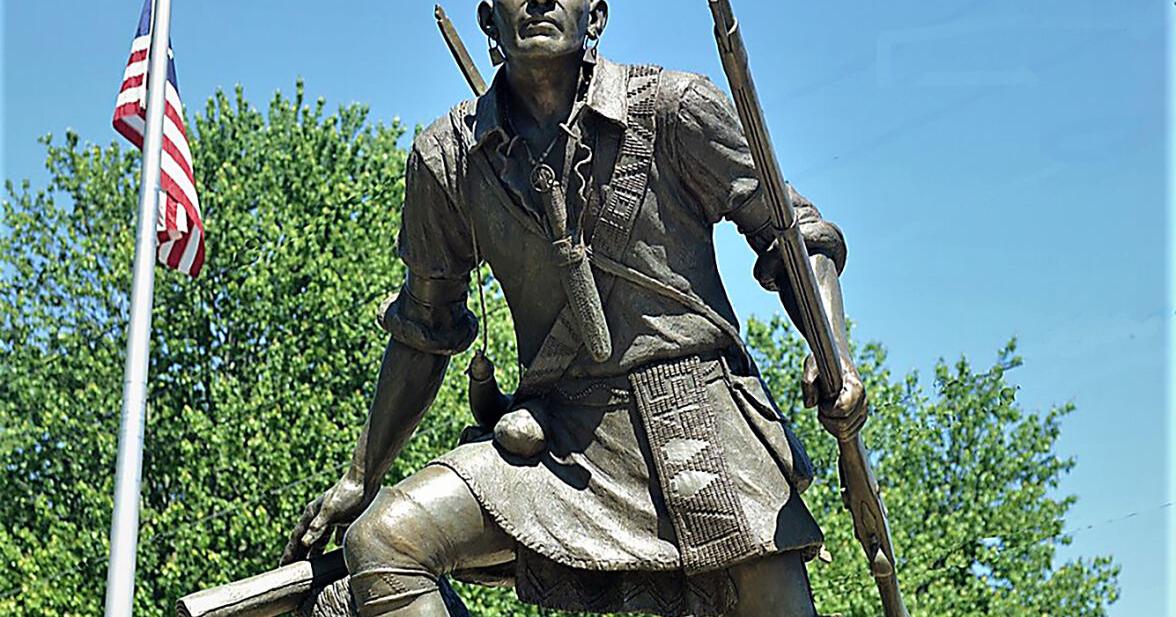
Yet the greatest tribute to Stockbridge’s Mohicans may be an impressive and incredibly lifelike bronze statue of Daniel Nimham near his birthplace in Fishkill, N.Y., erected in 2022. Portraying Nimham at human scale, in movement, leaning forward mid-stride, confident and intelligent, his visage and likeness implies indigeneity: wearing feathers on his head and earrings, slinging a tomahawk under his belt and powder horn, Nimham carries a bow and quiver of arrows on his back. Yet he also betrays Euro-American influence; dressed in a linen shirt and trousers, Nimham’s left hand grasps French musket. Strangely, the sculptor used von Ewald’s morbid fascination with Kingsbridge’s Mohican corpses to bring Nimham to life in such detail.
Most important, this statue allegorically conveys Nimham’s struggle to recover the Wappingers’ Hudson Valley lands. A wampum belt bears the year “1745,” the date of a treaty with New York, which that colony (and state) refused to recognize. The sachem’s right hand touches a scrolled deed documenting his lost Wappinger homeland, cradled by a scarred tree stump connoting a life cut short, fighting for American liberty.
Read the Original Article
This article was originally published by Berkshire Eagle. Click below to read the full article on their website.
Visit Berkshire Eagle