
Gov. Maura Healey pledges to sign bill closing age-of-consent loophole at play in Miss Hall's School rape accusations
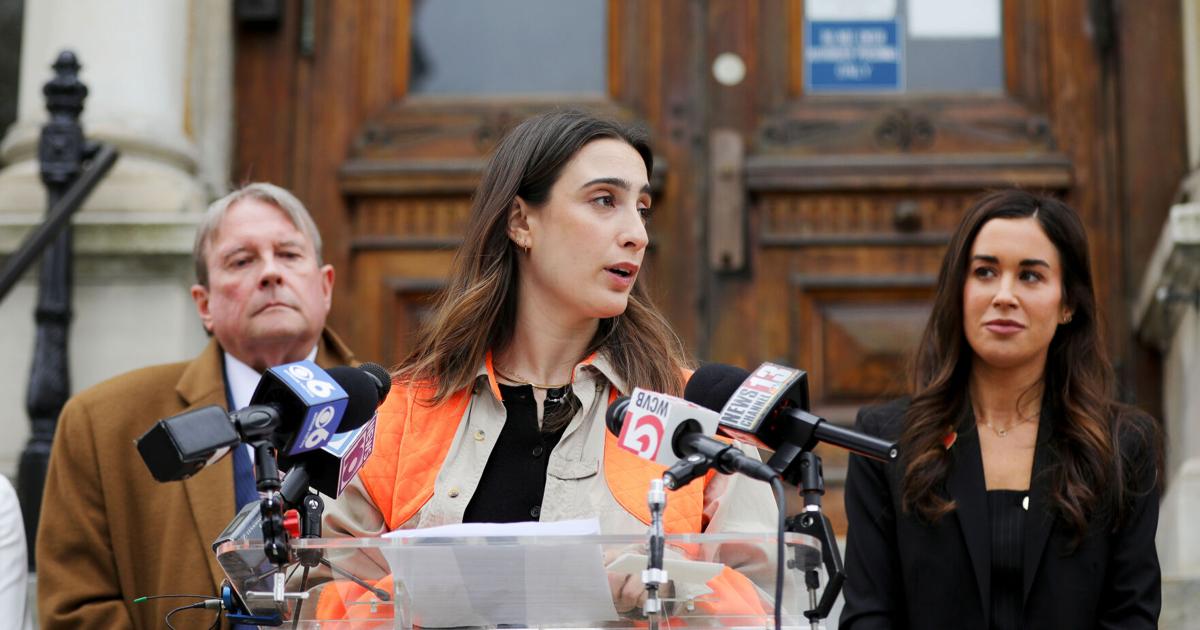
PITTSFIELD — Advocates are celebrating the adoption of a bill that would make it illegal for adults in positions of authority to have sexual contact with minors, closing a key loophole that complicated the prosecution of a Miss Hall's School teacher.
The Trusted Adults Act, filed by state Rep. Leigh Davis, D-Great Barrington, and Sen. Joan Lovely, addresses an issue that was thrust into the spotlight after two former Miss Hall's students accused the same teacher of grooming and sexually abusing them as minors.
The lack of such a law was cited by authorities for not initially prosecuting that teacher, Matthew Rutledge.
But this week, after a yearslong effort by lawmakers, survivors and prosecutors to criminalize sex between adults in positions of authority and 16- and 17-year-olds, the bill passed the Legislature. It is included in a supplemental budget, which Gov. Maura Healey has pledged to sign in the coming days, making the Trusted Adults Act law.
"I feel strongly about closing that loophole," Healey told The Eagle, signaling her support. "I want this to be addressed as soon as possible. People who have a responsibility for young people need to be held accountable."
Melissa Fares and Hilary Simon, now both in their 30s, came forward in April 2024, accusing Rutledge of sexually abusing them while they were students at Miss Hall's. But Berkshire District Attorney Timothy Shugrue initially declined to prosecute because the state's age of consent was 16.
After a longer investigation, alongside advocacy by Fares and Simon, a grand jury indicted Rutledge on three counts of rape earlier this year. While the new law does not apply retroactively, going forward prosecutors will more readily be able to file charges in such cases.
"It's relief and vindication," Simon said. "The law is finally catching up to what survivors have always known."
When Fares and Simon and first came forward in 2024, Shugrue said state law made it difficult to prosecute the case because both women were over 16 at the time of the alleged abuse.
Investigators had to prove the encounters weren't consensual. Under the new law, consent is no longer a defense.
“It would have made my case a lot easier,” Shugrue said. “Two years ago, I could have indicted him, charged him, and probably the case would have probably been over by now. Probably would have facilitated a plea, because I only would have had to prove two things: did a sexual activity take place, and how old were you? That's it.”
Shugrue said his office, along with state and local police, kept working the case and developed evidence showing a pattern of grooming over several years.
“Once I saw that grooming pattern in a culture that existed there, I could put that into context for a jury to understand how they manipulated and how it happened,” Shugrue said. “I will not put a victim survivor through a criminal trial that I don't expect to win, and I got to this case to a level that I expect to win.”
The investigation led a grand jury to indict Rutledge on three counts of rape stemming from incidents in 2009 and 2015.
“They can't consent because they're being manipulated into this behavior,” Shugrue said. “They're being conned into this behavior, and the people that groom are very dangerous, manipulative people. They know what they're doing. Chances are this isn't the first time.”
The law includes an exception allowing consensual relationships between people within four years in age, while targeting adults who abuse positions of authority. It also creates a felony offense for indecent assault and battery by teachers, coaches, clergy members and other trusted adults against children ages 14 to 18.
For Shugrue, the change makes prosecutions of cases involving authority figures far clearer.
“They are mandated reporters that we put our kids’ safety and our lives in their hands every day,” he said. “But it wasn’t illegal for them to take advantage of a 16- and 17-year-old and have sexual intercourse with them. Now, to me, that’s insane, and it’s bizarre.”
Lovely, a Democrat who represents Beverly, Danvers, Peabody and Salem, and other lawmakers and prosecutors have worked to pass similar legislation for more than a decade. The Miss Hall’s School allegations reignited broader conversations about relationships between students and adults in positions of power.
Right after being elected but before being sworn in, Shugrue told Davis: “There’s a loophole we need to close.” That same concern, she said, came up repeatedly while she was campaigning.
“That really created this momentum that, after 10 years, I think that we needed to give this issue a breath of fresh air, and to draw attention,” Davis said. “Being a freshman legislator, I had that energy, I had that focus, I had the support and I was compelled to do what I could to help and to listen to my constituents."
Julia Sabourin, a spokeswoman for the Berkshire District Attorney's Office, called it a “real unique collaboration,” noting the combination of a first-time district attorney and freshman legislator helping advance legislation that had stalled for years.
“They were able to remarkably push something over the line that’s been worked on endlessly by many other advocates,” she said. “This is remarkable. This is unprecedented.”
Davis and Shugrue credited Simon and Fares’ advocacy as critical to the effort.
“This is what good policymaking looks like," she said. "Survivors, prosecutors and legislators all working together toward the same goal, protecting children.”
Simon and Fares have publicly relived what happened to them in hopes of preventing it from happening to someone else.
“For two years, Melissa and I were told that the system was too slow and there were too many factors. It was too hard to change and it was just that no one had looked at it,” Simon said. “I’m so grateful that Melissa and I didn’t stop talking about it.”
Reflecting on the victory, Fares said, she and Simon kept pressing forward — even when it was hard — because silence was never an option.
"I’m thinking about everything it took to get here, and how hard survivors have to fight for what should so often be obvious," Fares said. "Advocacy has been healing, but it’s also meant revisiting hell over and over again."
But for Fares, it's worth it if it helps someone else.
"I hope we’ve made it a little easier for the next person," she said. "I really do."
Throughout the past two years, there were times when Simon said she thought about giving up — the politics and bureaucracy were too much — but what kept her going was knowing she was in a position to use her story to change the law.
“It’s a personal sacrifice,” Simon said. “I have a child, and I have traded moments with him and bedtimes for a trip to Boston for meeting with lawmakers and it’s an emotional sacrifice as well, continually speaking out and repeating the worst thing that ever happened to me in order to make this change.”
Simon encouraged other survivors to use their voices to take back their story.
“Waiting is not evidence that you're wrong. I would say to other survivors, keep going," she said. "The law can change; you can speak out and you can be the reason the law has changed.”
Simon spoke to The Eagle over the phone Thursday while getting her nails painted orange — the color of their movement — as a way to “mark this monumental moment.”
But this isn’t the end of her advocacy.
“There are still 10 other states around the country that have this loophole and so, for me, the work isn’t done,” she said. “I’m going to keep going until the number is zero.”
Read the Original Article
This article was originally published by Berkshire Eagle. Click below to read the full article on their website.
Visit Berkshire Eagle