
'He followed his dreams': Thom Smith, Berkshire Museum naturalist and Eagle columnist, dies at 85
PITTSFIELD — Long before his name ever appeared under a byline in The Berkshire Eagle, Thomas Smith was already answering the Berkshires' questions about the natural world.
Smith, the self-taught naturalist who spent decades at the Berkshire Museum, built its beloved aquarium and became a familiar voice to readers through his "Ask Mr. Smith" and "NatureWatch" columns, died Sunday at age 85 after a years-long battle with dementia.
It all began when he was 8 years old and brought what he thought was gold to the Berkshire Museum. It turned out to be pyrite, but what he found inside the museum's walls was something richer: a world of birds, fish, animals and nature that would define the rest of his life. By 12, he was a regular at its Saturday morning nature hours. By high school, he was working there part-time.
He never really left.
Thom Smith, a self-taught naturalist who spent his career at the Berkshire Museum, built its beloved basement aquarium and wrote The Eagle's longtime nature column, died Sunday at 85 after a battle with dementia.
"The museum was who he was," said Susan Smith, his wife of 55 years. "He spent his whole life there, never thought of doing anything else."
Smith graduated from St. Joseph's High School in 1960 and took a full-time job at the museum running its after-school children's programs in 1962, a position that grew, evolved and expanded over the decades into something no job title could quite contain.
He began by taking charge of the "junior room" and launching the museum's Junior Naturalist program, where he made nature touchable. In Saturday "Animal Hour" programs and impromptu weekend demonstrations, he would pull out a Florida kingsnake or a boa constrictor, speak calmly about the animal and then invite wary children to reach out and feel its dry scales.
“He was really good, especially with kids,” said Brian Warner, the current building manager of the museum who got his first job there working for Smith as a teenager and has now been at the museum for more than 40 years. “A lot of people have phobias of snakes, but then, if he's holding, you could touch it, and you could feel what it felt like, so it helps the kids say, ‘oh, this isn't such a bad thing.’”
Smith also designed interactive exhibits, including a feather display that used a fan to show how natural oils help birds fly — the oiled feather billowing as the stripped one sagged — and a "guess the scat" display to teach children which animals lived in their own backyards. He organized the museum's first dedicated mineral room and rewrote exhibit labels so visitors could make sense of what they were seeing.
Thom Smith worked at the Berkshire Museum for 46 years from 1962 to 2008 as natural science curator and head of the junior nature program. Smith built the museum's aquarium during his tenure. Seen here in 1978, Smith had just reorganized the museum's mineral room.
People would bring in birds, minerals and animals for Smith to identify. He'd handle the objects, explain what they were and often turn the moment into a lesson for whoever happened to be standing nearby.
“Thom was a great mentor, and I have to say he was a great mentor for so many different people and kids,” said longtime friend Randy Johnson, who first met him 57 years ago as a high school student eager to learn about aquariums and salt water.
One of Smith's most lasting contributions to the museum was its aquarium, which he started with a single tank and grew, by 2004, to 30.
He later helped relocate and expand the collection into the basement, working with outside institutions and local tradespeople while also cutting and sealing glass himself to save money. He scavenged equipment, built tanks by hand, made trips to the shore and drove to Florida to collect marine life.
From left, Scott Jervas, Thom Smith and Randy Johnson meet in the reptile room of the Berkshire Museum aquarium. Smith, who died Sunday, was an honored guest as the museum celebrated the aquarium's past and looked forward to a planned expansion.
The result, Johnson said, was "probably one of the finest exhibits that the Berkshire Museum has ever had," drawing in generations of schoolchildren and their families.
“He brought the energy to the museum,” Warner said. “Back then it was kind of a stale museum, you just walked around, you read a label. ... But when Tom did a program, it was, ‘We’ve got to go this day because Tom is doing a program.’”
Nature didn't end for Smith when he left work. When the family needed a new car in 1979, he pitched a weekly nature article to then-editor Ruth Bass at The Eagle's Sunday publication, the Berkshire Sampler. The column was accepted and ran for years, evolving into a regular nature feature and eventually the popular "Ask Mr. Smith" then "NatureWatch” Q&A column. His first column answered a question readers would keep asking for years: how do you keep a hummingbird feeder from freezing solid?
“He had an exceptional store of nature knowledge in his head and added to it probably every day,” Bass said. “His formal education stopped with high school, but he credited Miss Frances Palmer, Berkshire Museum staff, with getting him absorbed in the natural world. He passed that knowledge on to kids and adults all his life.”
He went on to write extensively about wildlife, wildflowers and local landscapes for The Eagle and Berkshires Week, as well as other nature and animal publications. Even after retiring from the museum, he continued writing for The Eagle until dementia made it impossible about two years ago.
On hikes to places like Pleasant Valley, where Smith would often go as a member of the Hoffmann Bird Club, he could pluck a plant from the trail and list its uses, or stand completely still and identify birds by sound alone.
"His birding expertise was amazing," Johnson said. "He could hear a bird and he could identify that bird, and it was truly phenomenal."
“He could tell you the name of every plant and its Latin name,” said his daughter, Laura Smith. “When we used to go hiking or off walking with other people, it would take us twice as long to get to our destination, because he would stop to take a picture, and then start talking about the Jack in the Pulpit on the side of the trail.”
Away from the trails, Smith loved history and would go antique bottle digging with friend Charlie Flint at old cellar holes and along brooks. He kayaked, hiked and wandered the woods with friends and family, building overlapping circles of people who shared his love of the outdoors and local life.
“When you become friends with Thom, you get to meet other people,” Flint said. “He was a very sweet man. Everybody liked him. He had a huge following. He was liked by children all the way up to retired people.”
Smith's wit and wide-ranging curiosity made him easy company for anyone. Johnson recalled a Florida trip when, after Johnson suffered a severe sunburn, hospital staff refused to treat him because he was underage. Smith introduced himself as "captain of the Calypso" — the small rowboat they used back home — and convinced the staff he had authority to consent to care.
"That's how he was," Johnson said. "He would think on his feet and come up with stuff that was just amazing."
Smith and his wife Sue married in 1971 and raised two daughters, Laura Smith and Lisa Smith O'Connor, in a tight-knit Dalton neighborhood where they lived for 35 years before moving to Pittsfield. Summers often meant one or two weeks on Cape Cod, one of his most beloved places, where family memories centered on tide pools, sea creatures and long days outdoors.
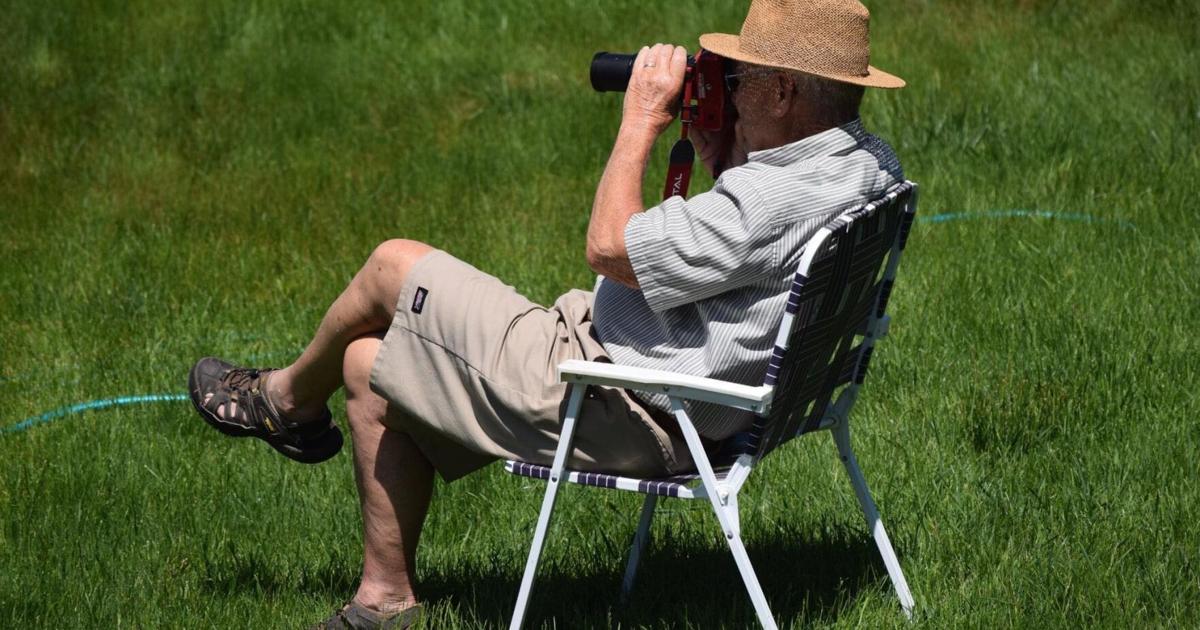
Thom Smith birdwatching on Cape Cod, where the family spent summers exploring tide pools and the outdoors. Smith, the Berkshire Museum's beloved naturalist, died Sunday at 85.
He instilled that same love of the outdoors in his daughters. Both attended nature camp at Pleasant Valley Wildlife Sanctuary in Lenox. Lisa, now a child therapist, still hikes and runs regularly. Laura, an English teacher at Berkshire School in Sheffield, traces her own environmental writing and teaching to time spent in the museum and on local trails with her father.
"One of the greatest gifts that he gave to me was that connection with the natural world," Laura said.
He did the same for his grandchildren — Zachary Gross, Patrick Smith O'Connor and Gabriel Smith O'Connor — turning birthdays into small natural history lessons, bringing home snakes in pillowcases and making it to their soccer games whenever he could manage it.
The day before he died, on a BiPAP machine in a nursing home, Lisa said he woke briefly, looked at her, and asked whether her kids had any games that weekend.
"He loved hard, and we knew he loved us," Lisa said. "He was such a special person that touched so many people's hearts. He was gonna live his way and die his way, and not a lot of people can say that. He followed his dreams."
“He was so smart, and so creative, and just knowledgeable about anything,” Laura said.
A funeral service will be held at Dery Funeral Home at 2 p.m. Saturday, followed by calling hours from 2:30 to 4:30 p.m. A celebration of life outdoors is planned for a later date to be announced.
Read the Original Article
This article was originally published by Berkshire Eagle. Click below to read the full article on their website.
Visit Berkshire Eagle