
Here's why local protest leaders continue to organize in blue Berkshire County
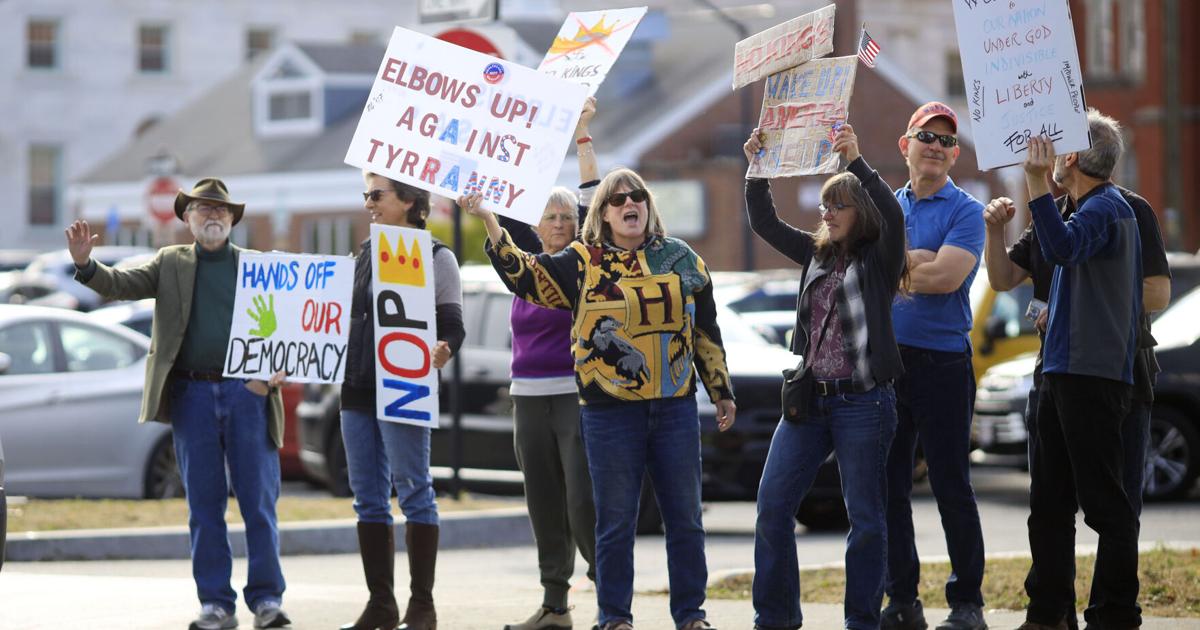
GREAT BARRINGTON — Fears of democratic backsliding and threats to civil rights have compelled Berkshire County protest leaders to continue mobilizing over the past year
Activists like Jessica Dils, a leader of Greylock Together, the Northern Berkshire Indivisible group, are determined to make their voices heard by elected officials and to inspire those who feel voiceless across the country.
“It is more urgent than ever for people in communities like ours to stay connected, to find strength and courage from each other, and to encourage others to do the same,” Dils said. “Massachusetts must be a bulwark and a sanctuary to our neighbors, marginalized people who are the ones most targeted and vulnerable.”
Braced against the cold across the street from of North Adams City Hall, from left Patti Lentine, Jessica Dils and Wendy Penner attend a stand out for Democracy protest last March. Thousands of Berkshire County residents have gathered repeatedly with signs, songs and chants since President Donald Trump took office again last January.
Many Berkshire protest leaders came of age during, or were directly involved in, the civil rights movement. They say that lived experience and an understanding of how hard-won and fragile basic rights can be is what keeps them going.
Activists say they are organizing protests, expanding local networks and urging residents to remain visible during what they describe as a critical moment for democratic participation.
Since President Donald Trump's second inauguration, thousands of Berkshire County residents have gathered repeatedly with signs, songs and chants.
Protesters gather at The Common and along First Street in Pittsfield, joining together with other participants in "No Kings" rallies held across the country in October.
“This past year, as we reactivated, we have grown in number, scope and demand, both here locally and across the country, in response to the horrific assault on our democracy, our institutions, our Constitution, and most importantly, the lives and livelihoods of our neighbors,” Dils said.
Leaders say that even small gatherings in deeply Democratic communities serve an important purpose by pressuring elected officials and drawing attention to policies they say threaten democratic norms and vulnerable populations.
“Democracy doesn't just happen by itself,” said Holly Morse, an activist with Left Field. “It requires citizens to be engaged."
It also serves as a reminder that an ordinary person can be involved during a non-election year, said Ben Hillman, a founder of the Rural Freedom Network.
“One of the missions of activism is to fire people up,” Hillman said. "The more that the message gets out there and the more energy that's out there, the more people are likely to join in and do what has to be done.”
As the year went on, Trump continued to take actions that sparked protests nationwide, including a crackdown on immigration, the implementation of tariffs and what organizers describe as a disregard for constitutional norms.
Jim Mahon, co-chair of the Berkshire Democratic Brigades, speaks at The Common in Pittsfield during the "No Kings" rally in October.
Jonathan Perloe, of South County Resistance & Berkshire Visibility Brigades, said it's important to stay visible.
“Our elected officials need to know that we’re not OK with what’s going on, and that we need them to do everything in their power to hold the Trump administration to account,” he said. “They need to know that we support them when they push back on Trump’s disastrous economic policies like tariffs and tax cuts for the rich, and that we expect more from them when they don’t aggressively oppose Trump’s dangerous and mean-spirited agenda.”
Lee Harrison said it does not matter that Berkshire County votes overwhelmingly Democratic. Smaller gatherings across the country, he said, are needed to make an impact as democracy is “hanging by a thread.”
Harrison, chair of the Williamstown Democratic Town Committee and the Berkshire Democratic Brigades, said he draws inspiration from past movements he lived through, including the civil rights, voting rights, women’s rights and environmental movements, and from Benjamin Franklin’s warning at the Constitutional Convention that the country is, “A republic, if you can keep it.”
“We intend to keep it here in the Bay State, as well as in all 49 other states, and protesting the Trump administration even here in true blue Berkshire County is our way of acknowledging Franklin’s warning about the fragility of democracy,” Harrison said.
Morse said activists play a critical role regardless of geography.
“I think that the space that activists hold in any state, blue or not blue, is to continue to shine a light on the policies and practices that we would like the government to undertake,” Morse said.
Wendy Penner speaks in front of North Adams City Hall during Ocdtober's "No Kings" protest.
Despite seeing little immediate change at the federal level, many organizers say the persistence of the movement keeps them hopeful for the future.
“It's only in the community that we have strength, " Morse said. “We don't have strength individually, particularly when we're up against the power brokers, the huge money interests that run the government. If we aren't visible, then nobody can find each other. It's a question of generating greater visibility so that people can find a place to amplify their own voice.”
For Robin O’Herin, action became a response to fear. Though she marched with Martin Luther King Jr. in the 1960s, she described herself as largely apolitical for decades until last April.
“I was upset during Trump's first term, but I was still pretty apolitical,” she said. “I became so anxious and so scared, and I started going to training online and I started listening to things and I discovered for me that the cure for anxiety and fear is action.”
After attending a few smaller gatherings, she organized a local "Hands Off" rally.
”If you're silent, you've already lost,” she said. ”If you can get 3.5 percent of the population in the streets for peaceful protests and sustained action, however long it takes, you will win your democracy back. I decided I want to do big events that push that number."
Protests also create joy and connection for O'Herin.
“Being with people and laughing and singing and dancing, it changes us, it's a paradigm shift in our mindset from hopelessness to despair. From anger that has no outlet. And that's what keeps me going,” she said. “Action is the antidote to fear and anxiety.”
She also pointed to recent changes in Pittsfield’s permitting process for First Amendment rallies, including the removal of an insurance requirement and faster approvals, as evidence that activism can produce tangible results.
“It’s a major victory for every activist that wants to do anything in Pittsfield,” O’Herin said. “Pittsfield has been really cooperative. it took a lot of standing our ground about first amendment rights, but they are cooperating now.”
Smaller wins, including court rulings, have also kept her motivated.
“There have been victories. The tide is changing,” O’Herin said. “We've been winning consistently in the courts, even in the Supreme Court, and as things get worse, a lot of people who voted for Trump are feeling the crunch, they're feeling the pain. What they're experiencing is not what is being said by the administration.”
The point of protesting in a blue state comes down to pressuring local legislators to continue pressing back on behalf of their constituents.
“Time and again, I’ve seen ordinary citizens who work together achieve significant legislative victories,” Perloe said. “I’m optimistic that our resistance movement will prevail because to think otherwise is to give up, and to give up means a future that I can’t wrap my head around.”
Despite little change at the federal level, Harrison and others continue to stand up for those who can’t.
“So, it’s not a question of why I am still active,” Harrison said. “The more pertinent question is why more people aren’t.”
Read the Original Article
This article was originally published by Berkshire Eagle. Click below to read the full article on their website.
Visit Berkshire Eagle