
Hoosac Valley free pre-K shows strong results, but district must rethink funding
ADAMS — After a bit of storytelling, singing and discussion on a colorful mat, teacher Laura Crane instructs the 13 4-year-olds in her prekindergarten class at Hoosac Valley Elementary School to stand.
Pre-kindergarten students in Laura Crane's class dance around in their classroom at Hoosac Valley Elementary School in Adams. The class is one of its Community Preschool Partnership Initiative classrooms.
“This is going to be a visual motor challenge,” she said. Then she demonstrates with a student, first saying good morning, and then carefully transferring a long red stick from the coffee mug she’s holding to a mug the child holds.
“You got it,” she told one girl, helping her with the task. She also used the word “steady,” one of the day’s vocabulary words, and “gentle,” one of last week’s, to describe the motion required.
Crane is the lead teacher in one of Hoosac Valley Elementary School’s Community Preschool Partnership Initiative classrooms for 4-year-olds.
Pre-kindergarten teacher Laura Crane holds class at Hoosac Valley Elementary School in Adams. Crane, who has been teaching for 23 years, said having the full day with students is crucial.
These four, free, full-day preschool classrooms — as well as two more offered at partner preschools — are geared toward kindergarten readiness and funded through $1 million annual state grants.
Since its inception in the 2023-24 school year, the program has logged measurable gains among students. Now, Hoosac Valley Regional School District is faced with the prospect of having to shift the way it funds this program.
Superintendent Aaron Dean said he doesn’t expect there to be cuts in funding next year.
“I don't think our funding is necessarily going to go down next year, but how we use the funding has to change,” Dean said. “They want us to start building some sustainability.”
Teacher and staff salaries have been paid through the grant, and next year, grant funding can only be used to pay 50 percent of lead teachers’ salaries, Dean said.
“We're going to have to look at what we can do to shift resources around,” he said. “So that's going to be part of our planning that we're starting very soon for the fiscal 27 budget.”
The school district qualified for this grant because it is considered high needs. In Adams and Cheshire, 67 percent of the students are considered high needs, with 58.1 percent of students from low-income families and 25.6 percent with disabilities.
Kristen Palatt, assistant superintendent, said early intervention makes a difference for these students when they enter kindergarten.
“It makes the transition to Hoosac Valley Elementary School — regardless of where students are coming from — much smoother and gives kids a chance to remediate any skill deficits that they may have prior to entering kindergarten,” she said.
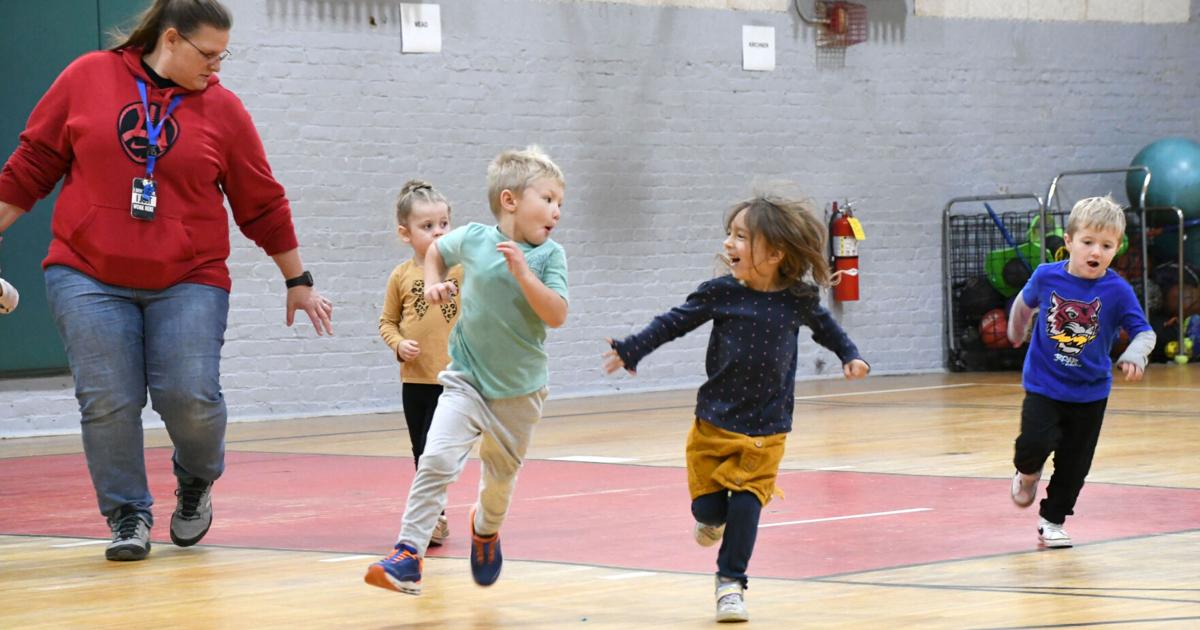
Physical Education teacher Matthew Maffuccio has class with preschoolers in the gymnasium at Hoosac Valley Elementary School in Adams. The classrooms of up to 15 students are balanced by peer mentors with students with disabilities.
At Hoosac Valley, the classrooms of up to 15 students are balanced by peer mentors with students with disabilities.
Prior to the beginning of the grant, Hoosac Valley offered half-day prekindergarten two days a week in mixed-age classrooms. Today it offers full-day pre-kindergarten five days a week in four classrooms.
In the 2022-23 school year, Hoosac Valley conducted a needs assessment and strategic planning with its community partners with a $380,606 grant.
In each of the three subsequent school years, the district has won a $1 million state Commonwealth Preschool Partnership Initiative grant to pay for teachers’ salaries, classroom equipment and supply, professional development special education services within the preschool classrooms and itinerant services to the partner preschools.
Prior to the program’s start, in spring 2021, not one 4- or 5-year-old prekindergartner was on benchmark. By spring of 2024, 74 percent of the students tested in that age group were on benchmark, Palatt said.
Among the services offered through the grant are itinerant services — meaning specialists who offer occupational and speech therapy meet the children in the program at the two partner preschools — Magic Seasons School Age Program in Adams and at Youth Center Inc., in Cheshire.
“It's wonderful to have those services come right to our center,” said Amy Hall, executive director of Child Care of the Berkshires, which oversees Magic Seasons. “It is less disruptive for the children because they get those services right within their preschool classroom. They don't have to have parents pick them up and drive them to Hoosac Valley.
“It also benefits the other children in the classroom too, because [the specialists] give ideas of just how to help certain behaviors or how to help develop their speech in certain ways that the teachers learn as well, so they can reinforce it in the classroom,” she said.
The free preschool program, largely funded through grants, is not in risk of being shut down next year, but school officials say they will have to get creative to keep the model going.
Dean, the superintendent, said he is committed to continuing the program, calling it key to building a model school system.
He’s been in contact with state Sen. Paul Mark, D-Pittsfield, about possible earmarks, but it's still early.
“It's clearly been largely effective, and it's clearly a need in our community, so this is not something we can abandon,” he said.
Crane, the preschool teacher, has been teaching for 23 years, most of that time in a half-day program. She finds the full-day program allows her more time to expand on concepts with her students.
“Seeing kids who are nonverbal participate is amazing,” she said, noting that having additional time makes a difference. “I love to pair academics with movement, because they need those breaks. And then we go back to the academics.”
In class, during that visual motor challenge, she asked students, “Is that OK?” when the stick drops to the floor. “Can we just pick it up and try again? Do we get a second chance?”
When a boy finished the task successfully, she asked the students, “Shall we give him a firecracker?”
So they did, clapping their hands once and then forming an arc above their heads.
“Oh my gosh, look what we did,” she said, chanting those words with the students three times. “Did it feel good to be successful?”
Read the Original Article
This article was originally published by Berkshire Eagle. Click below to read the full article on their website.
Visit Berkshire Eagle