
How a Pittsfield space lab is helping astronauts prepare for future Artemis missions
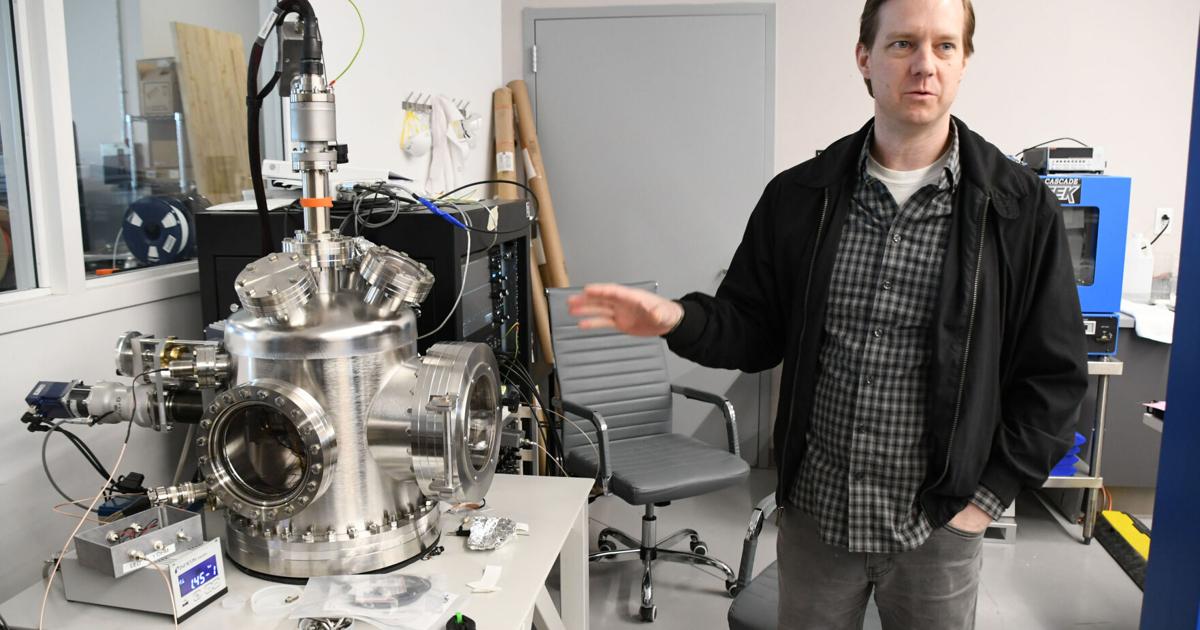
Brian Wood, senior scientist for Electro Magnetic Applications, stands next to a vacuum chamber in the lab at the Berkshire Innovation Center in Pittsfield. The device is used to simulate what happens to items in outer space.
PITTSFIELD — Houston, home of NASA’s Lyndon B. Johnson Space Center, has garnered a reputation as America’s singular “Space City.”
But the titanic act of launching human beings beyond the stratosphere — preferably alive — requires help from a far-flung constellation of labs and scientists to make it possible.
Now, Pittsfield is about to shine a little brighter on that star map of collaborators. Last month, Electro Magnetic Applications announced it would use its lab in the Berkshire Innovation Center to test materials that will ultimately be used in the spacesuits meant for the upcoming Artemis missions.
The most recent mission in the series, Artemis II, took a four-person crew of NASA astronauts last month on a journey around the moon for the first crewed lunar flyby in over 50 years. The next two missions, Artemis III and IV, are set to take place within the next few years and hope to eventually allow astronauts to make contact with the moon’s surface.
Justin McKennon is the chief technology officer at Electro Magnetic Applications, a Colorado-based company with a lab at the Berkshire Innovation Center in Pittsfield.
EMA, a Colorado-based company founded in 1977, tests the impacts of electromagnetic effects for clients in a variety of fields, including the aerospace and defense industries. It has entered into research contracts worth more than $3.3 million with the Air Force and Navy since the start of 2025, according to federal spending data. It has also received just over $1 million from NASA in new contracts since 2020.
The company’s Space Environment and Radiation Effects, or SERE, lab in Pittsfield is used to recreate conditions in space to understand how certain materials will react once they leave Earth.
Its new spacesuit testing program, to be completed in collaboration with California-based company Synopsys, will ensure the suits can be used to safely navigate the surface of the moon.
Justin McKennon, EMA’s chief technology officer, said the lab is used to test “anything that goes to space” — including the materials that make up everything from cables to spacesuits.
“The overall domain that we work in is called electromagnetic effects,” McKennon said.
For the average person not familiar with space travel, the specifics of the field can get dizzyingly complex: jargon-heavy phrases like “triboelectrification from lunar regolith interactions” can be intimidating for outsiders to parse.
But McKennon’s introductory-level summary of EMA’s laboratory work is this: “Making sure that anything that has currents and voltages or a power button, that they all play nice on the same platform.”
“We do that through a lot of simulation and analysis,” he said.
The main test vacuum chamber in the Electro Magnetic Applications lab at the Berkshire Innovation Center in Pittsfield. The device is used to simulate what happens to items in outer space.
That simulation and analysis takes place in a lab that’s exactly as technical as most would imagine: “Whatever you think the lab looks like, you're probably right,” McKennon jokes. A variety of machines blink and whirr throughout the room, while whiteboards covered with math equations can be found along the walls.
“Remember kids,” reads one tongue-in-cheek sticker on a glass box filled with wires and knobs. “Electricity will kill you.”
By simulating the challenging circumstances that exist beyond our planet’s atmosphere, like more intense radiation from the sun or a lack of oxygen, it’s possible to troubleshoot potential issues with materials long before the countdown to launch begins.
“It’s challenging, but that’s what we’re here to do,” said Brian Wood, a lab manager and senior scientist. He’s one of just under 20 employees who currently work with EMA out of Pittsfield, which came to the city in 2019.
Even outside of EMA, Pittsfield is certainly no stranger to reaching for the stars: Stephanie Wilson, a graduate of Taconic High School, is one of 18 astronauts selected by NASA to participate in the Artemis missions.
The spacesuit project will be a continuation of EMA’s existing work with the Artemis missions. McKennon said EMA had been working to prepare the Orion space capsule for Artemis II since 2007, when Lockheed Martin first gave out subcontracts for the project.
“There's so many components,” McKennon said. “It's unfathomable to think about how complicated it is to launch a rocket and all the stuff that goes with it.”
Read the Original Article
This article was originally published by Berkshire Eagle. Click below to read the full article on their website.
Visit Berkshire Eagle