
How Mum Bett became Elizabeth Freeman, or, why the Revolution that ended slavery in Massachusetts exposed domesticity’s violence
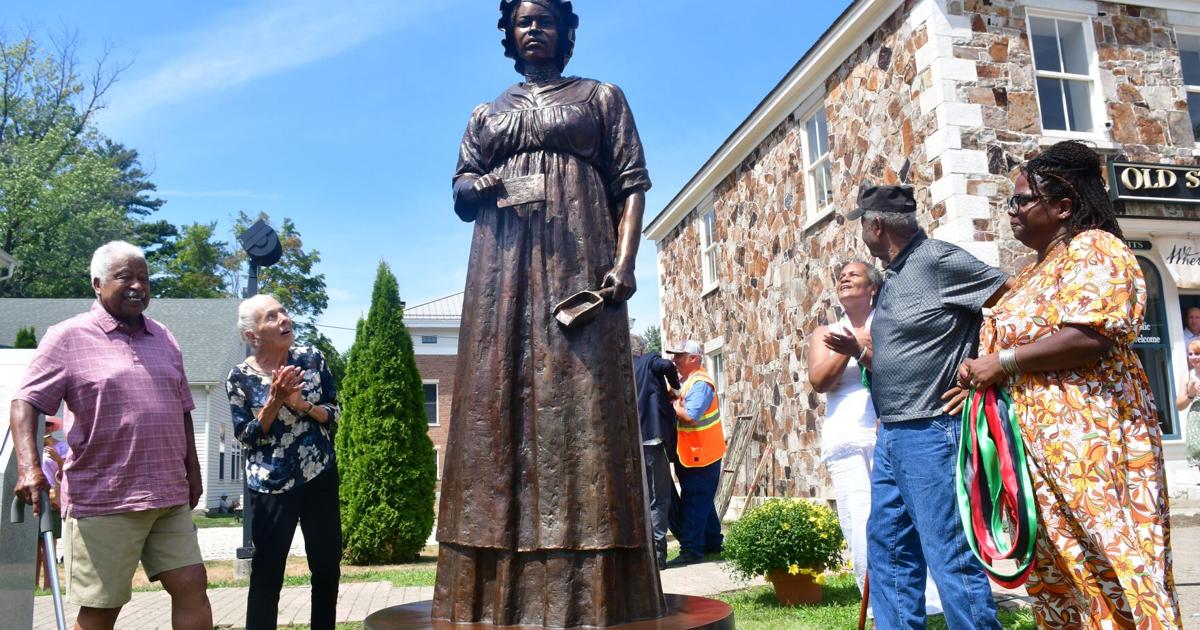
SHEFFIELD — In Boston’s North End, Paul Revere still rides, crying his alarm, cast in bronze.
In Washington, D.C., its namesake has his granite obelisk, 555 feet tall.
Nearby, a white marble neoclassical monument honors Thomas Jefferson.
Inscribed on its wall are haunting words Jefferson sent George Washington in a 1786 letter: “I tremble for my country when I reflect that God is just.”
“Commerce between master and slave is despotism,” Jefferson confessed to his fellow Virginia patriot, planter and slaveowner.
“Nothing is more certainly written in the book of fate,” Jefferson predicted, “than these people are to be free.”
A remarkable new bronze statue in downtown Sheffield explains Jefferson’s prophecy: By 1786, the Revolution already inspired northern states, including Massachusetts, to begin abolishing slavery. Even Washington freed his slaves, through his will.
A monument of Elizabeth Freeman was unveiled Aug. 21, 2022, in front of Sheffield’s Old Parish Church.
Sheffield’s allegorical statue of an emancipated slave thus confronts the apparent paradox that an American revolution made and republic led by wealthy white men, including slaveowners, also transformed an enslaved woman, Mum Bett, into a new person: Elizabeth Freeman. For even as Freeman’s likeness carries in her left hand a trowel, symbolizing skillful herbalism, her right hand displays the legal decision that not only freed Mum Bett, but ended slavery in the Commonwealth.
John Adams drafted Massachusetts’ new constitution; Mum Bett breathed life into it.
At Sheffield in 1780, a few steps from where her statue stands, she heard its first article read from the meetinghouse steps: “All men are born free and equal, and have certain natural, essential, and unalienable rights,” including “defending their lives and liberties,” “acquiring, possessing, and protecting property,” and “seeking and obtaining their safety and happiness.”
Mum Bett seized these words to declare her own independence, from slavery and domestic violence — not exactly the independence Thomas Jefferson envisioned in 1776.
A mural in Pittsfield and commissioned by The Black Lives Matter Art Committee features prominent leaders of the Black community in the Berkshires, both past and present, including W.E.B. Dubois, Elizabeth Freeman, Samuel Harrison, Agrippa Hull, Dr. Frances Jones-Sneed, James Van Der Zee and Stephanie Wilson.
By the late 1780s, it seems, Jefferson, a widower in his 40s, began forcing one of his teenaged enslaved domestics, Sally (or Sarah) Hemings — also his father-in-law’s enslaved daughter, and thus half-sister of Jefferson’s deceased wife — to bear his children, whom he likewise enslaved, on the agreement they would be freed upon becoming adults. Four of six survived to adulthood, and freedom.
Elizabeth Freeman’s story thus reveals how revolutionary ideas of natural rights and human equality prompted women of all colors to defy their subordination and abuse by men and, sometimes, white women, as in Mum Bett’s case.
Lisa Shepardson, a living descendant of Elizabeth Freeman’s, is seen during a visit to Freeman’s grave in the Sedgwick Pie section of the Stockbridge Cemetery on Aug. 21, 2024.
White women are prominent in the founding folklore. A New Jersey Turnpike rest-stop still honors “Molly Pitcher,” the water-carrying fury who took her wounded husband’s position at a cannon during the Battle of Monmouth, in 1778, swabbing and loading the gun under fire.
Before the war, women by the thousands boycotted British goods, including tea; during the war, thousands more joined patriot armies as camp followers. A few covertly fought in the rank and file; Deborah Sampson, of Plympton, disguised herself as a soldier for 17 months, until medical treatment outed her.
Men’s protests for liberty and equality inspired the same from women who lacked virtually all legal rights they enjoy today; laws prohibiting domestic violence were rarely enforced.
In 1776, Abigail Adams wrote to her husband, John, at Philadelphia, urging him and fellow Continental congressmen to “remember the ladies” as they organized a new government.
“Do not put such unlimited power into the hands of the Husbands,” she wrote; “remember all Men would be tyrants if they could.”
If “Ladies” were ignored, warned Abigail, they were “determined to foment a Rebellion," and would “not hold ourselves bound by any Laws in which we have no voice, or Representation.”
Enslaved Black women suffered the double oppression of their race, lacking even the few protections afforded to dependent white women. Yet they showed equal revolutionary zeal and ingenuity.
Phillis Wheatley, born in West Africa, was sold and transported to Boston when she was no more than 8 years old. By 1773, she became the first published African American poet; her owners freed her shortly thereafter.
As white colonists protested that Parliament was reducing them to “slavery,” Wheatley sympathized with their rhetoric: “I, young in life, by seeming cruel fate/Was snatch’d from Afric’s fancy’d happy seat.”
“Can I then but pray,” she asked, that “others may never feel tyrannic sway?”
Suffering tyranny, too, Mum Bett wrote her own revolutionary poetry.
Born at Claverack, N.Y., in 1744, she came to Sheffield as property its leading citizen John Ashley inherited when he married Hannah Hogeboom.
Ashley, born at Westfield in 1709, attended Yale before inheriting a vast Sheffield estate. Serving as selectman, county judge, sheriff, militia colonel in the Seven Years’ War and in the provincial legislature, Ashley was an energetic entrepreneur. Though he hesitated to endorse the Whigs’ protests against Parliament, by 1773 Ashley signed onto the Sheffield Resolves. When he died in 1802, Ashley owned 3,000 acres, 20 homesteads and several mills around his home (today, Ashley Falls).
Ashley’s reputation for kindness was not shared by his wife, Hannah. Under Hannah’s authority, Mum Bett raised the four Ashley children and cleaned, cooked, sewed, gardened, served guests, and trained and supervised younger female slaves. She also nursed, learning folk medicine she used in freedom.
Yet Mum Bett found Hannah intolerable. One of many legends surrounding Freeman has it that Hannah, becoming frustrated with an enslaved girl (possibly Mum Bett’s sister, Lizzy, or Mum Bett’s daughter, Betsey), went to hit her with a heated shovel (probably for fireplace ashes). As Mum Bett shielded the girl, Hannah struck her arm instead, crippling it permanently.
Catharine Sedgwick, whom Freeman later raised, claimed Hannah was notorious for such “cruelties.”
While John Ashley was “the gentlest, most benign of men,” with “pity, tolerance, and forgiveness for every human error,” she observed, “there was no such word as error in Madame Ashley’s vocabulary.”
“A shrew untameable,” in Sedgwick’s words, Hannah was “the most despotic of mistresses.”
Catharine’s father, the Sheffield lawyer Theodore Sedgwick, proved the linchpin of Mum Bett’s liberation.
In 1780, the day after Mum Bett heard the state constitution, she walked from Ashley Falls to Sedgwick’s house in the village. Like Ashley, his fellow patriot, Sedgwick owned people (at least six).
When Theodore Sedgwick answered his door, Mum Bett — according to one of Catharine Sedgwick's many legends about her — said: “I heard that paper read yesterday that all men are born equal and that every man has a right to freedom.”
Trained by talented Connecticut lawyer Tapping Reeve, Sedgwick devised a clever strategy. In May 1781, he filed a “writ of replevin,” claiming Mum Bett was property wrongly claimed by Ashley. Enslaved men and women in Massachusetts had sued for freedom on grounds of abduction, abuse or past manumission. Yet Mum Bett was the first to cite the new state constitution as a basis for emancipation.
Because women had little legal standing, Sedgwick and Mum Bett enlisted another Ashley slave, a man named Brom, to join the suit. In August 1781, at the county court in Great Barrington (located on the site of today’s town hall), Ashley defended his “right of servitude” in Brom and Bett (as the case was designated) — and reasonably so, given law and precedent.
The jury of white male neighbors disagreed, apparently convinced by Sedgwick. Sadly, no trial transcript exists. The next day, they not only freed Mum Bett and Brom, but ordered Ashley to pay each 30 shillings in wages for their labor, and court costs. (Perhaps they sympathized with Mum Bett’s widowhood; her husband died volunteering with the Continental army.)
Ashley complied but appealed, only to drop it later that year — possibly after a Worcester County court freed a fugitive slave, Quock Walker, who challenged his master’s attempt to reclaim him on similarly constitutional grounds.
Chief Justice William Cushing, reviewing that case’s appeal before the Supreme Judicial Court, instructed the jurymen who soon confirmed Walker’s freedom that “a different idea has taken place with the people of America, more favorable to the natural rights of mankind, and to that natural, innate desire of Liberty, with which Heaven (without regard to color, complexion, or shape of noses–features) has inspired all the human race.”
Proudly changing her name, Elizabeth Freeman watched slavery in Massachusetts wither and die on judicial vines. Other Northern states passed laws abolishing slavery outright or gradually phasing it out, by freeing enslaved young men and women when they reached young adulthood. Yet Bay Staters believed in free labor, paid fairly.
In 1783, Belinda Sutton, of Medford, petitioned legislators that her former master had denied her a “single morsel” of his “immense wealth, a part whereof hath been accumulated by her own industry.”
Lawmakers granted Sutton an annual pension — funded by her old owner. Though John Ashley was not legally obligated to do so, he supported three men he previously enslaved with pensions.
Elizabeth Freeman’s grave is shown in the Sedgewick Pie section of the Stockbridge Cemetery on Aug. 21, 2024.
Elizabeth’s emancipation did not free her from domestic toil. Soon after filing her lawsuit, she entered Theodore Sedgwick’s home as a servant, now paid. Moving with him to Stockbridge, she worked for him until 1807. Thrifty, she saved to buy a small farm from Agrippa Hull, also a former Sedgwick servant who carved out an independent life.
Freeman raised Sedgwick’s children as he pursued far-away political ambitions, and as his wife slipped into insanity. As slavery grew in the South, boosted by King Cotton, Sedgwick made his compromises. He joined Benjamin Franklin’s Abolition Society (the nation’s first). As a member of the U.S. House of Representatives, however, Sedgwick negotiated a law making it easier for masters to recover fugitives crossing state lines.
Beloved by Sedgwick’s children, Freeman became Stockbridge’s “elder stateswoman.” In 1811, Susan Sedgwick painted her portrait, as Elizabeth wore “robins egg-blue dress, ivory-colored head scarf, and her favorite necklace with golden beads.” Freeman died in 1829, at the age of 85, leaving 19 acres, a home, and possessions valued at $400 — more than that owned by many of the few women, white or Black, who then possessed anything at all.
The Sedgwick children memorialized Freeman as a “Good Mother” who loyally dispensed maternal domesticity.
Burying her in their circular family plot, “The Pie,” at Stockbridge’s village cemetery (unusual, given segregated cemeteries), they inscribed Elizabeth Freeman’s gravestone: “She was born a slave and remained a slave for nearly thirty years. She could neither read nor write, yet in her own sphere she had no superior nor equal. She neither wasted time nor property. She never violated a trust, nor failed to perform a duty. In every situation of domestic trial, she was the most efficient helper, and the tenderest friend.”
Yet Freeman’s resolve in domestic trials did more than end slavery; they exposed the tyranny lurking inside the home.
Catharine Sedgwick claimed a young girl once fled to the Ashley’s house, crying her father was abusing her. Freeman took her in, ignored Hannah Ashley’s demands to expel her, and persuaded John Ashley to have her father arrested and tried. The girl was sent east to relatives.
Freeman knew such terrible desperation intimately.
“Any time, any time while I was a slave, if one minute’s freedom had been offered to me, and I had been told I must die at the end of that minute, I would have taken it,” she professed (as quoted by Catharine Sedgwick), “just to stand one minute on God’s earth a free woman.”
Read the Original Article
This article was originally published by Berkshire Eagle. Click below to read the full article on their website.
Visit Berkshire Eagle