
How Pittsfield’s homeless encampment ban became an outreach-first plan
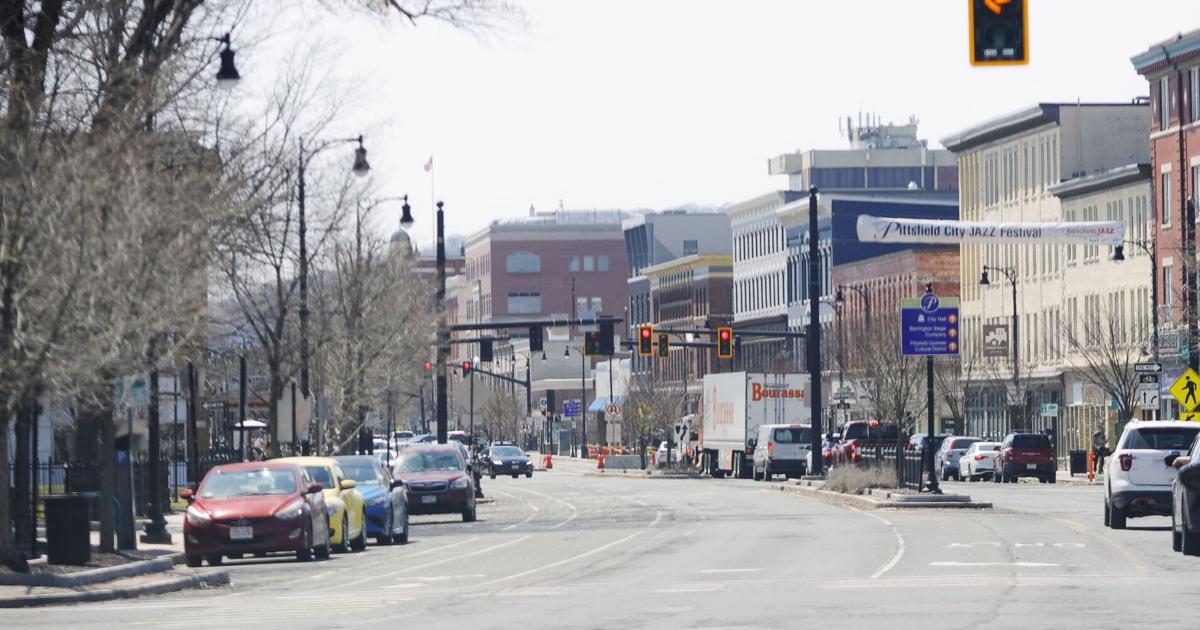
PITTSFIELD — Nine months after backing a proposed controversial encampment ban as a way to address drug use and disorder outside his North Street store, retailer Steven Valenti says he has changed his mind — and city leaders are following suit.
Valenti, owner of Steven Valenti Clothing for Men, was among several downtown business owners seeking relief from problems they said were hurting North Street and driving away customers.
But after months of conversations with advocates and a reassessment of his own assumptions, Valenti now sees the ordinance’s first draft — and its potential impact on the city’s homeless population — differently. In many ways, Pittsfield’s leadership has undergone a similar shift.
"More people got educated about the needs of our community," Valenti said. "The more we do that, the better it gets."
People pack up their belongings from the doorway of the former Cafe Namaste building on South Street on Friday. The city spent more than a year debating how to respond to homelessness before scrapping a proposed encampment ban in favor of a public health outreach program.
In May 2025, Mayor Peter Marchetti proposed a citywide ban on sleeping and setting up temporary shelters on public property, framed as a response to downtown business owners’ concerns. But the ordinance faced major pushback from advocates, who argue it penalizes poverty. After months of debate and protests, the original proposal was scrapped in February and a new, more outreach-focused program centered on public health was formed.
On Wednesday, the Board of Health voted to accept the draft version of that outreach program, marking a major turning point in a yearlong saga. While still awaiting City Council approval to officially establish the program, the vote allows the city to move forward in working with community partners to further the program's efficacy.
The tumultuous path the encampment ban took exposed a larger question the city and its residents had to reckon with: How do we view and treat people experiencing homelessness?
"I wanted to kind of cure a problem that was probably some real and some perceived," Marchetti said in a recent interview with The Eagle. "If you're a business owner and you're dealing with it every single day; at the same time, if you're a homeless person, you're dealing with it every single day, so you're kind of in a Catch-22."
A bundle of belongings is tucked behind the bus stop on East Street at Park Square in Pittsfield. Concerns about encampments and disorder on public property prompted the city to propose a camping ban in 2025 before ultimately shifting to a public health outreach approach.
The city’s homeless population has continued to rise, according to annual point-in-time counts. In 2025, 227 people were identified as homeless in Pittsfield on the night of the count, up from 202 the year before. The federally required count includes people staying in shelters as well as those spending the night in places not meant for habitation, such as parks, sidewalks or stoops.
And 2026's count, which won't officially come out until this summer, is likely going to increase again, advocates say.
Marchetti said the growing numbers made homelessness more visible, heightening tensions between those living outside and residents or business owners who say they feel disrupted.
Not every situation or person camping outside was dangerous, he said at the time. But when there is drug use and paraphernalia, "I think it can make it a dangerous situation."
"We were asking for a little more respect, at least leave the doorway in better condition," Valenti said. "We have a lot invested in our businesses."
Responding to business owners' concerns, Marchetti proposed extending an existing rule that prohibited people from setting up temporary shelters in public parks to all public property. The ordinance also permitted law enforcement to temporarily seize personal possessions and penalize people who assisted or abetted those in violation of the ordinance.
"The mayor put forward the proposal, and I think it was a hard read," said Alisa Costa, an at-large city councilor for Pittsfield.
Almost a full year after the encampment ban ordinance was proposed, the Board of Health urged City Council to scrap the proposal. City Council would scrap the ordinance and supported the proposed outreach program modeled after Northampton's Division of Community Care.
Enforcement and interpretation of the ordinance would likely be the police's responsibility, and the fines would further entrench people in debt they have no means to pay, said Sean Manion, the lead organizer for Berkshire Interfaith Organizing.
"All it did was create financial and criminal penalties for what it referred to as camping, but which really is survival," said Manion. "All it did was punch down."
Many advocates asked where people without stable shelter were supposed to go if the ordinance were to pass.
"It failed to offer any real, genuine solution to the crisis that people are facing," Manion said.
A woman holds a sign that reads "homeless please help" at the Park Square intersection in Pittsfield. The city spent more than a year debating how to respond to homelessness before scrapping a proposed encampment ban in favor of a public health outreach program.
As city officials began to realize the encampment ban ordinance was not the right solution, the underlying problems that prompted it — including how to respond to disruptive and unsafe behavior — remained. Looking for a better approach, Board of Health members turned to other communities for ideas. One model stood out: Northampton’s Division of Community Care.
Northampton's Division of Community Care is a people-first model supported and funded through the city's Health Department, the first to do so in the nation, said Donaven Gibbs, the program's director.
The program is the first in the nation to be supported through a city health department, said Donaven Gibbs, the director of the human-service program.
"We're not through police ... [people] see us in plain clothes, and we just have that connection," Gibbs said. "One of our superpowers is we meet people where they're at."
A person’s first interaction with the program begins with a conversation, said Anna Ganote, one of its coordinators. That initial meeting allows staff to assess the person’s immediate and long-term needs, connect them with resources and support them through the steps needed to address those challenges.
The program also has a dedicated office, which encourages people to come in on their own time, Gibbs said.
The peer-outreach program showed promise in combating the underlying issues people experiencing homelessness face, said Andy Cambi, director for Pittsfield's Health Department.
He said it was especially encouraging that Northampton’s successful program is housed within its health department rather than its police department, showing that an effective response does not have to come with a high price tag.
Pittsfield's proposed program would add a certified community health worker to oversee it and two full-time outreach employees, according to Cambi, who outlined the city's proposal during the board of health meeting on Wednesday. They would meet with people, connect them to services or respond to those in crisis.
"It takes that constant, consistent outreach to make sure that this public space is being respected," Cambi said.
A bundle of belongings is tucked behind the bus stop on East Street at Park Square in Pittsfield. Visible markers of homelessness were among the factors that prompted tensions between downtown business owners and advocates as the city wrestled with how to respond.
When the proposal to scrap the original encampment ban in favor of the outreach program Cambi recommended came before the City Council on Sept. 10, it drew overwhelming support — with Marchetti among its most vocal backers.
"I don’t think I could say it any louder," he said during the meeting. "It was a bad idea."
"We quickly saw the need out of the community and it was that community space," said Donaven Gibbs, the director of Northampton's Division of Community Care. "Originally, it was going to be like a place where we bring folks back to de escalate, but then the need of the community, so we adapted that need and the community space grew to what it is now."
It was eight months from the time Marchetti introduced the ordinance until he wrote a letter supporting scrapping it. What happened during that time?
Marchetti said he listened.
"I've put myself in some really uncomfortable situations, especially after the camping ban," Marchetti said. "I went to the Homes Not Handcuffs meeting — probably not a popular choice because they're all up in arms and it's me that they're after."
"But when I went back for the follow-up visit, it was kind of like, 'Maybe you don't really hate us; Maybe you want to help us and you're just misguided,'" he said.
That's similar to how advocate Manion described his once-tense relationship with the mayor.
"At the start of the process, I didn't really know Marchetti well, personally or politically," he said. "I would not have guessed at the beginning of the process that [this] outcome would have occurred."
Valenti also attended community meetings, crediting them for giving him a better understanding of the situation.
"These people are not problems, they're just trying to make a living," he said. "The process made us a little more aware."
It took vocal advocates to spur the change, but that advocacy led to people discarding their assumptions and listening to one another.
"We do have much better solutions when we come together," Costa said. "And this, to me, is the proof."
Read the Original Article
This article was originally published by Berkshire Eagle. Click below to read the full article on their website.
Visit Berkshire Eagle