If it's not about 'one big school,' where is the sustainability study for northern Berkshire leading?
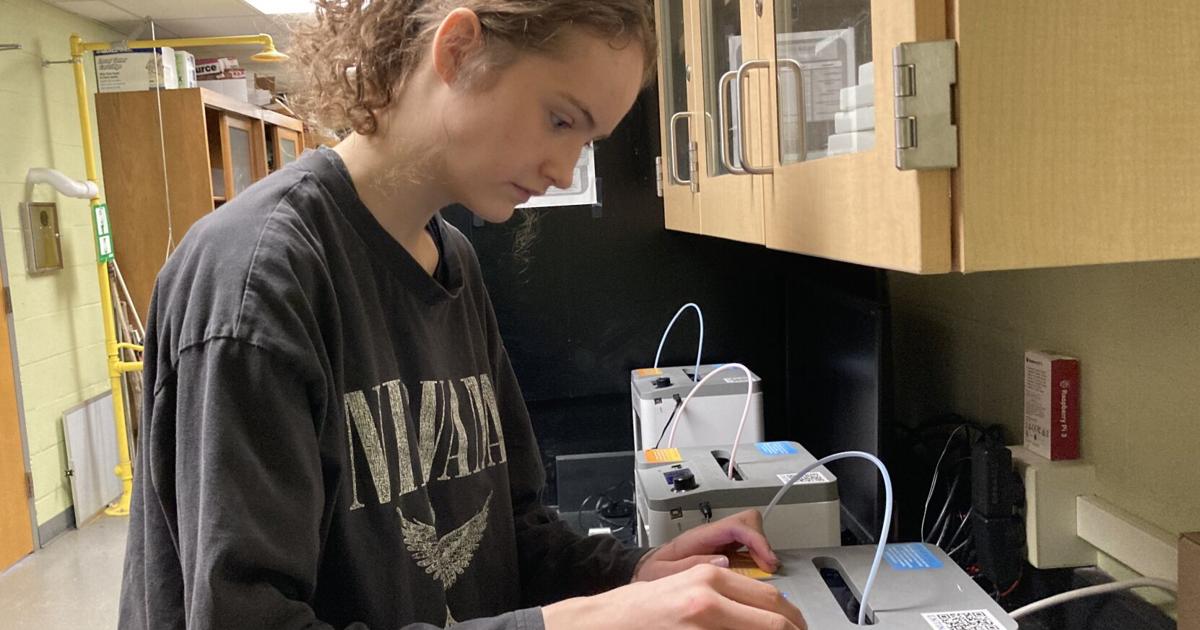
With her sights on studying engineering, Hoosac Valley High School senior Anna Thurston hoped to take Advanced Placement calculus this year.
But with just 65 students in her class, only four were interested. The course was canceled. Thurston chose Advanced Placement statistics instead.
Her experience isn’t unique.
As enrollment trends downward at northern Berkshire County’s three traditional public high schools, so does the number of courses offered.
For a public high school attempting robust programming, there is such a thing as being too small. With rising costs for transportation, and special education and state aid failing to keep pace, every taxpayer dollar spent on local education counts.
Across northern Berkshire County, shrinking class sizes, rising costs and the steady pull of school choice are reshaping the region’s public high schools. The leaders of Mount Greylock Regional School District, North Adams Public Schools, Hoosac Valley Regional School District and North Berkshire School Union are studying whether sharing services or regionalizing could help preserve academic programs while keeping costs under control.
Anna Thurston is a senior at Hoosac Valley High School. She has enjoyed the collaborations she's taken part in with students from other schools and sees value in establishing closer ties.
At Mount Greylock Regional High School in Williamstown, enrollment is declining. In 2010, Mount Greylock’s enrollment for grades seven to 12 was 641. Today, it is 543.
In North Adams, enrollment for grades seven to 12 was 616 in 2010. Hoosac Valley’s was 692. Today, both Drury and Hoosac Valley have enrollments of 389 for those grades.
Northern Berkshire schools are mirroring population trends in Berkshire County over recent decades.
Births have declined in Berkshire County, as has the overall population. In 1995, there were more than 1,400 births. By 2021, the number of births fell below 1,000.
The Berkshire Regional Planning Commission’s Public School Enrollment Projections predicted a 21 percent decline in enrollment between 2020 and 2030. Between 2015 and 2020, the county saw the number of students decrease from 15,911 to 14,758. Projections in a 2024 report predict the school population will continue declining to 11,397 by 2035.
Joe Bergeron, Mount Greylock’s superintendent, said lower enrollment presents a challenge to schools: “Costs are increasing faster than revenues are increasing, and so offering the same or better opportunities to our students is becoming more difficult.”
In February, 15 members of the Northern Berkshire Regionalization Study Steering Committee — representing nine towns — weighed two proposals from consultants for a six- to 12-month sustainability study on grades six to 12. The studies will culminate with four options to consider.
Mount Greylock School committee member Carrie Greene said state aid just isn't keeping up.
"We're all in the same boat in terms of funding and stressing our local communities to be able to meet the needs of our school districts," she said. "It's only going to make sense if it makes sense financially."
Greene said none of the state aid coming to district schools is adequate: Chapter 70 school aid, transportation reimbursement for regional schools, and aid for out-of-district placements for students with special needs.
State aid actually has increased over the past six years. However, student need and inflation have outpaced the increase.
“The system is broke,” state Rep. John Barrett said. “The (2018) School Opportunity Act hasn’t panned out to what it should be. There’s a lot of schools that have been left out.”
He estimated that rural school aid is underfunded by about $60 million annually as well.
Simply put, “More and more is falling back to the local communities, and they can’t afford it,” Barrett said.
House Bill 555 would establish a legislative commission to study and make recommendations for “a more equitable distribution of Chapter 70 school aid to municipal and regional school districts” as well as other entities receiving that aid.
Barrett said that bill appears to have traction.
The commission would review per pupil allocations, could recommend establishment of a reserve fund for extraordinary circumstances, and would look at long-term fiscal trends in school districts experiencing declining enrollment, as well as the impact of regional school districts on municipalities.
Barrett said, if established, the legislative commission also would look at the inflation factor, which is now capped at 4.5 percent annually.
It would be operating under a deadline of Dec. 31 to file its report and recommendations.
This isn’t the first time school districts in northern Berkshire County have tried to cut costs and enhance services by working together.
And it’s not the first time the subject of regionalization has come up.
In 2018, when Barbara Malkas was superintendent of North Adams Public Schools and Rob Putnam was superintendent of Adams-Cheshire Regional School District (now Hoosac Valley), the two discussed sharing an administrative team and superintendent as a cost-saving measure. While the concept had the backing of the North Adams mayor, it didn’t gain traction among the Adams-Cheshire school committee.
At about that time, the three districts also collaborated on special education services. That proved to be a short-lived experiment. The program relied on a state regionalization grant that ended, according to Malkas. Ultimately, it wasn't able to be sustained, said Tim Callahan, North Adams superintendent.
Carol Cushenette served on the Hoosac Valley Regional School Committee and is now on the Adams Finance Committee.
“This is not a new concept,” Cushenette said. “This is something that people have been talking about.”
In April 2024, she initiated discussions with Hoosac Valley Superintendent Aaron Dean and North Berkshire School Union Superintendent John Franzoni about regionalization.
“It’s not just about cost,” she said. “It’s about programming.”
The three looped in Jake Eberwein, project manager at Berkshire Educational Resources K12, and appealed to Barrett. Through state legislative earmarks, a total of $125,000 is available for the sustainability study.
Without that money, this process might not be happening.
“Even though the state maybe would appreciate fewer districts and larger districts than dealing with so many small districts, the state at this point does not incentivize regionalization studies or regionalization conversations,” Callahan said. “They’ve actually stopped the funding of grants that would facilitate regionalization studies or regionalization support, so that's one of the barriers that slows the process down.”
Barrett said he will seek more funding in the next legislative session if additional study is warranted.
Lyndon Moors was the band director at Mount Greylock until 2020 and now serves as chairman of the Lanesborough Finance Committee.
Before his first steering committee meeting, someone asked Moors whether the committee would contemplate building "one big school."
“I don’t think that’s what this is all about,” he said. “This is more organizational, structural, financial, avoiding duplication of boss contracts, of services (and taking advantage) of buying power when you’re associated with a larger group.”
Moors was a leader of the Mount Greylock Teachers Association when his district added Lanesborough and Williamstown elementary schools. He brought up a tricky aspect of that process: teacher salaries.
“We had to somehow synchronize pay scales amongst the faculty and the staff,” he said. “And so you can have various theories there. Do you bring down the top? Do you bring up the middle to meet it somewhere in between? Do you freeze the top and incrementally raise the lower salaries?”
If one of the recommendations does end up being full consolidation — or simply to share student services — there is a 3,491-foot obstacle to get around.
Transportation time and cost also come into play — particularly if students are moving among schools.
“Having Mount Greylock right in between all of us does make it more difficult to figure out,” said Bergeron, the Mount Greylock superintendent. “What does it mean for the logistical side of things?"
It's an example of the level of detail required when considering all aspects of consolidation of programs and sharing resources. Mount Greylock sits squarely in the middle.
Drury and Hoosac Valley are on the east side of it; Mount Greylock Regional on its west. Traveling between Mount Greylock and Hoosac Valley, a distance of 16.8 miles, takes 33 minutes, according to Google Maps. Traveling between Drury and Hoosac Valley, a distance of 6.4 miles, takes 12 minutes. Traveling between Drury and Mount Greylock Regional, a distance of 11.8 miles, takes 24 minutes.
North Berkshire School Union and North Adams Public Schools don’t get state aid for transportation because they aren’t part of regional school districts. Neither do towns in the North Berkshire School Union. Mount Greylock and Hoosac Valley do.
Even though the earlier experiment failed, the biggest driver to collaboration might be special education because it represents one of the largest uncontrollable costs for districts.
“It's just exponentially gone up,” Dean said at Hoosac Valley. ”Post pandemic, we've just seen an unbelievable increase in the numbers of students we have to serve, but also the cost of those services.
“We're dealing with a society in crisis, so we have to have programming to meet the needs," he said. "And it's very difficult to balance that with costs.”
If there were students that were behind going into the pandemic, their growth may have stalled or declined, Dean said. As they move into higher grade levels, those students are further behind. The pandemic also created a high level of anxiety among some families, leaving some students traumatized and requiring mental health support.
As of now, the Hoosac Valley district has 274 special education students. He estimates that’s about a 5 percent increase prior to the pandemic.
The total cost to place 10 students out-of-district is $1.3 million this year.
Prior to the pandemic, out-of-district placement cost Hoosac Valley about $300,000.
The criteria for special education hasn’t changed but more students are meeting the threshold for eligibility.
Collaborating on special education might not help the districts reclaim many students who are now placed out of district in programs costing as much as $200,000 annually, but it might help in other ways.
“Instead of having a program for three or four kids in a particular district, if you're combining districts or services, now that program will serve 12 students, and it won't be replicated in two to three other places,” Dean said. “That's where you're going to get the efficiency that makes sense.”
In terms of state aid for special education, Callahan summed up the problem: “The funding is not keeping up with the requirements.”
At Hoosac Valley, Dean has to contract for speech and language pathology services, a more costly solution than direct hiring. He said certified behavioral analysts and school psychologists can be hard to find as well.
With housing at a premium in Berkshire County and an associated labor shortage, the three districts are competing for labor and paying more for bus drivers.
After Hoosac Valley initiated its first innovation pathway to the medical field, Drury decided to implement a similar program.
“It's a situation where, if we were together, it wouldn't water down resources,” Dean said, adding that students from the two schools may well be competing for a limited number of slots with the Berkshire Workforce Board, which supports teens and adults entering the workforce. “But you're also having to work with schedules for two different schools. The county has only so many resources.”
Students from multiple schools already play on the same teams for lacrosse, hockey, football, golf and volleyball.
“The identity around athletics and around the athletic mascot and around the high school has certainly been more minimized over the last few years, because we've had to co-op,” Callahan said.
That's the case even though the demographics of students in North Adams and Hoosac Valley are more similar to each other than to those of far wealthier Mount Greylock.
“Mount Greylock was extremely proud of their football team," Callahan said. "Their football team won a state championship, and then a few years later, they couldn't sustain a football team, so all of their football players ended up wearing Drury blue and becoming part of the Drury Blue Devils.”
Now students from all three schools are wearing red and playing as Hoosac Valley Hurricanes.
“The kids want to play sports,” Callahan said. “And most of the sports that they play are with friends from other schools anyway, because they play in AAU basketball or they play in other leagues across the county. So they're not as stuck on this idea of the identity of the mascot or of the high school being their identity as an athlete. That’s more of a community identity. But it is a real challenge, and it's something that is definitely part of the conversation.”
Callahan said that’s one reason why community engagement will be an important piece of the sustainability study.
Sharing athletics has worked partly because practices take place after school, but programs like band and theater, which also rely on a critical mass of students for success, are more difficult to combine across schools. They take place during the school day.
In her time at Hoosac Valley, Anna Thurston has enjoyed meeting people on the volleyball court, when she played with the Drury team, and has enjoyed meeting students from other schools as part of her work with the Portrait of a Graduate, which aims to give students soft skills prior to graduation.
She sees benefits to closer connections among schools in northern Berkshire.
“If things were more closely knitted to each other, there would be more relationships built with students,” she said. “Probably schools would kind of operate the same and just (be) one big community.”
Read the Original Article
This article was originally published by Berkshire Eagle. Click below to read the full article on their website.
Visit Berkshire Eagle