
If passing MCAS replacement exams won't be a graduation requirement, what will their role be? Educators and lawmakers seek answers
A new set of proposed statewide graduation requirements has lawmakers and educators asking questions about continued reliance on testing — even if, as Gov. Maura Healey insists, those tests won’t be “high stakes.”
There’s also questions about whether the proposed standards, which include the coursework requirements for admission to the state’s public four-year colleges and universities, contradict years of educators promoting career technical education as a viable path not requiring college, or thousands of dollars in loans.
A K-12 Statewide Graduation Council, created by a Healey executive order, was formed last January in response to voters passing a ballot question removing MCAS exams as a high school graduation requirement. Its draft proposal was released last month, shortly after it also embraced the "Portrait of a Graduate" core competencies and skills that are already being applied in Berkshire County classrooms.
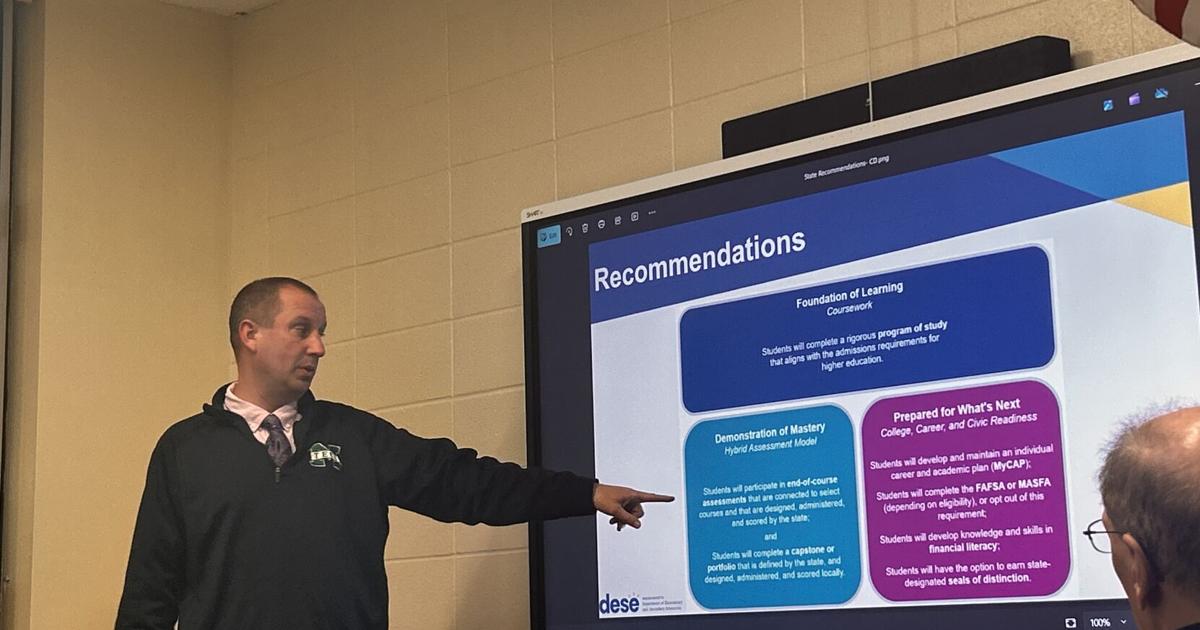
The statewide council's draft recommendations include “end of course assessments” in certain subjects that would be designed and graded by the state. Those exams would eventually replace the 10th grade MCAS tests, and passage would not be required for a high school diploma.
“What the end-of-course assessments are, are basically the tests you take normally at the end of your course,” the governor said last month. “That gives us the opportunity to assess how much the students learned, whether the right kind of progress has been made."
If the new exams aren't a diploma requirement, then what would they signify? That's still being worked out, the Graduation Council said. "The weight and role of EOCs, as one component of a comprehensive system that validates a student’s readiness to graduate, will need to be further reviewed and discussed with stakeholders before anything is finalized."
Traditionally, Massachusetts graduation standards, other than MCAS passage, have been set by each district. Setting statewide standards, the council said, "will also ensure that Massachusetts is the first state in the nation to offer a comprehensive statewide set of student-focused diploma requirements."
But Question 2, which passed with 59 percent of the vote, required students to only "complete coursework certified by the student’s district" to graduate.
In its draft proposal, the council said the weight and role of end of course exams “will need to be further reviewed and discussed with stakeholders before anything is finalized.”
The proposed standards would also require:
• Completion of coursework reflecting the MassCore college admissions requirements, including four units each of English and math, three units of lab-based science and social studies (including U.S. history), two units of the same world language, one unit of art and five units of other courses such as career technical education or electives. Financial literacy education would also be required.
• Completion of the federal or state application for student financial aid for college.
• An end-of-year capstone project or portfolio for graduating seniors.
In its report, the council said research on end-of-course assessments “positively correlated with high school graduation rates” with the biggest positive impacts on math and English language scores and high school graduation rates.
The Graduation Council is due to submit its final recommendations in June. But in the meantime, districts have been asked to submit “competency determination” standards for graduation, now that a minimum MCAS score is no longer the benchmark. The Department of Elementary and Secondary Education sought those requirements by the end of the year.
At the Northern Berkshire Regional Vocational School Committee’s Dec. 18 meeting, McCann Tech Principal Justin Kratz said there’s a consensus among the state’s vocational principals that the competency determinations are being sought as a “placeholder” for the Graduation Council’s work.
“There’s a large consensus that [DESE is] having us submit this so the Graduation Council has a repository of ideas,” Kratz told the School Committee.
But Northern Berkshire Regional Vocational Superintendent James Brosnan noted that many aspects of the proposed standards — notably requiring students and their families to fill out college financial aid forms — seem like a return to emphasizing college over technical career paths.
“I have to ask to the Secretary of Education why is that a goal?” Brosnan said. “We’re right back to where we were 40 years ago.”
A number of area districts already reflect the MassCore standards in their graduation requirements. But concerns have been raised that meeting those requirements could be complicated by teaching shortages, particularly in world languages.
State Sen. Paul Mark, in evaluating the proposal, said it was important to note that DESE “isn’t looking for a workaround to reimplement a different version of MCAS.” But he also stressed that any set of standards should not be one size fits all.
Mark noted his own story — he left college after a year, pursued a job in the building trades, and then returned to college — as an example of how young people can succeed without all following the typical path.
“What’s most important to me is that as students prepare to graduate they are able to find the skills they need to be successful throughout life without taking on exorbitant amounts of debt,“ he said. “There definitely needs to be flexibility on those paths while recognizing that whether you go into a trade or a college track, you still need to know a solid level of English skills, math skills, science skills, and personally, I think civics education as well.”
State Rep. Tricia Farley-Bouvier of Pittsfield said she has questions about the proposal — notably, how it will be funded, and whether it will still require “teaching to the test” even if the MCAS disappears. “We don't want an MCAS alternative. We want more teaching and less testing,” she said.
“Development of tests and purchasing of tests from big companies costs a lot of money,” Farley-Bouvier added. “So one of my questions is that money better spent supporting families and paying teachers and lowering classroom sizes?”
The Berkshire delegation to Beacon Hill includes a pair of former teachers: Rep. John Barrett III, who taught at Johnson Elementary School in North Adams before his long tenure as mayor of North Adams, and Rep. Leigh Davis, who taught in Ireland for 10 years before moving with her family to Great Barrington.
Barrett noted the process is just starting, and he will want to hear from teachers, administrators and state officials.
“A lot of questions need to be answered,” he said. “But I do believe there has to be some type of measurement for proficiency … I think that’s a must.”
Davis is withholding judgement until she sees the final proposal in June. That’s when she’ll be looking for input, especially from educators, on how new statewide standards would be rolled out. She'll be looking for funding support for local school districts, especially rural districts such as those educating Berkshire County children, to help implement new standards.
“The next phase of the council’s work is crucial,” Davis said. “It’s the final details that will that bring this into focus for me.”
Eagle reporter Izzy Bryars contributed to this report from North Adams.
Read the Original Article
This article was originally published by Berkshire Eagle. Click below to read the full article on their website.
Visit Berkshire Eagle