
Kathleen Lambert, BRTA’s new administrator, discusses goals for public transit in the Berkshires
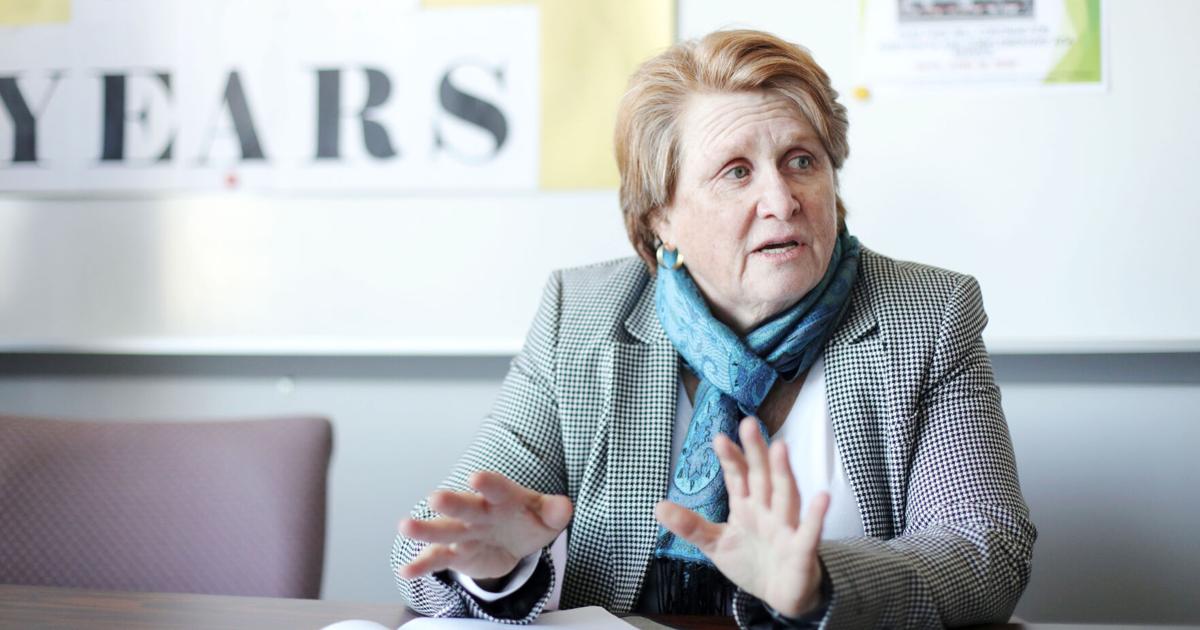
PITTSFIELD — Kathleen Lambert has always wanted a car-free lifestyle. As the new administrator for the Berkshire Regional Transit Authority, she’s thrilled that she now lives close enough to walk to work — and hopes to make car-free commutes a reality for as many people in the Berkshires as possible.
“Making transit reliable, fast, convenient is something that is my goal,” she said. But she’s aware of the challenges ahead: “We need more funding, no doubt.”
Lambert began her three-year contract with BRTA on Dec. 1, putting her in charge of a transit system struggling to balance a boom in ridership with an ongoing driver shortage. She previously served as the deputy administrator for the Merrimack Valley Regional Transit Authority for four years, following stints working in architecture as well as community and transportation planning across several states.
The BRTA advisory board decided her experience was worth higher pay: Lambert’s first-year salary of $152,250 is about 28 percent higher than what her predecessor, Robert Malnati, made in 2024.
State funding has made it possible for BRTA to provide fare-free bus rides until June, which has resulted in a substantial increase in ridership on fixed-route buses; keeping it that way will require continued advocacy from BRTA in Boston to secure a share of the governor’s annual budget.
The latest performance measure data shows that ridership on fixed routes this past October came to 66,807, a 30 percent increase compared to the same month last year. While BRTA has introduced hiring incentives for new drivers, including a $1,000 sign-on bonus, the transit authority still struggles to staff its 15 fixed bus routes and paratransit services with qualified drivers.
At the end of Lambert’s first week as administrator, she sat down with The Eagle to discuss her top goals, including her plans to improve Berkshire County’s public transportation offerings and address the driver shortage.
The following questions and responses have been lightly edited and condensed for clarity.
THE EAGLE: What made you decide that this position was the right next step for you to take in your career?
LAMBERT: I think the Berkshires and this region has a tremendous amount of opportunity for really taking advantage of multimodalism. We have terrific trails here. We have great cycling infrastructure on a lot of the roads, including highways. And when you have that, [and] a major transportation network, the cycling and pedestrian access becomes the secondary access, which is incredibly important for connecting to those services and meeting the needs of folks who don't have other transportation, particularly folks who are low income and work in low income jobs. If they can afford a bicycle or an e-bike, then they can access our services and also get to work, maybe a better opportunity for more pay. That will help support their growth.
THE EAGLE: What are your biggest priorities for improving public transportation in the Berkshires?
LAMBERT: We have a great bus network that runs the spine of the Berkshires. But it is hourly service, so it's not as good as it could be. If we could improve service to [every] half an hour and add Sunday service over time, I'd really like to be able to do that. ... We might want to look at the schedule and see if we can add later hours. I'd like to get [that] at least in Pittsfield, in the cities, in Great Barrington. ... Maybe not the entire length of the Berkshires, but maybe in some of the more densely populated areas. The other opportunity to serve our rural communities is microtransit. … I think technology is the important piece to make that run properly. Microtransit is most effective when it can connect to the major transit routes, whether it's a train or a bus or our [Link] 413 coach service.
(The yet-to-be-implemented Link 413 project aims to connect Pittsfield to Northampton and North Adams to Greenfield through an express service that will utilize four buses.)
THE EAGLE: Do you have an exact date for when the Link 413 system will be active?
LAMBERT: We don’t quite, but we’re close to announcing a date. Part of the issue is we’ve run into some technical problems with the vehicles we’ve purchased. They need a little bit more refurbishment than we originally understood.
THE EAGLE: How will you approach the unique challenges of providing public transit in a rural area like the Berkshires?
LAMBERT: What the transit can provide is that ride that's far away to a job. … Microtransit can fill those gaps. Microtransit will allow someone to book a local ride within the community, but also connect them to our major transit routes for longer runs or our coach service for even longer runs. It's going to give a lot of mobility to different populations. … We need more funding, no doubt. We need more personnel. Getting drivers is a challenge, and recruiting folks into the industry is a challenge. But I think we can utilize our technical schools to assist us with that. A lot of folks, they're not necessarily college material, and they don't know what alternatives are out there for a good career with longevity, union pay, benefits and respect from the community for the job that you do. And I think that our drivers have that.
THE EAGLE: With free fares for buses slated to continue into June, there's been a significant increase in ridership rates that has tested the limits of BRTA’s driver shortage. There have been delays and even some canceled routes. What are you going to be doing to address this problem?
LAMBERT: What I really want to do is work on the cancellation issues. … We need better coverage in our driving staff to make sure it doesn't cancel routes if [callouts] happen. ... It's not always easy, however it is important to respect the job that you're doing, and also for us as an agency to respect our driving staff for the job they're doing. We rely on them. We wouldn't have a service if we didn't have the dedicated folks who run these buses, and I value that 100 percent. I just want the public to know that we are working on that issue.
THE EAGLE: What are some of your plans to incentivize new drivers to come onto the force?
LAMBERT: I'd really like to understand how we can partner with local technical schools and also community colleges. … Working in this industry is a great career. You may start as a driver, but you may end up as a general manager or a transit administrator. ... There are folks who end up in my seat, who become administrators. So I think it's an opportunity to work in an industry that a lot of folks aren't aware of. And we desperately need mechanics to work on the big vehicles. Finding a good diesel mechanic is like hen's teeth these days. … There's a lot of folks that we need to support getting into more traditional trades.
With our new federal [bus and bus facilities] grant, we got the opportunity to purchase a driving simulation piece of equipment. The state has been talking about opening up a new CDL driver training program out here. We're going to partner with the [Berkshire Innovation Center] and the city to set up that driver training program, which we're working on now since we got the grant for the machine and the software.
Read the Original Article
This article was originally published by Berkshire Eagle. Click below to read the full article on their website.
Visit Berkshire Eagle