
Lenox police to crack down on speeding on Pittsfield Road state highway
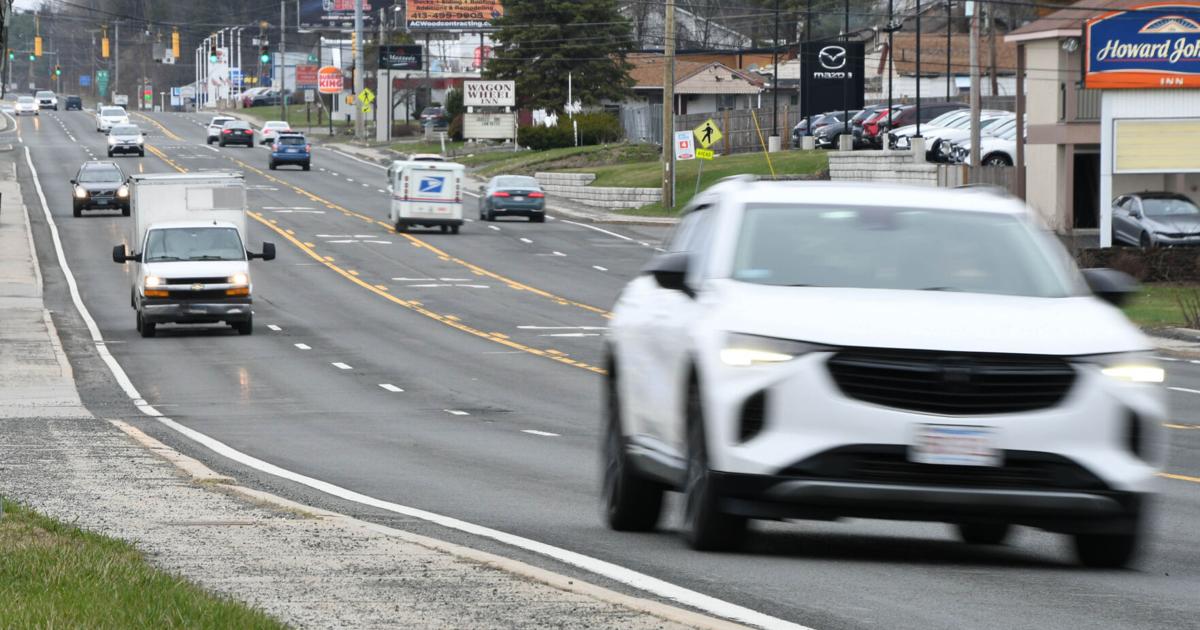
LENOX — Chronic speeders on Pittsfield Road beware: Lenox Police are stepping up enforcement with drivers exceeding the limit by 10 mph or more.
The 4-mile stretch of Route 7/20 from the start of the bypass heading north to the Pittsfield city line is initially posted at 55 mph, then drops to 45 mph and finally to 40 mph, with the lowest limit in the commercially congested area from New Lenox Road to Guido’s Marketplace.
Chief Mark L. Smith has been using his unmarked cruiser to stop speeders, usually with warnings since the typical speeding citation carries total additional costs of $1,300 or more, he said, reflecting insurance surcharges for six years until the violation is cleared from unsafe driving “points.”
“People drive awful,” said Lenox Police Chief Mark L. Smith, shown in his office recently. “It’s definitely a pet peeve of mine." He is pursuing grants from the state Department of Transportation that pay overtime for officers dedicated to speed enforcement and awareness.
“People drive awful,” he said. “It’s definitely a pet peeve of mine." Smith noted that “contrary to popular belief, you don’t get 10 mph over the limit. The speed limit is the speed limit, legally speaking.”
But motorists pushing 10, 15, 20 mph or more beyond the limit, “that doesn’t work,” the chief emphasized, noting the number of side streets and business entrances and exits that come off the state highway, which has a variety of mixed-use commercial and residential development.
“We are taking it seriously," he said. "Our patrols have been told we’ll soon have two unmarked cars out there."
The Pittsfield Road section of the state highway is among the county’s most heavily traveled local roadways, with nearly 24,000 vehicles per day on a year-round average, rising well over 30,000 during the summer tourism season, according to MassDOT surveys — second only to the MassPike section through Berkshire County.
At last week’s televised Select Board meeting, road safety and speeding came up again, Selectman Neal Maxymillian stressed that “the speeding there is terrible” but that the highway is under state jurisdiction.
“I’ve raised my own concerns about this many, many times,” he said in response to a concerned resident of Pittsfield Road.
Smith is pursuing grants from the state Department of Transportation that pay for officers’ overtime to educate the public about speed.
Lenox Police are stepping up enforcement along Pittsfield Road in Lenox as drivers typically exceed the speed limit by 10 mph or more.
A moveable speed trailer is on the way from the state — mobile radar units that display the posted limit as well as an approaching motorist’s actual speed. They will be deployed on Pittsfield Road northbound just before New Lenox Road for a number of weeks and then moved to other areas of town to help step up enforcement.
There’s also a speed device mounted on a pole heading into town on North Main Street from the state highway, alerting drivers to the business district ahead and the 20 mph limit through the heart of downtown.
Recent complaints haven’t fallen on deaf ears.
“We’re doing as much as we can," Smith said. "We need people to slow down. The speed limits are fast enough; they’re generous.”
Last December, a citizens petition signed by at least 137 area residents sent to MassDOT Region 1 headquarters in Lenox advocated for a one-lane per direction highway and a 25 mph limit. The petition, also addressed to city and town officials in Lenox and Pittsfield, urged a traffic study and it advocated for a “protected bicycle lane and a continuous ADA-compliant sidewalk.”
At the time, Lenox Town Manager Jay Green suggested it was unlikely the town would support the proposal because of anticipated adverse results such as shifting traffic onto streets in dense residential neighborhoods.
According to the state's website, a "road diet" is "a roadway configuration that involves narrowing or eliminating travel lanes to calm traffic speeds and increase safety of all roadway users. A road diet does not automatically cause congestion, and when it does safety is the preferred tradeoff."
Read the Original Article
This article was originally published by Berkshire Eagle. Click below to read the full article on their website.
Visit Berkshire Eagle