
Mass Audubon creating its second-largest Berkshire wildlife preserve on newly acquired Becket parcel
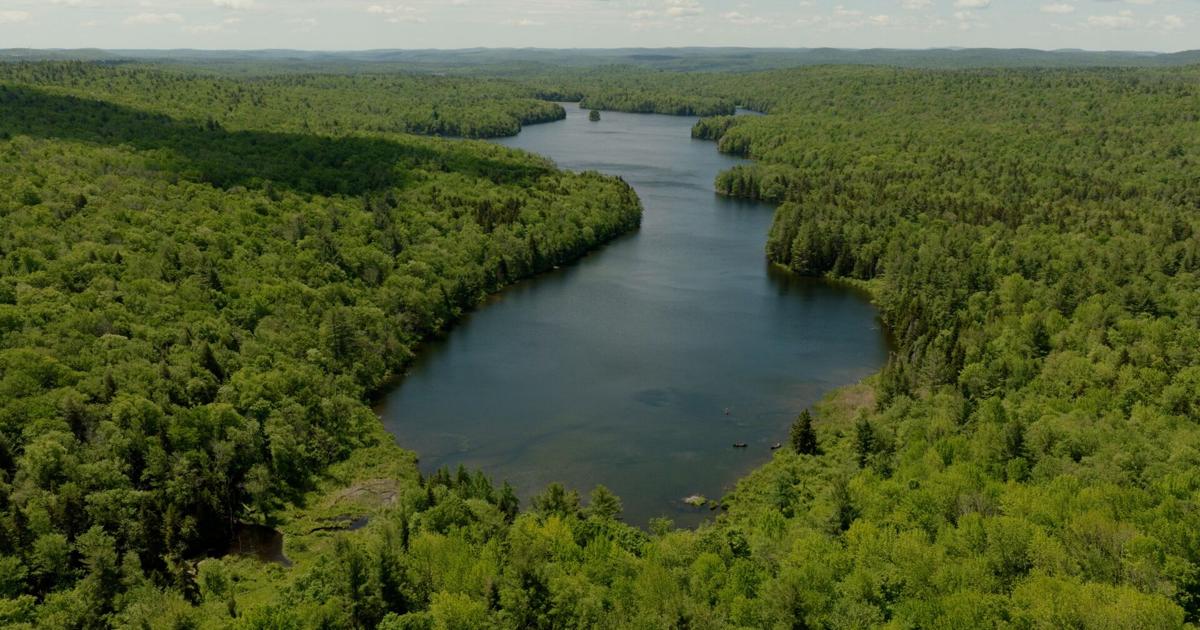
BECKET — A remote woodland wilderness framed by a pristine lake is now in hands of Mass Audubon as the Palmer Brook Wildlife Sanctuary following a major land purchase last month.
Eventually, the 850-acre property in a remote section of Becket will be gently transformed into the statewide land protection nonprofit’s second largest wildlife preserve in Berkshire County — after the 1,405-acre Pleasant Valley Wildlife Sanctuary in Lenox.
The Strassler family's Palmer Brook Corp., which had owned the property since the 1960s, sold it to Mass Audubon for $5 million. The site at Plumb and Tyne roads, previously home to the private Berkshire Fishing Club, is about 2 miles beyond the Jacob’s Pillow dance center and festival.
The property includes the 125-acre pond known as Palmer Brook Lake, impounded by an earthen dam constructed by the former owners for recreation, as well as a small lodge that may become a visitor center hosting a broad range of nature education and recreation opportunities for the community.
Mass Audubon is planning to lightly develop its newest land preservation project in the Berkshires, Palmer Brook Wildlife Preserve in Becket, 2 miles from Jacob's Pillow. The nonprofit acquired the 850-acre wilderness land last month for $5 million.
The site offers habitat for a wide variety of plant and animal species, enhances climate resiliency, and eventually it will be a wildlife sanctuary fully open to the public, according to Mass Audubon.
“There are very few land protection opportunities at this scale in Massachusetts, especially a single parcel like this one,” said David Santomenna, Mass Audubon’s senior director for land conservation. “It’s an extremely intact landscape, and the sense of place is really special. You see no other structures, and the way you get there is also special.”
“It’s been a pleasure to share this space with so many people over the past 26 years the Fishing Club was open," said family representative Alan Strassler.
"All of the family members are thrilled and could not ask for a better outcome of the property. And in the end, it’s not really saying goodbye, knowing it will be preserved for future generations with Audubon managing the space in a controlled way," he said. "I am looking forward to visiting the property in the future to keep my memories fresh. It will always be a very special place to our family.”
Mass Audubon’s purchase was partly financed through its 30x30 Catalyst Fund, whose lead donor — MathWorks Corp. in Natick — gave $25 million to the fund two years ago, Santomenna said.
Two state conservation grants contributed $2.5 million for the acquisition, which also was supported by private donors, mostly in the Becket vicinity.
To prepare the property for visitors, a total of $2.5 million to $3 million has been budgeted from Mass Audubon’s sanctuary startup fund, said Regional Director Becky Cushing Gop, who oversees 20 sanctuaries in Western Massachusetts, including Pleasant Valley, Canoe Meadows in Pittsfield and Lime Kiln Farm in Sheffield.
“Palmer Brook offers a lot of diversity in the kinds of experiences visitors could have,” she told The Eagle in a recent interview.
The Palmer Brook Lake in Becket is part of the 850-acre parcel acquired by Mass Audubon. The nature conservation nonprofit plans to open the land for recreation over the next two years.
Trail development as well as building and water access and educational programming for adults and children are all under consideration. The plan will take roughly two years to complete, but in time there may be visiting opportunities before a full opening, Cushing Gop said.
“Starting a sanctuary is an incredible opportunity, and we want to take the time to set it up in the best way we can,” she said. “We don’t want to just jump in and put in a trail anywhere.”
Mapping the trail potential will be an important first step.
Evaluating the potential use for the existing small lodge is also under close examination, she added. Parking lots and signage will also be part of the master plan under development.
“It’s going to be a lot of work, but you can see the potential intuitively that made it compelling when you see the property,” Santomenna said.
Community meetings will be held in Becket to gather ideas from residents. Still to be determined is the extent of winter activities, though the land will have year-round access.
“Already, folks are sharing their perspective and that’s been really helpful,” Cushing Gop said. “People have raised their hopes and dreams, and shared their concerns, and all of that goes into our planning documents.”
The property, once it’s open to the public, will remain under a state conservation restriction. Mass Audubon has been eying it for decades, Santomenna said. The final steps toward acquisition took about 18 months.
The land purchase expands a 26,000-acre conservation corridor anchored by the adjacent October Mountain State Forest’s 16,500 acres.
"The land has challenging issues that we can resolve," Mass Audubon President David O'Neill told The Eagle last fall as the transaction was developing. Recalling a wintertime visit to the property, even when it was encased in snow and ice "it's a beautiful parcel of land; it's brilliant," he said.
The creation of a trail system while upgrading the existing log cabin clubhouse and parking area mean “we're not starting from zero," O'Neill said.
The vast forested acres provide excellent habitat for forest-dependent birds as well as moose, bear and other species, according to MassAudubon. A forest of that size also acts as a natural climate solution, storing carbon and preventing it from entering the atmosphere, an announcement from the nonprofit noted.
Local conservation partners included the Becket Land Trust and the Berkshire Natural Resources Council.
Read the Original Article
This article was originally published by Berkshire Eagle. Click below to read the full article on their website.
Visit Berkshire Eagle