
McCann Technical School's fiscal 27 budget adds staff, begins payments on long-planned roof project
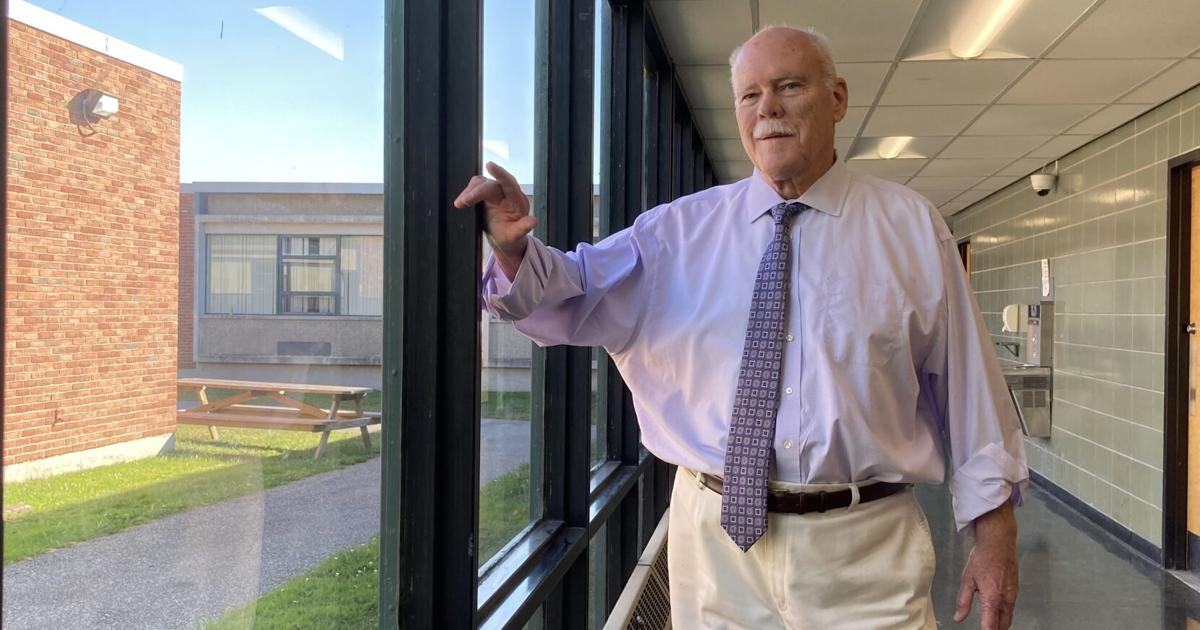
James Brosnan, superintendent of Northern Berkshire Regional Vocational School District, is trying to drive costs — and the need for borrowing — down for a roof and window replacement project at McCann Technical School.
NORTH ADAMS — McCann Technical School has proposed a $13.2 million level-service fiscal 2027 budget that includes the first-year borrowing costs for its upcoming building project.
At a recent budget hearing, McCann officials presented an increase of about 4.5 percent over last year, which accounts for rising fixed costs, new administrative staff and the initial interest costs for the school’s $16.8 million roof and window repair project. The building project cost will be spread across its nine member communities: Adams, Cheshire, Clarksburg, Florida, Lanesborough, Monroe, North Adams, Savoy and Williamstown.
The fiscal 27 budget includes $157,000 of short-term interest, the first local payment toward the school’s roof and window replacements. Superintendent James Brosnan told the North Adams finance committee on Monday that the project was currently under budget and total contributions could be slightly less than expected, though there are no final numbers yet.
Last year, the Massachusetts School Building Authority agreed to pay for roughly $9.3 million of the long-needed roof and window repairs to the school. After that, McCann’s communities agreed to split the remaining $7.4 million with $2.2 million of interest over a 15-year bond, totaling the local share to just over $9 million.
“We've got to maintain our facility; we've got to keep it up, otherwise, we are faced with ruin,” Brosnan said.
The level-service budget reflects rising cost-of-living adjustments and nearly $200,000 in increases for health insurance. It also adds a second assistant principal at $120,000, along with a special education teacher and an English Language Learner teacher, which Brosnan said are critical to “right-sizing” the administration.
He assured McCann’s school committee and member communities at a recent meeting that the added salaries would fit in the budget and that this position should’ve been added five to 10 years ago.
With one principal and one assistant principal overseeing the administrative work of some 500 students, Brosnan said the team cannot do all the work, from keeping up with teacher evaluations to reviewing state data reports to overseeing the disciplinary reports of students — 40 percent of which are on Individualized Education Programs or 504 Plans, or disability accommodations.
As McCann has added more special education offerings, Brosnan said, the state has added more compliance — which means more paperwork that is piling up with the staff they now have.
“I need three people, the principal and two assistant [principals] to get that done properly,” he said. “We need someone to focus strictly on the discipline piece” and the other would focus on curriculum.
Further, in discussions with the state, Brosnan said he learned that McCann has the lowest number of administrative staff statewide.
“What [DESE] sends us for reporting data is absolutely unbelievable … it’s a full-time job,” he said, and when asking other schools how they do it, they have multiple aides to the principal to divvy up work.
Brosnan told the finance committee meeting in North Adams that state aid is also not keeping up with costs, partially because the aid raises slightly but so does mandatory district spending.
Chapter 70 state funding rose half a percent, or $35,000, the same as last year, Brosnan pointed out, while municipal minimums rose 5 percent and net school spending raised more than 2 percent, or over $200,000. Similarly, transportation assessments from the state increased 0.19 percent, though the legislature is trying to increase that, a game that will play out into June, he said.
Driven by enrollment, Lanesborough saw the largest assessment increase of the school’s communities, $272,273 to $412,209.
Brosnan also pointed to a leveling of Chapter 70 aid starting around 2024-2025, which he said was partly due to the Student Opportunity Act formula that determines aid increases partially based on district enrollment.
“We reached that point where we were no longer gaining on that piece,” he said. “So you see significant changes up to 24-25 and it's leveled out in the last three years.”
Brosnan said the faculty is currently at about 55 teachers and six special education teachers.
“Staff-wise, we are in a good place.”
Read the Original Article
This article was originally published by Berkshire Eagle. Click below to read the full article on their website.
Visit Berkshire Eagle