
Meet Hara Charlier, the new president of Berkshire Community College
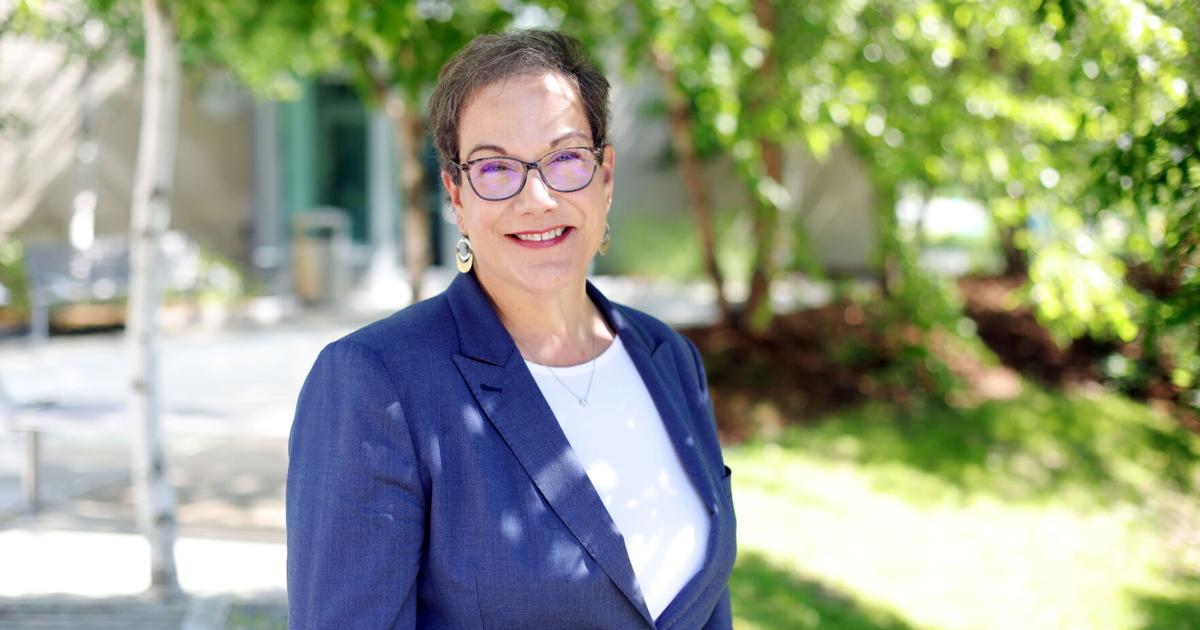
PITTSFIELD — Hara Charlier knows firsthand that the journey — in education and in life — is rarely a straight line.
Berkshire Community College’s eighth president, who officially succeeded Ellen Kennedy on July 1 and moved into her office this week, says she attended five colleges on the path to her undergraduate degree from Cornell University.
“I tell students, 'Do as I say, not as I do,' please,” Charlier said. “But you know, what kept me going was those special faculty and staff members who helped me along the way.”
That support is the key to BCC’s continued success, Charlier — pronounced “SHAR-lear” — said in a conversation with The Eagle on Thursday morning.
Students and faculty walk through the campus between classes at Berkshire Community College in Pittsfield. The college named its eighth president, Hara Charlier, to replace Ellen Kennedy.
The following is a condensed version of Charlier's interview, lightly edited for clarity:
THE EAGLE: What about this place, once you were here and talking to folks, made you think, 'This could be my next job'?
HARA CHARLIER: When I came here the very first time, I could tell this was a community that cared … that it had a sense of place, a sense of community, and grassroots efforts to make it a better place. They care about one another here, and that was so obvious. ... And in the first few days I've been here, people are really quick to tell me "We're about community here. This is our place. We take pride in it, and we want to make it better." That doesn't happen everywhere in the country, so I'm very excited.
THE EAGLE: Tell me about your academic background and how you came to higher education, and then how you came to work in administration?
CHARLIER: I often refer to myself as the accidental president ... My background is in teaching biology and anatomy and physiology and microbiology, and I thought that's what I would always do because I love the magic that happens in the classroom, and I really believe in the power of education.
I thought I'd always do that, and then opportunities come up. And at first, I'll be honest: When I had the first opportunity to go into administration, I said, "Why would you ever want to do that?" But you know, colleagues help you see yourself in different ways, and I've been very fortunate to have mentors in my career who said, "I really think you should try that."
But the interesting thing is that I'm all about people. Everyone here is all about people, and as you move into administration, you get to see a much bigger view of all of the really cool interactions between faculty and staff outside your own classroom. You start to see it at the department level, and then the division level, and then the college level, and that's really powerful.
"Community colleges exist for the community," said Hara Charlier, Berkshire Community College’s new president.
THE EAGLE: You mentioned you attended five colleges in pursuit of your undergraduate degree. Tell me about the climb.
CHARLIER: I came from a really privileged background, and I want to be clear about that. I never forget that my parents went to college, so I had people behind me. Not all of our students have that. What I didn't have is any direction or a lot of belief in myself, so I'd go to one college and get a bag of credits and hit a bump, and then leave. I never connected with the college, but I did keep going because I had parents that said to me, "You can do this." ... So although I was able to keep going, that direction took me a long time.
Along the way, it was just the people who helped kind of pick me up and keep me going. But it really informs the work I do in my career, because I probably would have stayed at a college if I'd connected with the college. Here at Berkshire Community College, we have incredible student engagement, incredible student success, and if some of those institutions had had that, I probably would have weathered those bumps and stayed there. Instead, I left. So we never want any student to walk alone.
THE EAGLE: What are you seeing so far, in terms of how the college is meshing with the community?
CHARLIER: Community colleges exist for the community. You've probably seen the college's campaign that says "Powered by the Berkshires," which is something that I obviously had no part of developing, but my incredible colleagues did, and it says an awful lot. You know, everything this college does is powered by the community, and it's reciprocal. So everything the institution does has to go back and serve Berkshire County.
A community college does its work when we transform students' lives. We do that by helping them develop specific skills, but also being these contributing members of society and growing into the people that we know they can grow into. So our programs are very much dedicated to helping students grow in all of those different ways. So the college has a lot of liberal arts and sciences and humanities and a tremendous dedication to making sure that students have access to applicable skills and they have practice communication and team building and problem solving.
In addition to that, of course, we have other programs that are very much specific skill-based, right? Things like training EMTs and looking at a new HVAC program. All of these things are needed desperately in Berkshire County.
THE EAGLE: AI seems to be changing things so quickly, but is there still a real need for human skills that transcend technology?
CHARLIER: AI is changing a lot of things, but we will always need people who can communicate, who can problem solve, who can work together, and the best way to learn those skills is through higher education. We can demonstrate that each and every day, and I'm so impressed by what I'm seeing in my first few days.
THE EAGLE: Have you had the opportunity to talk to Diana L. Rogers-Adkinson, your new counterpart at MCLA?
CHARLIER: It was very brief. We met at an event for [Gov. Maura Healey] in the last few weeks, but it's really exciting to have both of us coming in at the same time. So in our brief interaction, we both looked at each other and said, "Wow!" I mean, this is our new community, and we're very committed to making sure that the two institutions are working together and collaborating, so that students have tremendous opportunity.
Students come to us with lots of gifts and challenges and goals. Some will start at MCLA and other institutions. But the connection between our institutions is critically important, and we see MCLA as one of a number of really powerful institutions where students can finish up at BCC and then continue on to get that bachelor's degree, which is so important to so many careers.
THE EAGLE: What would you like people to know about you?
CHARLIER: I would like people to know that everything I do in my life and in my career is about people and relationships. I think the way we live a rich life is by connecting with others. So if someone has a thought about the college, is curious about me. I would love them to reach out and have that authentic conversation. That's how I will learn about Berkshire County. That's how I'll learn what the community needs, and that's how my life becomes richer too.
THE EAGLE: You mentioned the importance of focusing on students. Why is that so important?
CHARLIER: As I shared earlier, our students come to us from so many different backgrounds, and they bring all these gifts and challenges and opportunities, and it's our job to meet them where they are. There was a time in higher education when people used to say things like, "Is this student ready for college?" But really, a long time ago we realized that is the wrong question. The right question is, "Is BCC ready to accept every single student with every single opportunity, gift, and challenge?" And I can tell you that this is a college that really embraces that, that makes sure that this is welcoming and inclusive and there are resources for every student.
So when students talk to us and they say things like, "I'm not college material. I don't belong in college," the answer to that is "That is absolutely false." Of course you do, and we know that higher education helps students change lives. We know this, and communities. So we want people to know that this is the place they belong.
Read the Original Article
This article was originally published by Berkshire Eagle. Click below to read the full article on their website.
Visit Berkshire Eagle