
Meet the historian bringing W.E.B. Du Bois' Great Barrington to life
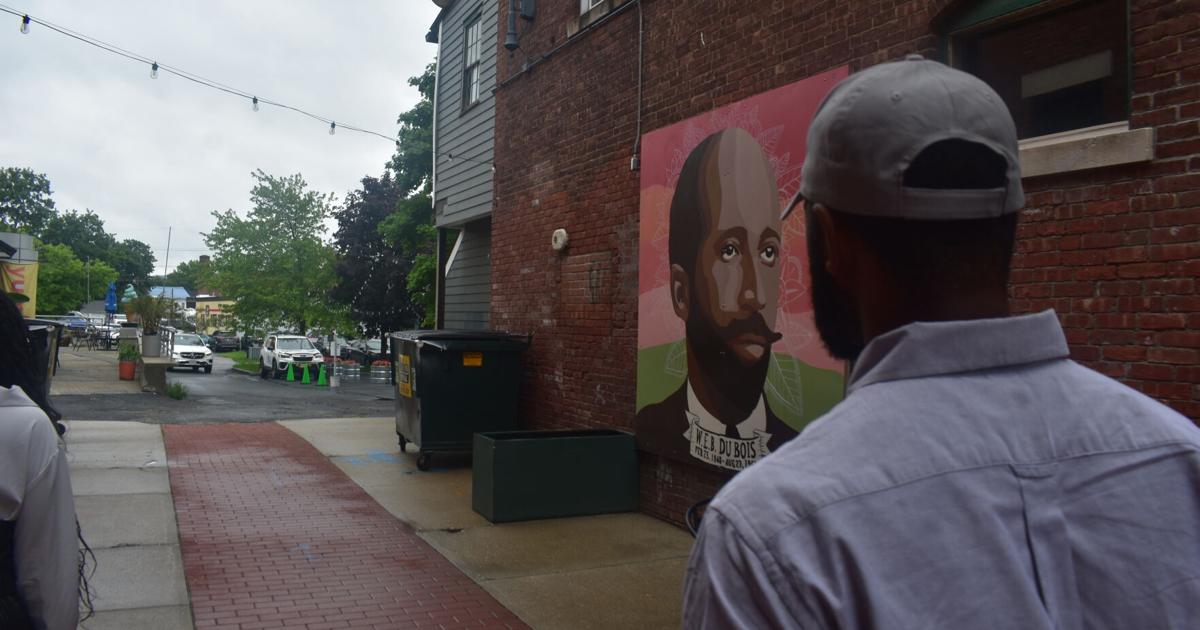
Marcus Smith, 33, is the deputy director of the Du Bois Freedom Center, a nonprofit transforming the A.M.E. Zion Church into an interactive museum of Du Bois and other prominent Black individuals in the Berkshires.
GREAT BARRINGTON — Marcus Smith turned the key to the aging and deconsecrated Clinton A.M.E. Zion Church. Once the center of Great Barrington’s Black community — and an early influence on Berkshire native W.E.B. Du Bois — today it sits in disrepair, its front doors boarded shut.
He pushed on the door, fighting to keep his balance on the wet, wooden stoop.
The door would not budge. But Smith unlocked another kind of history, tracing the lives and legacy of Great Barrington's Black community.
Marcus Smith turned the key to the aging and deconsecrated Clinton A.M.E. Zion Church. Once the center of Great Barrington’s Black community — and an early influence on Berkshire native W.E.B. Du Bois — today it sits in disrepair, its front doors boarded shut.
“The connection between Du Bois, Great Barrington and the church is not a spurious one, it's an intentional one,” he said. “It’s a powerful one.”
Marcus Smith, deputy director and interpreter at the Du Bois Freedom Center, speaks to a tour.
Smith, 33, is the deputy director of the Du Bois Freedom Center, a nonprofit transforming the A.M.E. Zion Church into an interactive museum of Du Bois and other prominent Black individuals in the Berkshires.
This summer, Smith is guiding visitors on a tour through the streets of Great Barrington, bringing to life the sites and memorials that mark Du Bois’ upbringing, such as the A.M.E. Zion Church, where he served as the secretary to the Women’s Sewing Society in his youth, and his birth site, near the Housatonic River.
This summer, Marcus Smith is guiding visitors on a tour through the streets of Great Barrington, bringing to life the sites and memorials that mark Du Bois’s upbringing, such as the A.M.E. Zion Church, where he served as the secretary to the Women’s Sewing Society in his youth, and his birth site, near the Housatonic River.
Smith said his tours aim to strike a balance between celebrating figures like Du Bois and telling the stories of the ordinary residents who shaped Great Barrington's Black community.
“For all of [Du Bois’] intelligence, his creativity, his moral vision, it's important for us to understand the ways in which that was shared by the community he invested himself in,” Smith said.
Raised in Houston, Texas, where he received his bachelor's in political science at the University of Houston, Smith went on to earn a masters in African-American studies from Georgia State University before joining the W.E.B. Du Bois Department of Afro-American Studies at UMass Amherst as a PhD candidate in 2021.
Yolanda Covington-Ward, a professor in the department, met Smith in 2022. She was so impressed by his work ethic that she gladly accepted when he asked her to advise his thesis.
“One of the things I love about Marcus is that he doesn't want Black history to just stay in a book or in a classroom,” she said. “He wants it to be part of a larger public conversation.”
In 2025, Smith founded the Black Grassroots Heritage Preservation Network, an organization that supports and connects bottom-up efforts across the country to preserve history in Black communities. Part of that work includes interviewing the people who preserve these sites, and mapping them for the public.
Dr. Dennis De Shields, a physician and the co-founder of the Bellevue Passage Museum in Bellevue, Md., is a member of the network’s board. De Shields was struck by Smith’s enthusiastic approach to history when he participated in a field school at Bellevue in 2022.
“The community was really engaged with Marcus,” De Shields said. “He made a point of giving credit, but not only that, he had the oral histories transcribed and presented to the families.”
Ann Chinn, another board member and founder of the Middle Passage Ceremonies and Port Markers Project, said that while her organization focuses on the movement of captive Africans to the United States, being a part of the network unites the stories she tells with the broader history of race in the country.
Historian Marcus Smith leads a tour by a mural of W.E.B. Du Bois in Great Barrington.
While his work is national in scope, Smith said he has always seen it as a journey of self-discovery.
Every Christmas, Smith would travel to his grandparents’ home outside of Kilmichael, Miss., where his grandmother, Bernice Purnell Cain, would recite the oral history of his family.
“She would say, ‘This house was owned by your great-grandfather, J.C. Purnell, and his wife was Ella Purnell, who had two daughters and one son,’” he said. “They really emphasized the importance of oral history, of storytelling, but also what the importance was of communicating history to new generations.”
Last May, American Heritage Chocolate, a Mars brand, chose Marcus Smith for their 2026 History Tellers award, spotlighting him for his work at the Du Bois Freedom Center.
Last May, American Heritage Chocolate, a Mars brand, chose Smith for their 2026 History Tellers award, spotlighting him for his work at the Du Bois Freedom Center.
The news came only weeks before his grandfather, Percy L. Cain, passed. Even with that loss, Smith said he felt like he was honoring his grandparents’ memory.
“It feels like I have the ability to say, ‘Du Bois’ voice is calling everyone here,’” he said.
“I'm glad I'm contributing to the legacy of those who came before, and promoting the legacy of Du Bois.”
Read the Original Article
This article was originally published by Berkshire Eagle. Click below to read the full article on their website.
Visit Berkshire Eagle