'Meeting people where they are.' Inside Berkshire Harm Reduction’s approach to addiction
NORTH ADAMS — For Samantha Kendall, progress in addiction care might not look like progress to the general public.
Whether encouraging people to test their drugs, handing out clean syringes or providing a trusted place to discuss drug use, Kendall, a harm reduction training supervisor at Berkshire Health Systems, wants to “meet people where they are” with substance use disorder.
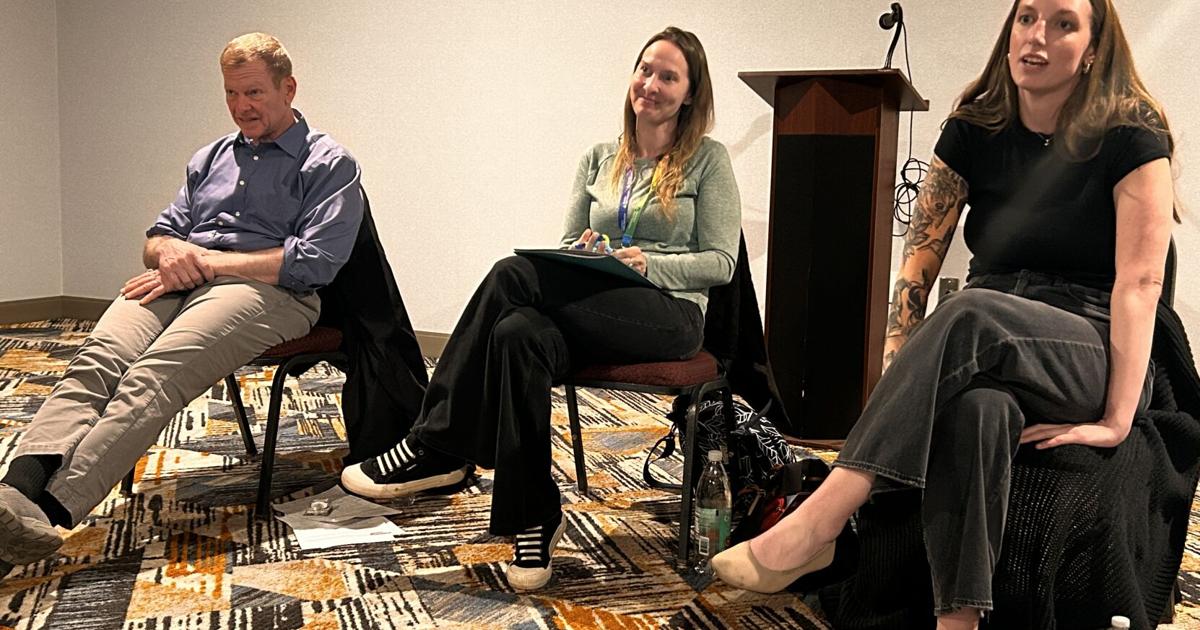
That’s why she and two other harm reduction specialists from Berkshire Harm Reduction led a panel and naloxone training April 22 inside Hotel Downstreet, where about a dozen residents learned how to connect people with harm reduction services — or help those with addiction mitigate the consequences of substance use, such as infectious disease or illness.
“It’s treating people with kindness, meeting people where they are at and not leaving them there,” Kendall said of harm reduction, noting it is not the same as treatment for addiction but a step toward it.
The North County HEAL Coalition's Into Light Project is currently at Hotel Downstreet in North Adams until June 30. The exhibit is part of a national initiative that memorializes people who have died from drug addiction with hand drawn portraits.
The forum was the first of five discussions alongside the HEAL Coalition's Into Light Project, a national initiative that memorializes people who have died from drug addiction with hand-drawn portraits. Four upcoming events, all at the hotel, are scheduled through June at the hotel.
The panelists in the first discussion were part of the countywide Berkshire Overdose Addiction Prevention Collaborative, or BOAPC.
At the end of the discussion, guests were given naloxone kits and taught to recognize overdoses and administer naloxone, which temporarily reverses an overdose.
The public discussions and portrait gallery are part of HEAL’s recent effort to reduce stigma and increase access of services available in Berkshire County — a region that has a strong service network for substance use prevention, said HEAL’s coordinator Anna Youngmann. It also has the highest overdose fatality rate in Massachusetts, almost twice the state average, according to BOAPC data.
The HEAL Coalition was formed in 2022 through opioid settlement funds from eight Northern Berkshire communities and North Adams Regional Hospital; both HEAL and BOAPC operate within the public health sector of Berkshire Regional Planning Commission.
“Part of it is a lack of willingness to come and accept resources, which is why we focus so much on stigma to try to build up that readiness,” said Andy Ottoson, a senior planner who facilitates BOAPC. “But it's also that in spite of everything, people just don’t know about the providers, about recovery centers, about harm reduction services.”
In 2024, Massachusetts recorded 1,314 fatal overdoses, a 38 percent decrease from 2023, while Berkshire County saw 41 overdose deaths, a decrease of only 13 percent, according to data from the Department of Public Health.
“And we're a small county, so losing that many people in one year, that has a ripple effect through so many people,” Kendall said.
A hand-drawn portrait and biography remembers Isaac Bastian, who died from substance use disorder, inside Hotel Downstreet in North Adams. The North County HEAL Coalition's Into Light Project exhibit on display is part of a national initiative that memorializes people who have died from drug addiction.
Bob Dean, another harm reduction specialist, thought of those overdose statistics in terms of the current Into Light Project gallery.
“We’d have to put 41 more [portraits] out there just for this year alone,” he said. “Some people [think addiction is] a question of weakness, but it’s a disease; it takes a long time to get rewired back.”
If someone knows they can come to Berkshire Harm Reduction to get their drugs checked, the greater the chance they hear more information about trying to quit. These small wins are big steps, Kendall said.
“It’s not enabling,” said Krystle Kincaid, a supervisor at Berkshire Harm Reduction in North Adams. “It’s realizing that people are going to do risky things.”
At Berkshire Harm Reduction’s two locations and moving visits, specialists will test any drugs, exchange needles, help with wound care from substances like xylazine, encourage people to smoke instead of inject, and spread awareness about the SafeSpot overdose hotline.
“We don’t require abstinence to build that level of trust and that does, in turn, bring other pathways to treatment,” Kincaid said.
For many struggling with addiction, especially to opioids or fentanyl, the drug supply poses new challenges, he said. Many who have started opioids thinking they were using heroin became unknowingly addicted to fentanyl, which is much stronger in concentration.
“I’ve never tested a dope sample that was just heroin,” Kincaid said.
In 2024, the Berkshires distributed 13,347 naloxone kits — triple the state ratio, according to BOAPC data, and 19,200 fentanyl test strips — 2.6 times the state ratio.
The group has 130 boxes across the county stocked with naloxone, which Youngmann thinks is among the highest density nationwide.
At a recent forum hosted by North County's HEAL Coalition, attendees were given naloxone kits that can be used to reverse the fatal effects of opioid overdose. The public discussion was part of HEAL’s recent effort to reduce stigma and increase access of services available in Berkshire County, which has almost twice the overdose rate as the state average.
And although naloxone only stops the fatal overdose effects, it allows the person to live another day, said Bob Dean, who has overseen the installment of “Nalox-boxes.”
Berkshire Harm Reduction can provide limited medical care but it also connects people with any of its resources within BOAPC they are interested in. Harm reduction specialists can’t ask about a person, Kendall said; it can only answer questions.
Youngmann and HEAL hope the forums and Into Light Project will make it easier for those struggling or families of those struggling to reach out for help.
“We’re trying to keep it really tangible,” Youngmann said. “There is help and support available but it’s helping people find it.”
As part of North County HEAL Coalition's Into Light Project exhibit, visitors can take buttons made from the gallery's portraits that remember local lives lost to addiction.
And for some, Berkshire Harm Reduction could be the only form of health care they will receive.
“A huge part of what we do is having those conversations … we are not just handing out syringes,” Kendall said. “It’s not our place to show judgement and we want to show up in those moments.”
Read the Original Article
This article was originally published by Berkshire Eagle. Click below to read the full article on their website.
Visit Berkshire Eagle