
Modular homes gaining traction in Berkshire County amid housing crunch
PITTSFIELD — Six months ago, the only evidence of a building at 74 Dewey Ave. was an 8-foot pit. Today, a three-bedroom, two-bath home stands on the lot, weeks from completion and just months from welcoming its owner.
Modular homes — which are homes built mostly off-site, then completed after being delivered — are increasingly popping up across Berkshire County. This type of home construction has big benefits, developers say, as it's faster and cheaper, making it another tool that could be used to bolster Berkshire County's stock of homes, especially affordable homes for first-time buyers.
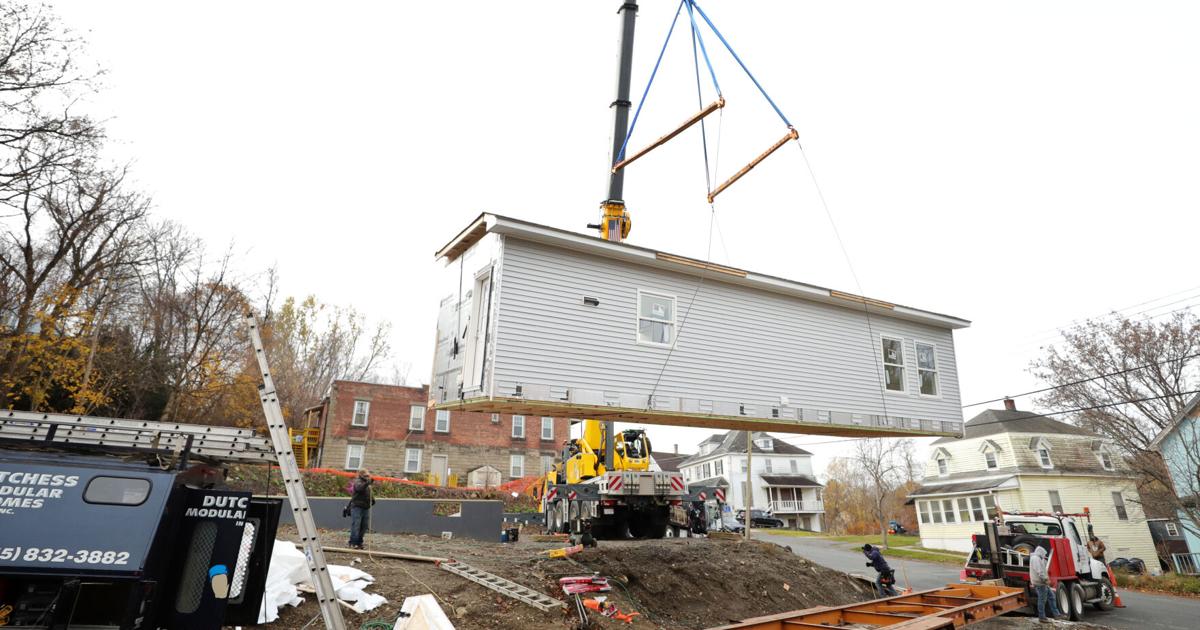
In November, crews used a crane to install the first half of a modular home at 74 Dewey Ave. in Pittsfield. The property is being developed by Westside Legends, and the nonprofit hopes to use more modular homes in the future.
Even before construction is complete on the Dewey Avenue home, Marvin Purry, treasurer of the nonprofit Westside Legends, said the organization is already planning another house on the neighboring lot.
A few years ago, Carolyn Valli, CEO of Central Berkshire Habitat for Humanity, saw potential in modular homes but wanted proof of where — and how much — they could save on construction costs. Valli decided to build two duplexes on Robbins Avenue — one using traditional stick-built construction and the other using modular construction.
The nonprofit saved $86,000 using the modular construction, Valli said. The biggest difference was the speed of each project, she said, as the modular duplex was built in four and a half months while the other took more than a year.
Now, the nonprofit is projected to build 17 of the 20 homes at Prosperity Way, an affordable-home development, in Great Barrington using modular building.
The origin of modular homes traces back to the late 1950s, though the concept of manufacturing homes goes back even further to pre-cut housing kits that only required assembly, according to Devin Perry, executive director of the Building Systems Councils at the National Association of Home Builders.
About 80 percent of a modular home is built inside a factory, said Marc DiGrigoli, president of Fox Homes, a home building company based in Lee that uses modular homes.
That off-site process is more or less the same as traditional, stick-built homes, DiGrigoli said, but there are some techniques modular construction capitalizes on, like installing the wiring and plumbing from the outside.
Having the electrical work and plumbing already done offsite avoids the hurdle of finding skilled laborers in Berkshire County, Valli said.
"Your tradesmen only have to do the tie-ins, which is a huge savings," she added.
Modular homes are built in pieces, or boxes, which are later assembled on site, DiGrigoli said. The off-site process can take as little as three weeks, he added.
Once the home is delivered, it is assembled by a crane, which lifts each section of the house and sets it down on metal support beams. The two pieces are then joined, usually along the middle of the house, and the home is finished.
The basement of 74 Dewey Ave. reveals one of the clearest signs the house is modular: red steel support poles marking where the two halves of the home were joined. The poles are cemented into the floor and bolted to the underside of the structure.
The entire process can take as little as three months, DiGrigoli said.
Transporting modular home components is one of the industry’s biggest limitations, Perry said. The oversized sections require costly wide-load permits and, in some cases, police escorts for highway travel — meaning larger modules are more expensive to ship.
That could also limit the use of modular built homes in more rural towns, Valli said, as roads might be too small for an oversized truck.
Still, the result is a home up to local building codes, Perry said.
Modular homes are not mobile or manufactured homes, he added, as those adhere to a federal standard and generally don't have a foundation.
Modular homes are still very customizable, DiGrigoli added, but, after too much customization, "it's just not going to be cost effective."
In November, a crane placed the second half of a modular home onto a prefabricated foundation. The home was likely only built about a month before this installation, and construction on the project will finish up in a month.
For nonprofits in Berkshire County, customization isn't what they're looking for.
"We're trying to build simple, decent, affordable, high energy-efficient homes," Valli said. "So we have a clear vision for what we need to do."
That makes modular homes ideal for building in bulk, she said.
"Being able to buy the modulars multiples at a time gave us cost savings," Valli said. That savings helps cut costs elsewhere, like pouring the foundation for the homes all at once.
Even for projects with one unit, like Westside Legends' home at 74 Dewey Ave., the rapid timeline is reason enough to use modular homes, Purry said.
"The best advantage is time," said Marvin Purry, the treasurer for Westside Legends, which is building the home at 74 Dewey Ave. This project is going to take about eight months to complete, while the rehabilitation projects the nonprofit has completed took two years. The darker areas on the wall is where the house was joined.
The Westside Legend's project will take about eight months in total. That timeline is inflated because it was the first time the nonprofit built a modular home, Purry said, adding that the process will only get more efficient.
The use of modular homes comes at a time when construction costs continue to rise and project timelines elongate, Valli said.
"Having something that you can do quicker when the demand is so dire and so necessary makes this a big solution for us," she said. "And I think for many other developers, it would be as well."
Read the Original Article
This article was originally published by Berkshire Eagle. Click below to read the full article on their website.
Visit Berkshire Eagle