
Pittsfield school officials hear parents describe racial insults, slurs among students
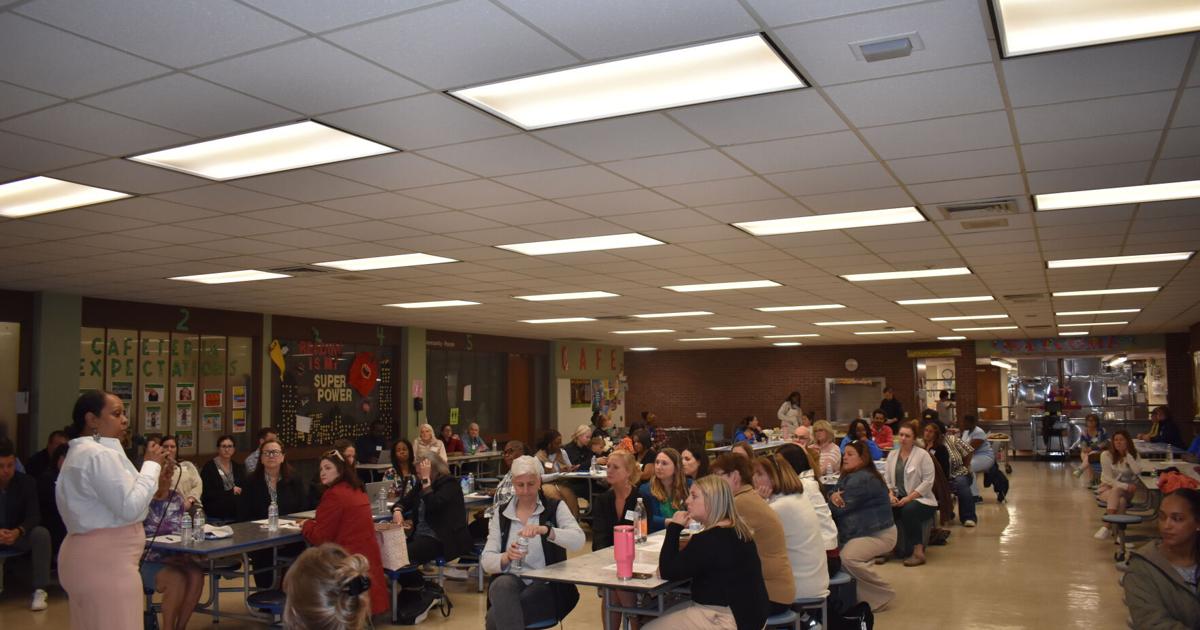
PITTSFIELD — The phrase was heard over and over again at Conte Community School on Monday night: The city schools need to "rip off the Band-Aid” and address racist and discriminatory language in its schools.
Parents, guardians, current and former teachers and former students said students have heard and continue to hear bullying and demeaning words from each other, and in some cases, from teachers.
“It’s not OK that kids normalize this language,” said Patricia Molina, a parent and therapist.
Others said children as young as elementary school are using the N-word, saying they hear it on the internet or in music, or from their peers. And several said they don't feel their kids are safe in the schools.
“They’re whipping out the N-word ... they don’t even know what it means,” said Delores Moore, a former Conte Community School teacher.
The meeting, called in the wake of a Herberg Middle School teacher being accused of repeating racist and homophobic epithets used by a student, revealed both general observations on the climate of tolerance and respect in city schools as well as more specific allegations of city educators speaking inappropriately.
Interim Superintendent Latifah Phillips, center, speaks with a parent in the Conte Community School cafeteria before a forum on discriminatory language in the Pittsfield Public Schools.
Interim Superintendent Latifah Phillips emphasized that the meeting is just a start of a larger community conversation on bullying, tolerance and respect in the city schools.
“We heard the importance of a home-school partnership, of community partnership,” she said. “It was heavy, but it's important."
That said: "It's really important that the public schools is seen as as stepping into this challenge, rather than trying to trying to address things swiftly and move on.”
The easy thing, Phillips told the roughly 60 people gathered in the school cafeteria, would be to “stay at the surface and try to look really good.” Meanwhile, schools that address negative behaviors can look worse because they’re actively documenting problems and dealing with their problems.
“I think that's what I want to encourage us as a system. Let's be open. Let's receive the experiences from our families, from our students, and let's be vulnerable," she said. "And this is easier said than done.”
Faculty and principals from every city school were present, as well as the entire cabinet and School Committee members Sarah Muil and Carolyn Barry. Shirley Edgerton spoke on behalf of the Berkshire NAACP, which provided a meal for attendees, and Tony Jackson, the president of Westside Legends, spoke by online conferencing.
The meeting was moderated by Leticia Smith-Evans Haynes, the vice president for institutional diversity, equity, and inclusion at Williams College.
Johanna Linski, a special education surrogate parent and advocate for vulnerable children, said a teacher at Herberg insulted and deliberately misgendered a Black transgender girl in her care. She said the same teacher spent 20 minutes during an IEP meeting attacking the character of another child in her care, a ward of the state Department of Children and Families.
Molina said she had a discussion with four city school students who said their peers make fun of students of other skin colors and from other cultures “all day every day.” She said one Hispanic girl was called a “fake Mexican” because she doesn’t speak Spanish.
She also said her own son, several years ago, was told by a faculty member at Herberg that “he fit the profile of a criminal and he wasn’t getting anywhere.” The result of the complaint she filed with the then-superintendent, she said, was that her son was transferred to Reid Middle School.
“The consensus between the four kids was that the adults still don't understand what bullying is anymore,” she said.
“Kids are now thinking that, ‘Oh, they're joking, it's not that serious,' but it is serious, and I have to have a real conversation with them, that this was racism,” Molina said. “But because the schools are minimizing these behaviors, these kids are starting to feel that that's OK. That when somebody calls you a dirty Mexican, or when somebody calls them an African, or when somebody makes fun of their skin because they're not dark enough or light enough, these kids are beginning to accept that as true, because adults aren't taking this seriously.”
Pittsfield High School teacher Janae Holloway described her efforts to work with students of color at PHS during a forum on Monday night about discriminatory language in the city schools.
Janae Holloway, a teacher at Pittsfield High, said her BIPOC (Black, Indigenous and people of color) student group has spent the year having “a lot of difficult conversations” about racism they see, hear and experience, including within their communities. “We have to have that hard discussion, and we talk about how we can fix it,” she said.
“I'm learning how to be a better student, a better teacher for them, but I also learn how to be a better Black person in my community,” she said. "We're trying our best. Change takes time. I don't see every student, but I can tell you that I have not had lunch alone or with adults since I started working at PHS.”
Roos Bajnath, a Pittsfield High graduate who just completed her freshman year at Howard University, said that while she was a PHS student she endured microaggressions such as “you’re really pretty for a Black girl.”
"I watched people get hit in school bathrooms,” she said, adding that she started using the bathroom in the nurse's office or waited to get home because she didn’t feel safe.
“I would have kids my own color call me the N word, and I'm like, 'Why are you doing that?'” she said.
Community activist Kamaar Taliaferro said the problems reflect the way the community has treated its school system, and compared the way the city has funded its police to the way it has funded its schools as an example of where the city has placed its priorities.
“It doesn't surprise me to hear that students are treating each other the same way that we treat their future, and it isn't all on the school system to change,” he said.
Of his own experience in the city schools, Taliaferro said, “You have to put up with a lot of bull---- and you have to let it roll off your back.”
Read the Original Article
This article was originally published by Berkshire Eagle. Click below to read the full article on their website.
Visit Berkshire Eagle