
Rail sidings planned in Pittsfield, Lenox for next phase of GE Rest of River cleanup
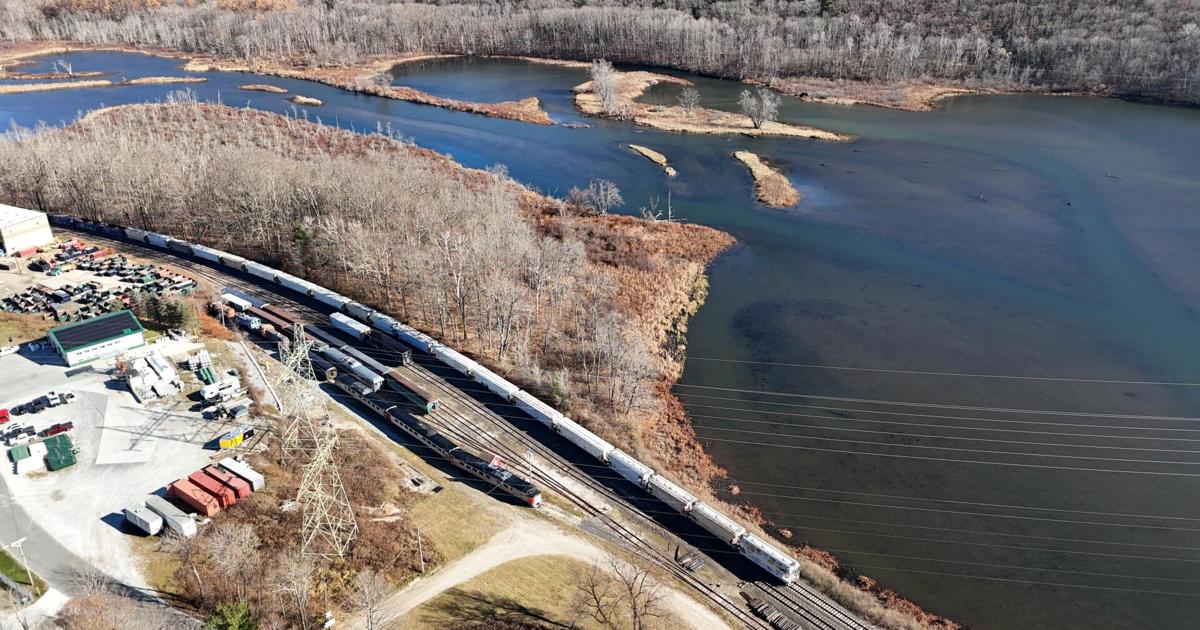
PITTSFIELD — General Electric Co. has proposed plans for a pair of rail sidings along the Housatonic Railroad, allowing for train transit of PCB-contaminated sediments from the Rest of River cleanup of the Housatonic River.
The company will present its plans at an online hearing hosted by the U.S. Environmental Protection Agency at 6:30 p.m. Thursday.
Those wishing to sign up for the online hearing are asked to register for a unique website link or URL to join the meeting. Persons having difficulty accessing the design plan and/or registering for the meeting are asked to contact Olivia Lopez at [email protected].
The company’s revised transportation plan was conditionally approved by the EPA in 2024 after an earlier proposal largely relying on trucks drew wide opposition. The revised plan now leans on trains carrying multimodal containers to ship less-contaminated sediments to a landfill being built in Lee, and more-contaminated sediments out of the region.
The transportation plan is part of the Rest of River cleanup, under the terms of a consent decree approved by a federal judge in 2000. Under the terms, GE agreed to remove PCBs, a probable cause of cancer, from the river and its flood plains, and pay for the work.
The GE transportation plan proposes three rail sidings: at Utility Drive in Pittsfield, at Woods Pond in Lenox near the Berkshire Scenic Railway Museum, and near Rising Pond Dam in the Housatonic section of Great Barrington. As the cleanup is moving from north to south, the Rising Pond segment, and its rail siding, are years away.
The presentation will include a summary of pre-design investigations completed for both locations, an outline of requirements the plans must meet, and a description of GE's design process. There will be time for questions following the presentation, and comments on the plan are being accepted through April 16 at [email protected].
The rail plan shows that sediments will be dewatered and loaded into intermodal shipping containers, which will be sealed before moving up or down the line.
According to the plan, rail cars carrying sediments averaging more than 50 parts per million will travel north to Pittsfield, where they'll change trains for travel to out-of-area disposal sites. Sediments averaging less than 50 ppm will head south to the Woods Pond siding, where they will be offloaded for transport to the Upland Disposal Facility off Woodland Road in Lee.
The Utility Drive siding will be a temporary facility built for the cleanup and will be removed when that phase of the cleanup is complete, according to the plans. Trucks will unload intermodal containers filled with dewatered soil and sediment removed from Reach 5A of the cleanup, temporarily store those containers, and load them for transport to their final destinations.
General Electric used PCBs in the power transformers it built at its Pittsfield factory. Use of PCBs, a family of man-made chemicals that was widely used in manufacturing, was discontinued in the late 1970s when they were found to be a probable cause of cancer and other health problems.
The Utility Drive siding will be an outbound-only facility, with two parallel tracks positioned at an angle away from the railroad right-of-way.
The Woods Pond spur will at first take in rail cars carrying intermodal containers loaded with sediment from Reach 5A of the cleanup — from the West and East branch near Fred Garner River Park in Pittsfield to Utility Drive. Later, it will take in sediment from reaches 5B, 5C and 6. Those multimodal containers will then be transported by truck to the Upland Disposal Facility, which will hold about 1 million cubic yards of lower-contaminated sediments.
Most sediments from Reach 6 — which includes sediment behind the Woods Pond Dam — are expected to be hydraulically siphoned directly to the landfill. But sediments that exceed the 50 ppm average must be disposed out of the area under the terms of the cleanup.
Unlike the Utility Drive rail transload area capacity, the Woods Pond Spur will receive sediments from multiple locations.
The Woods Pond siding will also include infrastructure for the Berkshire Scenic Railway Museum. Three additional rail spurs and an inspection pit will be built, where the railway can store and service its 26 railroad cars.
The company says it has been meeting with the Massachusetts Department of Fish and Game, which owns the Utility Drive property, on the potential impact of work and operations on recreational activities within the 818-acre George Darey Wildlife Management Area in Lenox.
The company also said it has conferred with the Berkshire Scenic Railway Museum to ensure that the redesign of the property will be sufficient for both Rest of River cleanup operations and the railway museum’s future use; with the Town of Lenox; and with the state Department of Transportation, which owns the rail right of way, and the Housatonic Railroad.
According to GE, both MassDOT and the Housatonic Railroad found the plans “generally acceptable, on a conceptual level.”
This Berkshire Scenic Railway Museum passenger coach, seen in 2022, serves as a gift shop, ticket counter and an exhibit of local railroad history. General Electric is proposing to build sidings for storage of the Railway Museum's cars as part of its work for the Rest of River cleanup.
When it was using PCBs, General Electric disposed of the man-made chemical in the Housatonic River, which remains posted with health warnings advising that anglers and hunters not eat what they catch. The company has already removed PCBs from a 1-and-a-half-mile stretch of the East Branch of the Housatonic River and capped contaminated sediments on its former plant and in Pittsfield’s Silver Lake.
A cleanup plan approved by EPA in 2016 would have required all removed sediments to be hauled away for disposal. But GE successfully challenged that plan in court, and a negotiated cleanup plan, brokered in closed-door executive sessions by a committee representing affected towns, approved a plan including local disposal in Lee.
Many Lee residents remain opposed to the landfill and its design, saying it threatens health, the environment and property values. And environmental advocates continue to call for on-site treatment of PCBs rather than disposal. But a federal appeals court tossed a lawsuit opposing the current disposal remedy in 2023.
Read the Original Article
This article was originally published by Berkshire Eagle. Click below to read the full article on their website.
Visit Berkshire Eagle