
Reza Pahlavi, a Williams College student once, tests his moment in Iran’s unrest
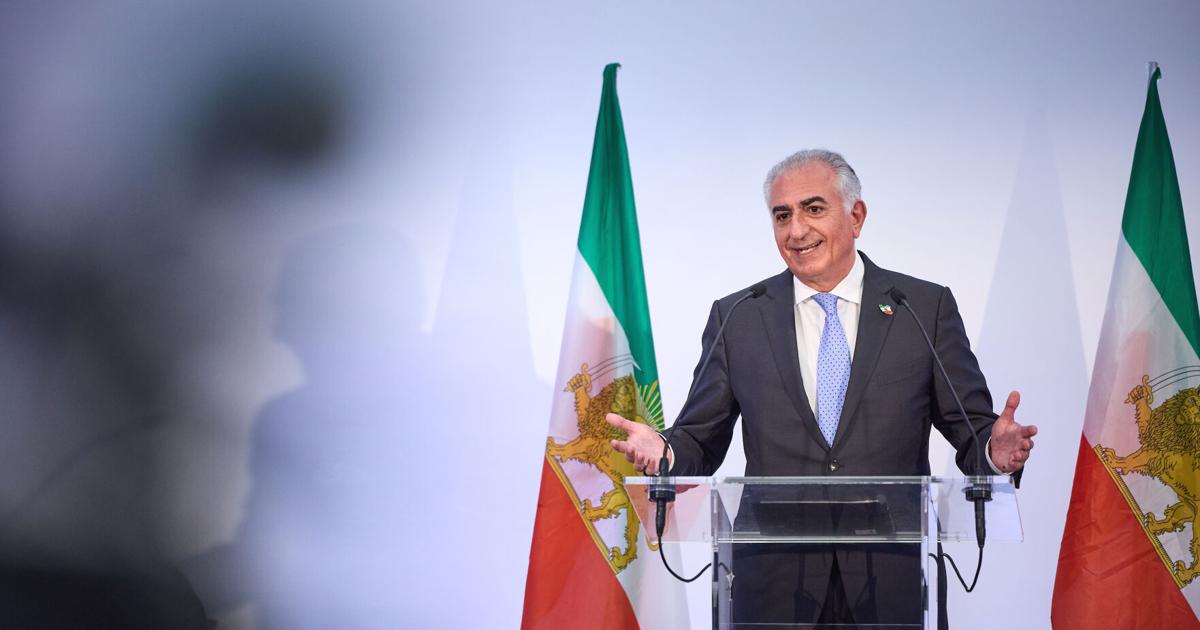
WILLIAMSTOWN — Crown Prince Reza Pahlavi has wanted a hand in the future of Iran ever since he and his family escaped to the United States nearly five decades ago — settling briefly in Williamstown.
Now he and some in Iran’s opposition movement are renewing calls for him to return to Iran, perhaps even lead it, after decades of opposition in exile.
Pahlavi, 65, hasn’t set foot in his native country since his father, the U.S.-backed Shah Mohammad Reza Pahlavi, was overthrown in 1979 by a coalition including Islamic fundamentalists after almost 38 years in power.
Pahlavi’s campaign for regime change comes as massive anti-government protests have erupted in Iran. As the Islamic Republic cracks down on dissent, estimates put the current death toll at more than 2,000 Iranians killed and protester arrests in the tens of thousands.
People hold up a photo of Reza Pahlavi, the exiled son of Iran's last shah, as they take part in a rally on Sunday in London. Members of the Iranian community gathered outside Downing Street, calling on the British government to support Iranians as anti-government protests continue across Iran.
Pahlavi, who lives near Washington, D.C., has been a prominent supporter of the Trump administration’s calls for military intervention to halt the Islamic Republic’s violent suppression. In a post on the social media platform X, Pahlavi called on the U.S. to “help [Iran] liberate themselves and Make Iran Great Again!”
Unrest in Iran is not new. Protests against the Ayatollah’s regime have spanned decades, with a recent example being the Women, Life, Freedom movement in 2022 that ignited after the death of Mahsa Amini, a 22-year-old student, in police custody.
But this current wave of protests has escalated since the government imposed an internet blackout on Jan. 8.
“It started as an economic dissent, [and it] now is turning into a political one: the inflation is rampant, the currency is falling,” said Williams College Professor Magnús Bernhardsson. “The situation is quite serious.”
Protesters wave flags depicting Iran's exiled crown prince, Reza Pahlavi, outside the Iranian Embassy on Wednesday in London. Pahlavi, who spent time in Williamstown, now lives near Washington, D.C.
Bernhardsson, a historian of the Middle East, and his former student Ian Concannon — whose 2018 thesis focused on Pahlavi’s time in Williamstown — recently spoke with The Eagle to share their thoughts on Pahlavi’s relationship to Iran today, and to shed light on the royal family’s intimate connection to the Berkshires.
In March 1979, after the Shah was deposed, the Pahlavi family fled the country with the help of their United States allies.
Mohammad Reza Shah Pahlavi (1919-1980), Shah of Iran, and Empress Farah Pahlavi of Iran, 1965. In March 1979, after the Shah was deposed, the Pahlavi family fled the country and ended up in Williamstown.
The U.S. government viewed the Pahlavi family “as a political liability, and no one really knew how the situation would shake out in Iran, so they just needed a safe place where no one really bothered them,” Concannon said. “And Williamstown happened to be such a place.”
Former CIA Director and Williams alumnus Richard Helms may have guided the family to the area, Concannon found in his thesis research, although the connection is not certain. There had been “routine correspondence” between Helms and Williams President John Chandler at the time, and this CIA connection allegedly made Williamstown an ideal candidate for the Pahlavis’ relocation.
Crown Prince Reza Pahlavi of Iran inspecting a "guard of honour" composed of young boys in uniform in Tehran, Iran, Sept. 19, 1963. At 18, Reza enrolled as a first year student in Williams College.
The family settled on South Street, in a 7,000-square-foot home tucked between the second and 17th holes of the Taconic Golf Club. Pahlavi, his mother, Queen Farah, and his siblings moved in shortly after the family was exiled.
Crown Prince Pahlavi, then 18, enrolled in Williams College as a first-year student in September 1979.
On one hand, “people didn't really know if he would be a target of the revolutionaries in Iran and he was accompanied by armed men who sat outside the classroom,” Bernhardsson said. “Not many [of the students’] parents were happy with that.”
On the other, Pahlavi “did his best to be a pretty normal first year — he took classes and went to the gym on campus,” Concannon found.
Pahlavi studied French, political science, economics and geology.
When Concannon interviewed Williams alums and community members about their interactions with Pahlavi, those experiences ranged from “I saw him partying once” to “I saw him at the dining hall.”
But legend also has it that Pahlavi helped his dormitory triumph in Williams’ annual freshmen snowball fight.
Shah Mohammed Reza Pahlavi of Iran, holding hands with his son, Crown Prince Reza, as they walk from the Caspian Sea at Nowshahr, Iran, July 8, 1963.
“He showed up with his two or three bodyguards, who were all like, 6-foot-8, 500 pounds,” Bernhardsson said. “I think his entry won the snowball fight that year.”
In a 2010 interview with The Williams Record student newspaper, Pahlavi recalled his decision to move to Egypt in 1980, right before his father passed away from cancer in Cairo. There, he assumed his father’s role as face of the Iranian opposition, which brought his time at Williams to an end.
While Pahlavi asserted his family’s claim to the rightful leadership of Iran from abroad, his family remained in Williamstown until 1984.
Pahlavi’s younger siblings drew attention from the local community as well. Pahlavi’s younger brother Ali-Reza attended Mount Greylock Regional School, and his younger sister Leila studied at Pine Cobble School. Both siblings have since passed away.
Leigh Perkins, a 1984 Williams graduate, remembers Ali-Reza auditing her class flanked by “imposing” bodyguards.
Mohammed Reza Pahlavi, the shah of Iran, skiing with his son, Crown Prince Reza, at Abali near Tehran, Iran, Feb. 24, 1963.
“At Williams back then, there were plenty of kids from 'famous' families, but there were never conspicuous displays like that," Perkins said.
In 2005, Reza Pahlavi returned to Williamstown, when Bernhardsson invited him back to campus to speak with Williams students and faculty.
Delivered in front of a packed crowd, his lecture, titled, “Iran: Past, Present, Future,” focused on the “need for democratization of the Middle East,” according to Bernhardsson.
“It was not a direct call for himself to take over the country, but it was clearly a critique of the Islamic Republic and its leaders,” said Bernhardsson.
Pahlavi reemerged in the campus consciousness again in 2018, when he joined in on a Zoom call with Bernhardsson’s history class.
This time, the topic stayed primarily on the history of nationalism in Iran, “but then, also, people were asking him about his time at Williams,” said Bernhardsson.
Pahlavi’s continued communication with the Williams community has solidified his legacy with a new generation of students, as Concannon’s thesis experience suggests.
The inspiration to research Pahlavi’s story may have come from Bernhardsson, Concannon said, “but when he suggested it, it was, of course, already familiar to me, as it was to many students at Williams.”
Iranian royal Mohammad Reza Pahlavi (1919-1980), shah of Iran, and Farah Pahlavi arrive for a private visit at Heathrow Airport in London, England, June, 1972.
This recent fascination with Pahlavi parallels how students felt about him during his year in Williamstown.
Concannon interviewed alumni about the crown prince’s time on campus and compiled their recollections for his thesis.
“The stories themselves weren't that interesting,” Concannon said, “but [Pahlavi’s name] immediately rang a bell, because, I think, people were interested and excited [about him].”
These students’ proximity to Pahlavi, and the power he represented, made him a “mythic” figure on campus, as Bernhardsson said — even as he participated in the same day-to-day activities that they did.
Whether Pahlavi’s story ends with his return to Iran or continued exile, all eyes are on what happens with the current upheaval in Iran.
Though the crown prince could emerge as a figure the Iranian opposition unites around, Bernhardsson said his support may best be described as “anti-Islamic Republic” rather than “pro-Pahlavi.”
“Iran is a huge country, and how do you gain political control if you don't have a mass movement behind you?” Bernhardsson said. “And it's hard to see that he has that in the country.”
Read the Original Article
This article was originally published by Berkshire Eagle. Click below to read the full article on their website.
Visit Berkshire Eagle