
Stuck at this Main Street traffic light? North Adams has a plan to speed things up
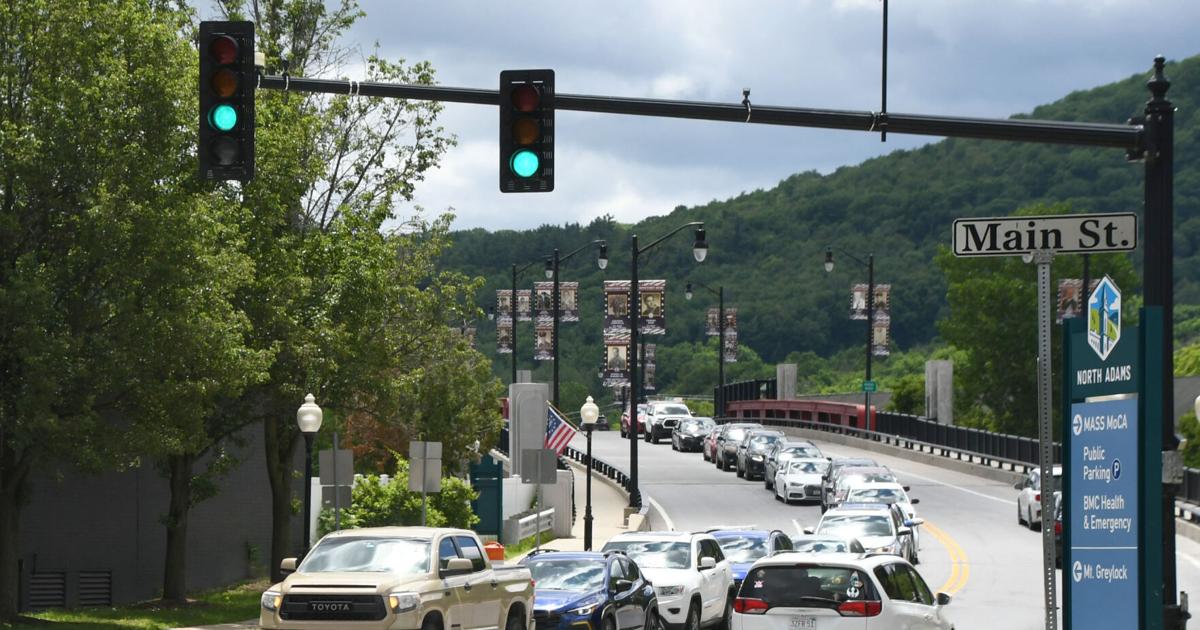
NORTH ADAMS — Well before northbound drivers can see the Main Street traffic light on State Street (Route 8), they know what's ahead: a line of cars stretching past City Hall and waiting at the light for not one, but maybe two cycles.
The congested intersection at the heart of downtown is a daily frustration for residents, with faulty traffic sensors contributing to backups that can leave drivers sitting in standstill traffic where State and Main streets meet. That's especially true during the morning and evening commutes and following afternoon school dismissal.
But relief may be on the way.
The city wants to install new sensors and cameras and is working with MassDOT to improve traffic flow as officials plan for a broader downtown redesign tied to the eventual removal of the Veterans Memorial Bridge.
The Reconnecting Communities study concluded last year that the urban renewal-era bridge should be demolished. Before deciding what replaces it, Mayor Jennifer Macksey said the city first needs to address the surrounding intersections that would absorb the traffic changes caused by its removal, particularly the one at Route 8 and Main Street.
‘We can’t just dump traffic downtown,” she said of removing the bridge.
With that in mind, traffic-dumping prevention efforts are underway.
A mechanical study last year determined that the sensors and cameras at the intersection — sensors that are supposed to prompt the lights to change — do not work properly. Even late at night, the signals can fail to detect vehicles, causing drivers to unnecessarily wait at red lights.
So, the city is requesting the City Council approve $57,000 to its wire and alarm budget for fiscal 2027 to install new cameras and sensors.
The congested intersection of Main Street and Route 8 in North Adams is the result of faulty traffic sensors contributing to backups and the city is looking to buy new sensors and cameras to help reduce the backup.
The council will officially vote to approve that spending next week at its budget hearing. If approved, the department can buy the new devices. Macksey said she expected drivers to notice a difference possibly later this year.
North Adams was one of the smallest communities to receive funding from a federal Reconnecting Communities pilot program in 2022, which prioritizes transportation projects that restore neighborhoods harmed by past infrastructure decisions. The study found the bridge splits the downtown into a "series of islands" and should be converted into a more pedestrianized area with smaller roads.
But new cameras and sensors in one problem area is not enough to move ahead with constructing something new when the bridge comes down, Macksey said.
Before it goes into engineering phases and works with a contractor to figure out what would work better than the bridge, the city received more planning assistance from MassDOT’s Local Early-stage and Actionable Planning (LEAP) Program.
This assistance will help the city do more testing and sampling of the intersection and better understand how changing it would impact other busy intersections across the city — including intersections at the top of Church Street and near Dunkin at Union and Eagle streets — to further inform how it could replace the bridge.
"Everybody wants us to address this intersection in [anticipation] of the bridge coming down,” Macksey said. “So the state has really stepped out and said, ‘We want to support you.’”
Macksey said the city has applied for an upcoming round of state grant funding through MassWorks that would fund the engineering phase of replacing the bridge.
Officials will find out in October whether that money will arrive.
Macksey said the Reconnecting Communities is a conceptual plan with recommendations that have to be chipped away at bit by bit over a period of years. Addressing this intersection, she said, is one start.
“We're trying to push the fix in multiple ways,” she said. “The immediate is that we're going to do [the traffic sensor project]. ... The future is what we're doing by pulling different kinds of money together in hopes of getting funding to really engineer it.”
Read the Original Article
This article was originally published by Berkshire Eagle. Click below to read the full article on their website.
Visit Berkshire Eagle