
'Take it down.' A study examining Route 2 overpass in North Adams recommends its removal
NORTH ADAMS — "Take it down."
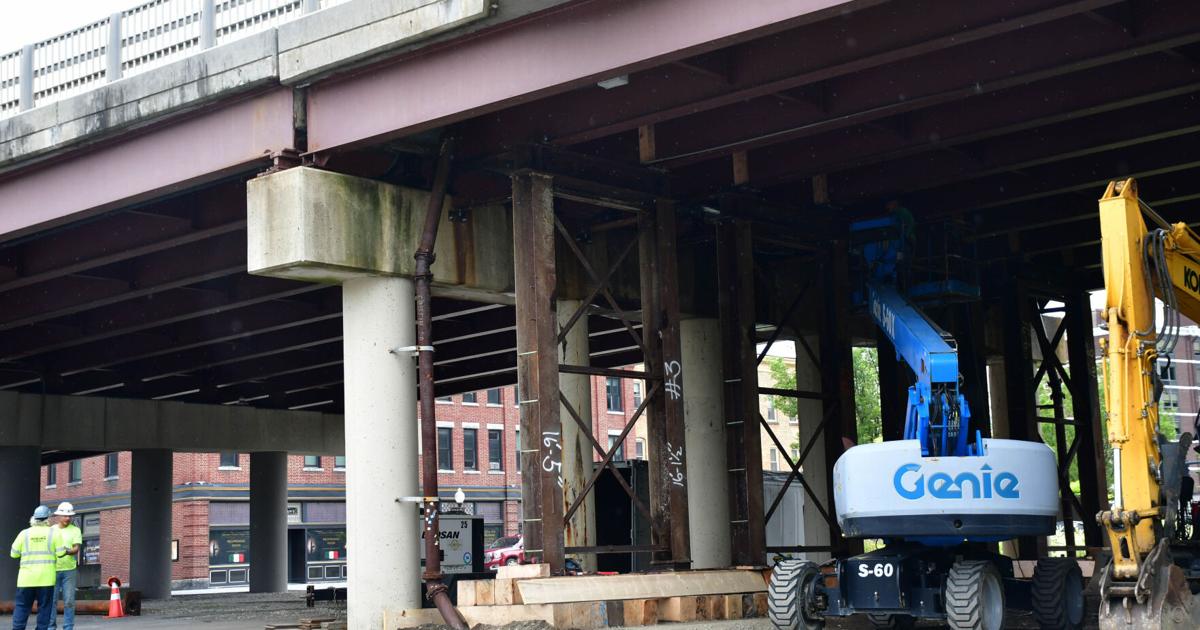
That was the message urban planner Chris Reed repeated Friday to dozens of people about the Route 2 overpass, or Veterans Memorial Bridge, as the best way to reconnect downtown.
During an event at Mass MoCA on Friday, Reed presented the results of a report compiled by his firm, Stoss Landscape Urbanism. The report concluded that dismantling the failing bridge would create more space, encourage walkability, and encourage new development. But, he emphasized, doing so will take money and cooperation at all levels.
The bridge should be removed to “restitch the community back together,” starting with re-extending and condensing Veterans Memorial Drive and the roads adjacent to the overpass. North Adams has too many big roads and parking lots that “threaten the safety of pedestrians and create an atmosphere of isolation," said the report, and it should look back to the "smaller-scale" street networks erased by urban renewal.
Chris Reed from Stoss Landscape Urbanism gives a presentation at Mass MoCA on Friday about why North Adams should remove the Route 2 overpass, or Veterans Memorial Bridge. “This bridge had an extraordinarily negative impact on this city,” he said.
“This bridge had an extraordinarily negative impact on this city,” he said at the event. “The hope for future development that never came wiped the heart of this community in a way that is quite extraordinary and unsurpassed in many of the cities and towns we work with.”
North Adams, the Massachusetts Museum of Contemporary Art and local partners commissioned a yearlong feasibility study conducted by Stoss examining whether to repair, replace or remove the bridge. The study was paid for by a $750,000 grant from the Reconnecting Communities pilot program, which prioritizes transportation projects that restore connections to neighborhoods harmed by past infrastructure decisions. North Adams was one of the only rural communities — and the smallest one by population — to receive a grant.
The executive summary and entire report, on the city website, includes visuals of how the overpass splits the downtown area. Reed called the current downtown landscape a "series of islands" and noted that many roads near the overpass are bigger than they need to be and built for truck sizes that "don't exist."
The study found that there can be a parking surplus of over 1,000 spots in the city even during peak times. Resident Desiree Taylor agreed, and said that it was also worth noting that oftentimes the surplus spots were in places that did not need parking, which Reed said Stoss also noticed.
According to the report, North Adams was the only community “west of Athol” where Route 2 is four lanes wide when running through a downtown — in other communities along the way, “two lanes are sufficient to carry the vehicular traffic that passes along it,” the study found.
“That is too much road for what is going through here,” Reed said.
“Complicated” traffic patterns created by urban renewal made, in some cases, intersections with up to five converging roads, said the report. It pointed out intersections like Route 2 at Holden Street and Route 2 at Eagle Street that “utilize a complicated signaling plan that uses multiple signal cycles, increasing vehicle delay and queuing on many approaches.”
The report also said incomplete street grids make it hard for large trucks to navigate additional city streets to get to the overpass westbound. This discourages walking, biking and other community activity in a large section of downtown. Reed said that businesses are struggling due to a lack of foot traffic, but that more people need to feel safe about walking downtown to increase foot traffic.
Since her first day on the job over a decade ago, Mass MoCA Executive Director Kristy Edmunds said she has been in discussions about how to tackle the overpass, which was built in 1959 and shoots directly west over the Mass MoCA campus. The study is a step toward changing the bridge, she said, and was a win for community voices — Stoss received input from over 500 people.
“When we start to normalize something that is a deep and profound scar, we also end up normalizing a kind of pessimism that a community voice may not actually be able to move the needle,” Edmunds said. “This moves the needle, y’all. It moves it from ‘it’s too daunting, it’ll never happen,’ to ‘It is possible, here is a way forward.’"
Reed said knocking the overpass down offers a “once in a lifetime” chance to change the fabric of the city, and had recommendations for how to “restitch” downtown. North Adams could create riverfront recreation, pedestrianize chunks of road that are too large for the volume of cars it serves and create room for more mixed-use development. Stoss recommended closing part of Center Street around Veterans Memorial Park to "create a new waterfront plaza.”
“I’m really happy this happened,” said Dawn Nelson, who has lived in the Eclipse Mill for about 20 years and attended as many community meetings for the study as she could. “I will be here for the rest of my life, so I'd like to see it be as vibrant as it can be.”
Mayor Jennifer Macksey was in full support of removing the overpass but reminded an excited crowd that it was just the beginning of a process to remove the structure. In the meantime, a $20 million repair funded by the 2026 state Transportation Improvement Program is required, since a temporary fix made this summer does not provide enough time to implement the study’s recommendations. MassDOT will oversee the repair, which is expected to go out to bid in the spring.
Now, the city will need to find funding for Stoss' recommended changes and fund more traffic studies on what Stoss' proposed plan would change, which Macksey said is already in the works.
"We can't take the bridge down until we figure out traffic," she said.
Read the Original Article
This article was originally published by Berkshire Eagle. Click below to read the full article on their website.
Visit Berkshire Eagle