
This stained glass window offers a view into the history of Adams' Polish community
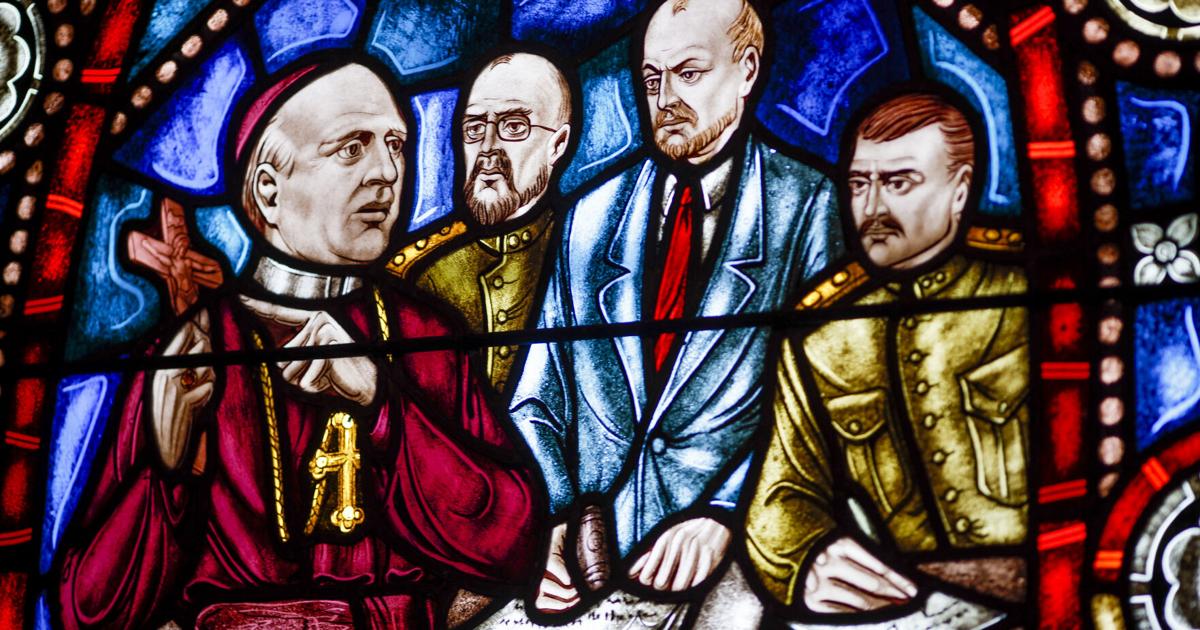
The choir loft is home to a towering stained glass window at St. Stanislaus Kotska Church in Adams. In one corner of the window, Archbishop Jan Cieplak, who was persecuted during the Russian Revolution, is depicted with communist leaders Trotsky, Lenin and Stalin.
ADAMS — Most of the stained glass windows at the St. Stanislaus Kostka Church feature traditional religious imagery such as angels and apostles.
The contents of one window, however, may raise some eyebrows: an image depicting Archbishop Jan Cieplak alongside the architects of Russian communism: Trotsky, Lenin and Stalin.
As congregants gather Sunday to honor the archbishop, who visited Adams a century ago following his religious persecution in communist Russia, the window serves as a curious reminder of his legacy and the resilience of Polish Americans.
"Our family is very happy to see Archbishop Cieplak being honored in this way," said Jenny Cieplak, great-grandniece of the priest. "We Poles have always been very proud of our heritage of standing up for justice and faith."
St. Stanislaus Kostka, built in 1905, was in many ways the heart of the Polish immigrant community in 20th century Adams.
According to Eugene Michalenko, a member of the Adams historical society and the church’s congregation, members of Adams’ Polish community in the 1890s had long desired their own priest and place of worship.
Eugene Michalenko speaks about the history St. Stanislaus Kostka Church in Adams. He is a member of the Adams Historical Society, and a scholar of Russian languages.
When the diocese of Springfield finally allowed the community to found its own parish in 1902, residents rallied, raising enough money to buy the Summer Street property and start a fund for the church’s construction. By 1905, the grand, yellow brick church was complete.
In the 1920s, bolstered by the profits of the Berkshire Cotton Manufacturing Co., where many Polish laborers worked, the community expanded further as businesses grew up around the church.
“The Polish people had transformed [eastern Adams] into a second commercial district,” Michalenko said.
Their success was not without growing pains. The Polish were only one of several minority groups at the time — including German, French-Canadian, Jewish and Lebanese immigrants, Michalenko said.
“Oh, and the Irish, can’t miss the Irish,” he said. “They were the elite group of the immigrant movement here.”
Having arrived in Massachusetts some decades earlier than other Catholic groups, the Irish held power over the bishop in Springfield, which oversees parishes in Berkshire county.
Exterior of the St. Stanislaus Kostka Church in Adams. Built in 1905, the church was the crowning achievement of Adams' Polish community, which raised the funds to construct it in only a few years.
“The Irish thought that the Polish would be subservient to them,” Michalenko said. To members of the Polish community, who already felt underrepresented by the lack of Polish bishops in the United States, this was an insult.
Unable to manage their own congregation, some parishioners joined the growing Polish National Catholic Church out of Scranton, Pa. — a schismatic movement that sought the right to own its church property and preach in Polish — while others left the church for Protestantism, Michalenko said. At the same time, Americans at large were skeptical of immigrants, especially Catholics.
The unity of Adams’ Polish community was in danger.
“The pope was worried at the time that the Polish Catholics in particular were falling away and needed some strong leader to tell them, ‘Your faith matters,’” said the Rev. Michael Lillpopp, pastor of the Catholic Parishes of Adams and Cheshire.
“‘You can be a strong Polish Catholic and also be a patriotic American,’” he said, paraphrasing Pope Pius XI.
For his messenger, the Pope chose Archbishop Jan Cieplak, who by then was a hero to Catholics worldwide.
The nave and choir loft of St. Stanislaus Kostka Church in Adams. The stained glass featuring Cieplak is located in the loft, beside the organ's pipes.
Cieplak, raised in a section of Poland controlled by Austria after the country was split between major powers in 1772, studied theology in Saint Petersburg in the 1880s. He went on to become the highest Catholic official in Russia during the 1917 revolution, which brought widespread religious persecution.
When Cieplak refused to renounce his faith, he and other Catholic leaders were imprisoned and subject to a show trial in 1923 that sentenced them to death. There, the judge decried each religion, saying that he spit on all of them, Lillpopp said.
“[Cieplak] was really standing up for all faiths,” he said.
While the archbishop’s priests were either executed or sent to prison camps, widespread, international outrage led to his release in 1924.
As the Pope’s messenger, Cieplak went on to visit hundreds of parishes in the United States in 1926. He visited St. Stanislaus Kostka that year, drawing 1,000 churchgoers who came to hear his sermon. Not a month later, he died from pneumonia in Passaic, N.J.
This stained glass window, installed in the 1950s, features Archbishop Jan Cieplak in the foreground, with communist leaders Leon Trotsky, Vladimir Lenin and Joseph Stalin in the background from left to right.
How did Cieplak and his symbolic judges come to adorn the stained glass?
“I wanna blame it all on Kempinksi,” Michalenko said.
The Rev. Edmund Kempinski, the church’s pastor during the 1950s, himself fled Russian violence. Given the choice between death and exile, he settled in Adams, Michalenko said.
“He had this animosity, or post-traumatic stress about the Russians,” Michalenko said. “And Cieplak was just another story in their oppression, their cruelty.”
Kempinski commissioned the window, at the height of the Red Scare, in an act that was political and historical as much as it was religious.
Now, as the 100-year anniversary of Cieplak’s visit and death approaches, the stained glass immortalizes the priest’s defiance against persecution, Michalenko said.
“Polish people have to be aware of their history," he said, "especially since it was almost buried by empires.”
Read the Original Article
This article was originally published by Berkshire Eagle. Click below to read the full article on their website.
Visit Berkshire Eagle